产能产量双控

Search documents
我国去年出钢产量多达9.61亿吨,占全球粗钢总产量的一半以上
Sou Hu Cai Jing· 2026-01-28 06:14
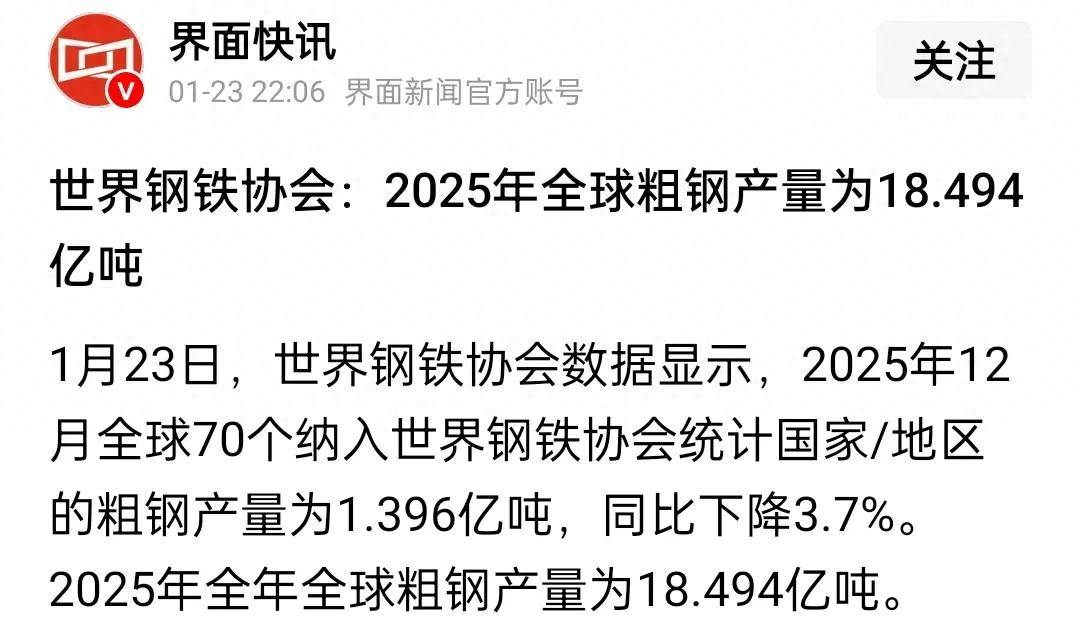
Core Viewpoint - The steel industry is experiencing a significant decline in production, with China's crude steel output projected to drop to 96.1 million tons in 2025, a decrease of 4.4% year-on-year, reflecting a shift towards quality and sustainability rather than sheer volume [1][5][7]. Group 1: Production Data - The World Steel Association forecasts global crude steel production to reach 1.8494 billion tons by 2025, while China's output is expected to be 961 million tons [1]. - China's crude steel production for 2024 is estimated at 1.005 billion tons, indicating a sharp decline of 44 million tons in just one year, which is more than the annual production of Germany [5][7]. - Despite the reduction, China maintains a 52% share of global steel production, significantly outpacing other countries like India and the United States [7][13]. Group 2: Policy and Market Dynamics - The decline in production is attributed to proactive industry adjustments driven by policy changes, particularly under the "dual carbon" goals, which emphasize capacity and output control [9]. - The Ministry of Industry and Information Technology has set clear guidelines to prohibit new capacity and promote the exit of outdated production facilities, particularly in regions like Hebei and Shanxi [9]. - The construction sector, a major consumer of steel, is facing a downturn, with a reported 18.14% drop in building steel sales from January to July 2025, leading to a noticeable demand gap [11]. Group 3: Industry Transformation - The shift from quantity to quality is evident, with high-end steel products now accounting for a larger share of production, and companies like Shagang and CITIC Pacific Special Steel meeting both domestic and export demands [13]. - The adoption of electric arc furnaces is becoming a trend, significantly reducing energy consumption and carbon emissions, with regions like Sichuan achieving a 40% share of electric furnace steel production [15]. - Industry consolidation through mergers and acquisitions is enhancing operational efficiency and cost savings, allowing for increased focus on research and development [15]. Group 4: Future Outlook - The reduction in crude steel output is viewed as a starting point for a transformation towards technological innovation and green low-carbon practices [17]. - Challenges such as limited scrap steel resources and high electricity costs for electric furnaces remain, but opportunities exist through government initiatives to boost infrastructure and manufacturing demand [17]. - The industry's evaluation criteria are shifting from production volume to technological advancement, environmental sustainability, and value chain collaboration, marking a new era for China's steel sector [19][21].

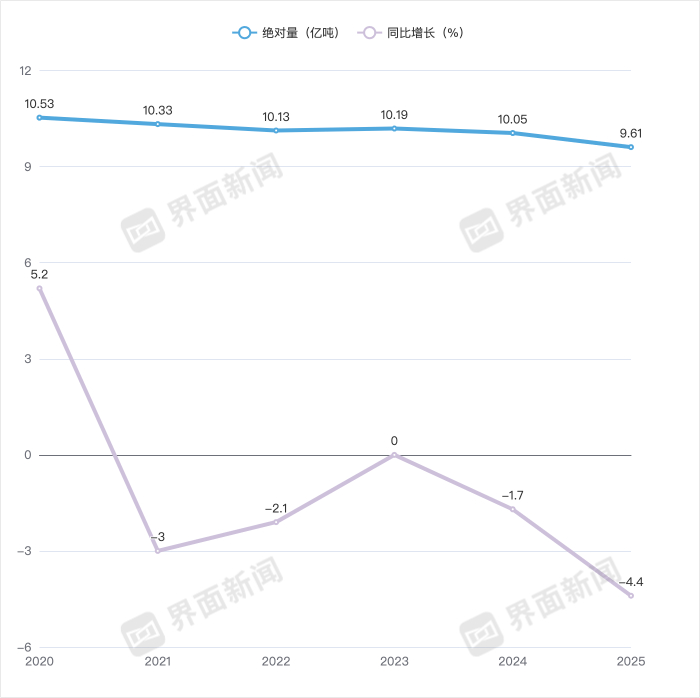
中国粗钢产量自2020年来首次跌破10亿吨
Xin Lang Cai Jing· 2026-01-19 14:06
Core Viewpoint - China's crude steel production has declined for the first time below 1 billion tons since 2020, with a total output of approximately 961 million tons in 2025, representing a year-on-year decrease of 4.4% [1][2]. Group 1: Production Trends - Since 2020, crude steel production has generally been on a downward trend, with a cumulative decrease of 92.19 million tons from 2020 to 2025 [2]. - The production in 2023 was relatively stable compared to previous years, but a further decline is expected in the following years [2][3]. Group 2: Policy Impact - The "dual control" policy on production capacity and output has been a significant factor in the decline of crude steel production, particularly since the introduction of carbon neutrality goals in 2020 [4]. - The National Development and Reform Commission has confirmed that production control will continue through 2025, emphasizing a "reduction development" approach [4]. - The Ministry of Industry and Information Technology has set clear production control requirements, prohibiting new capacity and promoting the reduction of excess capacity [4]. Group 3: Demand Changes - The demand structure for steel is undergoing significant changes, with a notable decline in demand for construction steel due to the downturn in the real estate sector, leading to a 19.37% drop in 2024 and an 18.14% decline in the first half of 2025 [5][6]. - Although the manufacturing sector's demand for steel has increased, it is insufficient to offset the decline in construction steel demand [5][6]. Group 4: Export Dynamics - Exports have become a crucial outlet for the steel industry, with a 6.7% year-on-year increase in steel exports in the first eleven months of 2025, totaling 10.8 million tons [6]. - However, international trade disputes and tariff barriers pose challenges to sustaining high export levels, with new export license management set to begin in 2026 [6].