
人口结构优化

Search documents
31省份出生人口数量一览 最能生娃省份排名来了
Di Yi Cai Jing· 2025-12-17 10:45
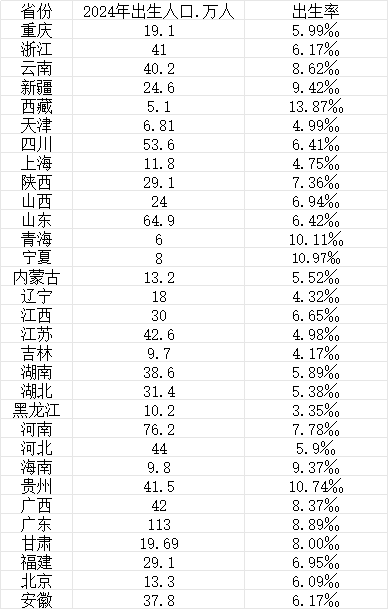
Core Viewpoint - The Central Economic Work Conference emphasizes the need to promote a positive view on marriage and childbirth to stabilize the scale of newborn population, which is crucial for avoiding rapid population decline and ensuring balanced demographic development [1]. Summary by Sections Population Birth Data - In 2023, 18 provinces in China reported over 200,000 births, with 14 provinces exceeding 300,000 births. The total number of births in these 14 provinces reached 6.968 million, accounting for 73% of the national total [1]. - The provinces with over 500,000 births include Guangdong (1.13 million), Henan (762,000), Shandong (649,000), and Sichuan (536,000) [2][3]. Key Provinces - Guangdong has been the top province for births for seven consecutive years, with its birth count surpassing that of the combined "postage area" of Shanghai, Jiangsu, and Zhejiang. Guangdong's birth rate accounts for 11.8% of the national total [2]. - The population structure in Guangdong is favorable for childbirth due to a high proportion of young, marriage-age individuals, bolstered by significant migration from other provinces [2]. - In 2024, Henan's birth population increased by 67,000 from the previous year, representing 7.99% of the national total, while Shandong's birth population rose by 39,000, making up 6.8% of the national total [2]. Other Provinces - Other provinces with significant birth numbers include Hebei, Jiangsu, Guangxi, Guizhou, Zhejiang, and Yunnan, each reporting over 400,000 births [4]. - The provinces of Hunan, Anhui, Hubei, and Jiangxi reported birth numbers between 300,000 and 400,000, while Fujian, Shaanxi, Xinjiang, and Shanxi had births ranging from 200,000 to 300,000 [5]. National Birth Statistics - The total number of births in China for 2024 is projected to be 9.54 million, an increase of 520,000 from 2023, marking the first rise since 2017. The national birth rate is estimated at 6.77‰, up by 0.38‰ from the previous year [5].

刘蓝予:把握人口高质量发展深刻内涵
Jing Ji Ri Bao· 2025-12-10 00:07
Group 1 - The core viewpoint emphasizes that population development is crucial for the modernization of China, requiring a focus on improving overall population quality to support Chinese-style modernization [1] - The "14th Five-Year Plan" suggests promoting high-quality population development and establishing a comprehensive population service system covering all demographics and life cycles [1][2] - High-quality population development is key to transforming a large population into a significant development advantage, representing an important aspect of "modernization with a large population" [1] Group 2 - Maintaining an appropriate total population scale is essential for economic production and circulation, influencing both labor supply and domestic demand [2] - As of the end of 2024, the labor force aged 16 to 59 is nearly 900 million, with over 15 million new laborers added each year, indicating that the "demographic dividend" still exists [2] - To sustain reasonable population levels, it is crucial to implement forward-looking policies, improve fertility support systems, and promote positive marriage and childbirth concepts [2] Group 3 - Enhancing population quality is the core goal of achieving high-quality population development, requiring the transformation of "demographic dividends" into "talent dividends" [3] - Significant progress has been made in improving population quality, with a higher education enrollment rate exceeding 60% and an average life expectancy of 79 years [3] - Future efforts should focus on optimizing educational resource allocation and strengthening health security systems to enhance overall population quality [3] Group 4 - High-quality population development necessitates a reasonable structural characteristic, including age and gender dimensions [4] - By 2024, the proportion of the population aged 65 and older will reach 15.6%, indicating a transition to a moderately aging society [4] - Optimizing population structure involves improving elderly care services, promoting gender equality, and ensuring the long-term balanced development of the population [4] Group 5 - A scientific and reasonable population distribution is vital for high-quality population development, promoting orderly population flow and distribution between urban and rural areas [5] - The urbanization rate has reached 67% by 2024, narrowing the gap with developed countries [5] - Ideal population distribution should reflect "regional balance and moderate concentration," enhancing the resilience of high-quality population development [5] Group 6 - Promoting high-quality population development is a comprehensive, long-term, and complex process that requires a people-centered approach [6] - It is essential to integrate investments in people with material investments, establishing a comprehensive population service system that considers various life aspects [6] - Systematic thinking is necessary to align population development trends with macroeconomic policies, fostering better coordination between population and economic development [7]
商贸零售行业快评报告:《育儿补贴制度实施方案》出台,关注相关消费产业链
Wanlian Securities· 2025-07-30 05:27
Investment Rating - The industry investment rating is "Outperform the Market," indicating an expected relative increase of over 10% in the industry index compared to the broader market within the next six months [6][9]. Core Insights - The introduction of the national "Childcare Subsidy System Implementation Plan" aims to alleviate family burdens related to child-rearing and promote long-term population balance. The subsidy will provide 3,600 yuan per child per year for children under three years old, starting from January 1, 2025 [3][4]. - The policy reflects the government's commitment to addressing declining birth rates and an aging population, marking a significant step in the establishment of a supportive policy framework for childbirth [4]. - The immediate effect of the subsidy is expected to stimulate consumption in the maternal and infant sectors, with recommendations to focus on industries such as baby care, dairy products, toys, and children's clothing. In the long term, the subsidy is anticipated to boost birth rates and support related industries like assisted reproduction, genetic testing, childcare services, and education [4]. Summary by Sections Event Overview - On July 28, 2025, the Central Committee of the Communist Party of China and the State Council issued the "Childcare Subsidy System Implementation Plan," which mandates the provision of subsidies for eligible families with children under three years old [2][3]. Financial Implications - The subsidy will be funded by the central government, with a structured allocation to eastern, central, and western regions, ensuring equitable distribution of resources [3]. Market Impact - The implementation of the childcare subsidy is expected to directly stimulate consumption in related sectors, enhancing economic growth and addressing demographic challenges [4].