人口自然增长

Search documents
重庆去年人口减少3万人
第一财经· 2026-03-26 13:16
Core Viewpoint - Chongqing has experienced a decrease in permanent resident population for three consecutive years, yet it continues to attract net inflow of population, indicating a complex demographic trend [2][3]. Group 1: Population Statistics - As of the end of 2025, Chongqing's total permanent resident population is projected to be 31.8726 million, with urban residents accounting for 23.2734 million, resulting in an urbanization rate of 73.02%, an increase of 0.88 percentage points from the previous year [2]. - The total permanent resident population in 2025 is expected to decrease by 32,100 compared to 2024, marking a continued decline in population [2]. - The natural population growth in 2025 is estimated at -147,000, while the actual decrease in population is only 32,100, indicating a net inflow of 114,900 people through migration [3]. Group 2: Migration Trends - Despite the overall decline in population, Chongqing has maintained a net inflow of population, with mechanical growth figures showing an increase from 82,300 in 2024 to 114,900 in 2025 [3]. - An analysis of data from 2019 to 2025 reveals that Chongqing has generally experienced net population inflow, with mechanical growth figures of 154,600, 218,400, 84,800, 77,100, -112,900, 101,500, and 114,900 respectively [3].

多省份公布2025年人口数据
Di Yi Cai Jing Zi Xun· 2026-02-27 08:46
Group 1 - Multiple provinces have released their population data for the year 2025, indicating varying trends in population growth and urbanization rates [2][3] - Hainan's permanent population is projected to reach 10.55 million by the end of 2025, an increase of 70,000 from the previous year, with an urbanization rate of 64.08%, up by 1.00 percentage points [2] - Guangdong's permanent population is expected to be 128.59 million by the end of 2025, increasing by 790,000, with a birth rate of 7.82‰ and a death rate of 5.56‰, resulting in a natural growth of 29,000 and a natural growth rate of 2.26‰ [2] - Guangdong has maintained its status as the only province with over one million births for six consecutive years, influenced by traditional fertility culture and local birth incentive policies [2] Group 2 - In contrast, Guangxi's population is projected to decrease by 240,000 to 49.89 million, with a birth rate of 7.20‰ and a death rate of 8.10‰, leading to a natural growth rate of -0.90‰ [3] - Guizhou's population is expected to decline by 30,000 to 3.857 million, with a birth rate of 9.25‰ and a death rate of 7.98‰, resulting in a natural growth rate of 1.27‰ [3] - Gansu's population is also projected to decrease by 15,000 to 2.443 million, with a birth rate of 6.65‰ and a death rate of 8.94‰, leading to a natural growth rate of -2.29‰ [3] Group 3 - Guangdong continues to experience high mechanical population growth, with a net inflow of approximately 500,000 people, driven by local industrial development and talent attraction [3] - Liaoning and Hubei have also reported net population inflows, with Liaoning seeing a net inflow of 45,000 people [4] - Hubei's economy reached 6.27 trillion yuan with a growth rate of 5.5%, making it the only province in Central China to experience a net population inflow [4]

海南去年常住人口增加7万人 多省份公布2025年人口数据
Di Yi Cai Jing Zi Xun· 2026-02-27 08:26
Group 1: Population Data Overview - Multiple provinces have released their population data for 2025, indicating varying trends in population growth and demographics [1][2] - Hainan's permanent population is projected to reach 10.55 million by the end of 2025, an increase of 70,000 from the previous year, with an urbanization rate of 64.08%, up by 1.00 percentage points [1] - Guangdong's permanent population is expected to be 128.59 million, increasing by 790,000, with a birth rate of 7.82‰ and a death rate of 5.56‰, resulting in a natural growth of 290,000 and an urbanization rate of 76.58%, up by 0.67 percentage points [1] Group 2: Birth and Death Rates - Guangdong has maintained its status as the only province with over one million births for six consecutive years, reflecting a strong birth culture supported by local incentives [1] - In contrast, Guangxi, Guizhou, and Gansu have reported population declines, with Guangxi's population decreasing by 240,000 and a natural growth rate of -0.90‰ [2] - Guizhou's population decreased by 30,000, with a birth rate of 9.25‰ and a natural growth rate of 1.27‰, while Gansu's population fell by 150,000, with a birth rate of 6.65‰ and a natural growth rate of -2.29‰ [2] Group 3: Migration Trends - Guangdong continues to experience high levels of mechanical population growth, with a net inflow of approximately 500,000 people, driven by local industrial development [2] - Liaoning and Hubei have also reported net population inflows, with Liaoning seeing a net inflow of 45,000 people [2] - Hubei has become the only province in Central China to experience a net population inflow, alongside a GDP growth of 5.5% and a high-tech industry value added accounting for 23% of its GDP [3]
中部人口格局生变:安徽、湖北逆势回流,第二大省靠生育突围
2 1 Shi Ji Jing Ji Bao Dao· 2025-04-14 10:33
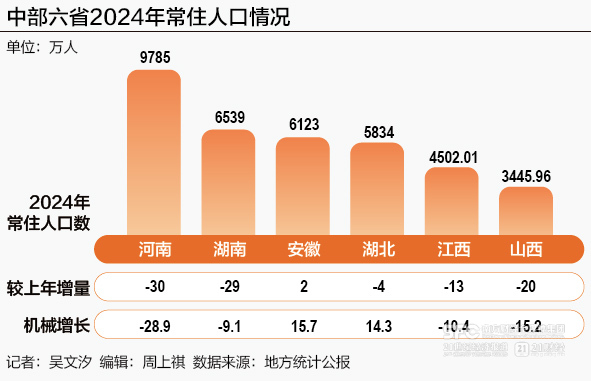
Core Insights - The population data for the six central provinces in China for 2024 has been released, showing that only Anhui experienced positive growth, while the other provinces saw declines in their resident populations [1][3]. Population Trends - As of the end of 2024, the resident populations of the central provinces are as follows: Henan (97.85 million), Hunan (65.39 million), Anhui (61.23 million), Hubei (58.34 million), Jiangxi (45.02 million), and Shanxi (34.46 million) [1]. - Anhui's population increased by 20,000, while Hubei, Jiangxi, Shanxi, Hunan, and Henan saw decreases of 4,000, 13,000, 20,000, 29,000, and 30,000 respectively [1]. Economic and Industrial Factors - The population inflow in Anhui and Hubei is attributed to successful industrial transformation and economic acceleration, with Anhui attracting 157,000 and Hubei 143,000 new residents in 2024 [3][5]. - Anhui's strategic location and policies have enhanced its attractiveness, with its high-tech industries contributing significantly to its economic growth, where the output of strategic emerging industries accounted for 43.6% of industrial output [3][4]. Natural Growth Rates - Henan and Jiangxi have natural growth rates above the national average, with Henan's birth rate at 7.78‰ and a total of 762,000 births in 2024, ranking second in the country [3][6]. - Despite a high birth rate, Henan faces challenges with a declining population, losing 300,000 residents in 2024 compared to its peak of 99.41 million [6]. Policy and Strategic Initiatives - Hubei has implemented various policies to attract and retain population, including reforms in the household registration system and incentives for childbirth [5][10]. - The central provinces are focusing on improving living conditions, employment opportunities, and supportive policies for families to enhance their attractiveness to residents [10]. Urban Development and Collaboration - Major cities in the central provinces, such as Hefei, Changsha, Nanchang, and Wuhan, have shown positive population growth, indicating the importance of urban centers in driving regional population dynamics [7]. - Hefei's integration into the Yangtze River Delta and its development of key industries like artificial intelligence and new energy vehicles have positioned it as a significant urban center [8][9]. Talent Attraction Strategies - The central provinces are shifting their talent attraction strategies towards high-end talent, with initiatives to develop and attract skilled professionals in various sectors [9][10]. - Policies aimed at easing residency requirements and enhancing job opportunities are being implemented to create a more favorable environment for population retention [9][10].
中部人口“缩水”近百万,哪些省份正在回流?
Mei Ri Jing Ji Xin Wen· 2025-04-07 15:56
Core Insights - The article discusses the population changes across various provinces in China for the year 2024, highlighting significant trends in population growth and decline among different regions [1][5]. Group 1: Population Growth and Decline - 28 provinces have reported their permanent resident population data for the end of 2024, with 8 provinces experiencing population growth, 2 remaining stable, and 18 witnessing declines [1]. - Guangdong has reclaimed its position as the province with the highest population increase, adding 740,000 residents, surpassing Zhejiang [6][7]. - Shandong has seen the largest population decline, losing 428,000 residents in 2023, marking it as the province with the most significant drop [1][6]. Group 2: Regional Analysis - In the central region, only Anhui has reported a population increase, while the other five provinces collectively lost 960,000 residents [5][13]. - Sichuan and Henan, both major economic provinces, have also experienced population declines, with Sichuan losing 40,000 and Henan losing 300,000 residents [10][13]. - The northeastern provinces, particularly Liaoning and Jilin, which had seen a brief population inflow in 2023, are now again facing outflows, with Liaoning losing 49,000 and Jilin losing 108,000 residents in 2024 [17][21]. Group 3: Factors Influencing Population Changes - Population changes are influenced by both natural growth (births minus deaths) and migration patterns [5][6]. - Guangdong's population growth is attributed to a high birth rate, with 1.13 million births in the previous year, making it the only province with over a million births [6][7]. - In contrast, Shandong's population decline is exacerbated by a net outflow of over 430,000 residents in two years, raising concerns about its population potentially falling below 100 million [9][17]. Group 4: Policy Responses - Jiangsu has introduced 15 measures to promote childbirth, including direct financial support for families [8]. - Both Hunan and Hubei are implementing strategies to attract and retain young talent, focusing on improving living conditions and reducing the cost of raising children [15].