
元冶·钢铁大模型

Search documents
南京大动作,全面升级
盐财经· 2026-03-07 09:52AI Processing
一到年关,南京就变成了金陵。 过去的春节假期,南京城被挤得水泄不通,明孝陵的游客多得令网友感叹:"朱元璋来了都得排队。"这 座本就名满天下的六朝古都,叠加了苏超的热度、秦淮灯会的招牌,一时间满城烟火,人声鼎沸。 作者 | 张来 编辑 | 江江 视觉 | 诺言 其实,就算不是旅游旺季,南京似乎也总是在话题中心。 自从2016年,英国作家阿克罗伊德的《伦敦传》被引进,中国便掀起了一阵为城市写书立传的风潮。几 年间,北京、上海、成都纷纷有了自己的城市传记。但让人记忆最深刻的,还要属叶兆言的《南京 传》。 叶兆言《南京传》 倒不是因为《南京传》出得早。而是因为,南京这座城市的往事,实在太多,太重,也太复杂了。如果 非要把城市当作一个人物看待,南京作为中国历史上数一数二的"天选之子",绝对充满叙事的张力。 但也正因如此,人们对南京的记忆,似乎一直停留在江南历史、秦淮灯影,却忽视了它在现代的语境 里,到底长什么模样? 今年2月初,盐财经记者走访南京,发现了一个与"金陵"意象截然不同的"新南京"。 在中国的区域经济版图里,南京的位置向来有点微妙,因其虽是省会,但远离上海大都市圈,辐射力一 直被压制。不可否认,过去几年里,江 ...



炼钢不再凭经验靠感觉——南钢以智能技术驱动产业升级
Zhong Guo Jing Ji Wang· 2026-02-13 23:03
Core Viewpoint - The integration of artificial intelligence with traditional steel manufacturing is transforming production processes, enhancing transparency and efficiency in operations [1]. Group 1: Digital Empowerment of Production - The Nanjing Steel Group has implemented a digital twin technology that allows real-time monitoring of the entire steel production process, significantly improving operational efficiency and product quality [2][3]. - The first-grade production rate of molten iron has increased from 80% to 99% due to the optimization of the iron-making process through advanced technologies [2]. - The introduction of over a thousand sensors around the blast furnace enables real-time data collection, leading to a trend analysis prediction accuracy of over 90% for furnace temperature [2][3]. Group 2: Innovation Leading Intelligent Manufacturing - The company has developed an industrial internet platform that integrates various data sources, enhancing energy management and production scheduling [4]. - The ongoing digital transformation is in its second phase, focusing on artificial intelligence and data assetization as key drivers for innovation and value creation [4]. - The company is exploring applications of large language models and AI image recognition technology to enhance production operations and customer service [4]. Group 3: Value-Driven Development - Digitalization has led to a comprehensive value enhancement for the company, with a 50% reduction in new product development cycles and a 12% decrease in comprehensive energy consumption per unit of output [6]. - The company has been recognized as a leading intelligent factory by the Ministry of Industry and Information Technology, reflecting its extensive experience in digital transformation over the past 20 years [6]. - The company has established a five-level digital twin system that covers the entire production process, achieving a full-scale digital transformation [6]. Group 4: Technological Leadership - The company has participated in the formulation of over 100 international, national, and industry standards, holding more than 4,700 patents, with 215 technologies reaching international leading levels [7]. - The company is actively sharing its digital transformation experiences and solutions with over 100 enterprises across various sectors, promoting the shift towards intelligent manufacturing [7].
炼钢不再凭经验靠感觉
Jing Ji Ri Bao· 2026-02-13 22:13
Core Insights - The integration of artificial intelligence with traditional steel manufacturing is transforming production processes, enhancing transparency and efficiency in operations [1][2]. Group 1: Digital Empowerment in Production - The Nanjing Steel Group has implemented a digital twin technology that visualizes the entire steel production process, allowing for remote operations and real-time data monitoring [2]. - The first-grade production rate of molten iron has increased from 80% to 99% due to the optimization of the entire iron-making process through advanced technologies [2][3]. - The introduction of over a thousand sensors around the blast furnace has enabled real-time data collection, leading to a furnace temperature prediction accuracy exceeding 90% [2][3]. Group 2: Innovation in Manufacturing - The company has developed an industrial internet platform that integrates various data sources, enhancing energy management and production efficiency [4]. - The ongoing digital transformation is in its second phase, focusing on artificial intelligence and data assetization as key drivers for innovation [4][5]. - The launch of the "Yuan Ye·Steel Big Model" aims to facilitate interaction with production systems through natural language, making advanced technology accessible to non-experts [5]. Group 3: Value-Driven Development - Digitalization has led to significant improvements, including a 12% reduction in comprehensive energy consumption per unit of output and a 9% decrease in total costs across the supply chain [6]. - The company has been recognized as a leading intelligent factory, reflecting over 20 years of digital transformation efforts and the establishment of a comprehensive digital twin system [6][7]. - Nanjing Steel has contributed to over 100 international and national standards and holds more than 4,700 patents, showcasing its leadership in technological advancements within the industry [7].
炼钢不再凭经验靠感觉 ——南钢以智能技术驱动产业升级
Jing Ji Ri Bao· 2026-02-13 22:01
Core Viewpoint - The integration of artificial intelligence with traditional steel manufacturing is transforming production processes, enhancing transparency and efficiency in operations [1][2]. Group 1: Digital Empowerment of Production - The Nanjing Steel Group has implemented a digital twin technology that allows real-time monitoring of the entire steel production process, significantly improving operational efficiency and product quality [2][3]. - The first-grade production rate of molten iron has increased from 80% to 99% due to the optimization of the iron-making process through advanced technologies [2]. - The introduction of over a thousand sensors around the blast furnace enables real-time data collection, leading to a trend analysis prediction accuracy of over 90% for furnace temperature [3]. Group 2: Innovation Leading Intelligent Manufacturing - The company has developed an industrial internet platform that integrates various data sources, enhancing energy management and production efficiency [4]. - The ongoing digital transformation is in its second phase, focusing on artificial intelligence and data assetization as key drivers for innovation and value creation [4][5]. - The launch of the "Yuan Ye Steel Big Model" aims to facilitate interaction with production systems through natural language, making AI technology accessible to non-professionals [5]. Group 3: Value-Driven Development - Digitalization has led to a comprehensive value enhancement for the company, with a 12% reduction in comprehensive energy consumption per unit of output and a 9% decrease in total costs across the supply chain [6]. - The company has been recognized as a leading intelligent factory, reflecting its 20 years of digital transformation efforts and the establishment of a five-level digital twin system [6][7]. - The company has contributed to over 100 international and national standards and holds more than 4,700 patents, showcasing its commitment to technological advancement and industry leadership [7].
南京:开启“十五五” 科创“打头阵”
Xin Hua She· 2026-01-22 07:16
Group 1 - Nanjing is hosting 128 New Year activities, leading to a significant increase in tourism consumption and setting a new record for subway capacity [1] - The government report projects a GDP growth of 5.2% by 2025, with a focus on integrating technological and industrial innovation [1][2] - Nanjing aims to strengthen its position as a key city in the Yangtze River Delta's international technology innovation center [1] Group 2 - The Software Avenue in Nanjing hosts over 4,800 software companies and 370,000 software talents, with the software and information service industry expected to exceed 1 trillion yuan by 2025 [2] - Industrial investment in Nanjing is projected to grow by 12.1% in 2025, leading the province, with significant investments in new electronic information and high-end intelligent equipment industries [2] Group 3 - Nanjing is implementing a "traditional industry upgrading" plan to enhance the value chain in sectors like steel and petrochemicals, aiming for 40% of the petrochemical industry to be new materials by the end of the 14th Five-Year Plan [3] - The city is also focusing on emerging industries, with a notable market share in industrial robotics and advancements in AI and biotechnology [3][4] Group 4 - Nanjing's strategic emerging industries are expected to achieve double-digit growth by 2025, with the smart grid industry projected to exceed 500 billion yuan [4] - The city is concentrating on ten emerging industry clusters and 26 key industrial chains during the 14th Five-Year Plan [4] Group 5 - Nanjing has established a comprehensive financial service system for innovation, with over 40 billion yuan in intellectual property pledges since the approval of the national innovation financial reform pilot zone [5] - The city aims to enhance the value-added share of the productive service industry to 57% by promoting deep integration with advanced manufacturing [5] Group 6 - Nanjing is fostering a "tropical rainforest" innovation ecosystem, providing a favorable environment for innovation and integrating various chains of innovation, industry, capital, and talent [11] - The city is focusing on creating a more competitive talent policy and efficient capital supply to support innovation [13] Group 7 - Nanjing is transforming its industrial ecosystem from a single-point investment approach to a comprehensive nurturing strategy, attracting major tech companies and enhancing its overall industrial environment [14] - The city plans to add 16 national manufacturing champions and 125 specialized "little giant" enterprises by 2025, reflecting an improved business environment [14]
推动“双新”融合筑牢现代化产业体系根基
Zhong Guo Zheng Quan Bao· 2025-12-09 20:22
Core Insights - The article emphasizes the integration of technological innovation and industrial transformation, highlighting how companies are leveraging AI and automation to enhance production efficiency and reduce costs [1][2][3] Group 1: Smart Manufacturing - Companies like Nanjing Steel are utilizing digital twin technology to create interactive 3D models of production lines, leading to increased efficiency and reduced costs [1] - Langbo Technology is enhancing its profitability by investing in automation equipment, which improves production processes and product quality traceability [1] Group 2: Green Transformation - Haiyang Technology has implemented intelligent production lines to address high energy consumption and labor intensity issues, achieving a fully automated manufacturing process that reduces resource consumption and emissions [2] - GCL-Poly Energy's subsidiary, GCL Lithium, focuses on green manufacturing, achieving approximately 50% reductions in investment costs, energy consumption, and overall process costs through innovative production methods [2] Group 3: Technological Innovation - Aviation engine manufacturing is highlighted as a complex system requiring advanced materials and manufacturing techniques, with companies like Hangya Technology developing barriers in precision processing and special treatments [3] - The development of R5-grade mooring chains by Yaxing Anchor Chain demonstrates the importance of understanding downstream demands and collaborating with research institutions to meet industry needs [3] Group 4: Balancing Technology and Market Needs - Companies must adapt to customer application scenarios and maintain competitive costs while ensuring product efficiency and ease of use [4] - Successful technology firms need to excel not only in technical capabilities but also in commercializing their innovations into valuable products for customers [4]
抢占“入口”,AI先行者掀起“产业风暴”
Xin Hua Ri Bao· 2025-12-01 04:05
Core Insights - The article discusses the emergence of vertical large models in the manufacturing sector, driven by AI technology, which are transitioning from technical competition to application-focused strategies [1][2] Group 1: Industry Developments - The 2025 World Intelligent Manufacturing Conference highlighted the launch of three vertical large models rooted in industrial scenarios, with key software companies like Zhongshu Chuanghe and Jin Heng Technology emerging in the Jiangbei New Area [1] - The vertical large models aim to address core pain points in industries such as rail transportation and ship manufacturing, focusing on breaking down information silos and reliance on experience [4][5] Group 2: Technological Innovations - Zhongshu Chuanghe's "Zhongshu Zhiqing Large Model" integrates data engineering and retrieval-augmented generation (RAG) technology to create high-quality industry-specific datasets, enhancing the decision-making process in manufacturing [4][6] - Jin Heng Technology's "Yuan Ye Steel Large Model" combines various AI models and industry mechanism models to create a dual-brain intelligent model cluster, addressing the complexities of the steel manufacturing process [5][8] Group 3: Application and Impact - The application of vertical large models has led to significant efficiency improvements, such as a 74.36% green electricity ratio and a carbon reduction of 335 tons in the Nanjing Tianjia Energy Zero Carbon Factory project [7] - The models facilitate a comprehensive reconstruction of industrial processes, enabling a shift from traditional automation to autonomous intelligence, thereby enhancing operational efficiency across the manufacturing value chain [6][8] Group 4: Collaborative Ecosystem - The establishment of an AI innovation ecosystem in Jiangbei New Area aims to foster collaboration among universities, enterprises, and research institutions, enhancing the adaptability and applicability of AI technologies in the manufacturing sector [10][11] - The initiative encourages a collaborative innovation network, focusing on original breakthroughs and scene empowerment to accelerate the integration of AI in intelligent manufacturing [11]
在这里体验钢铁是怎样“智”成的 南钢股份亮相世界智能制造大会
Zheng Quan Shi Bao Wang· 2025-11-28 09:27
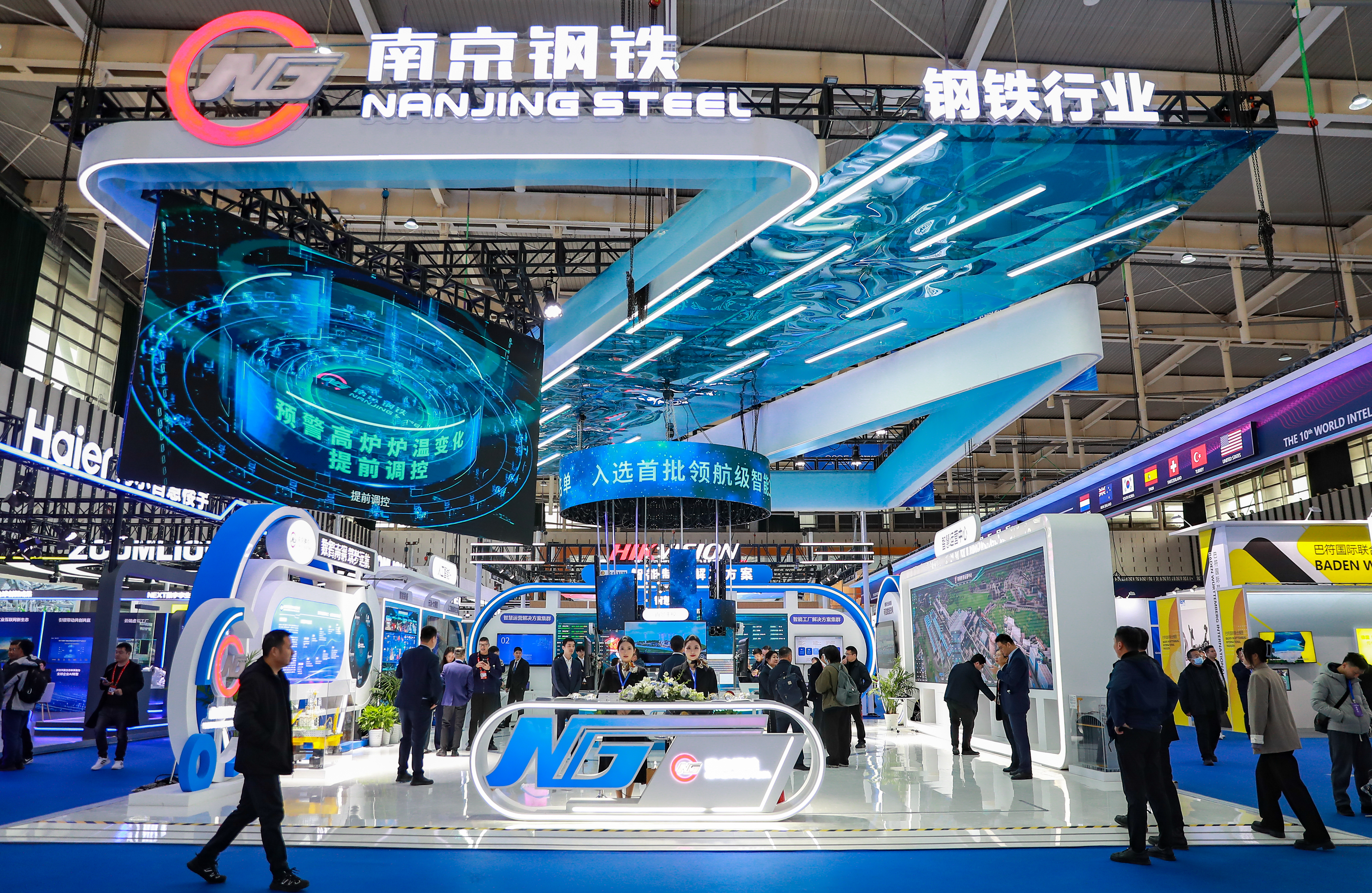
Core Insights - Nanjing International Expo Center hosted the 2025 World Intelligent Manufacturing Conference from November 27 to 29, where Nanjing Steel (600282.SH) was recognized as one of the first national leading intelligent factories and included in the top ten technological advancements in intelligent manufacturing in China for 2025 [1] Group 1: Evolution of Nanjing Steel's Intelligent Factory - The evolution of Nanjing Steel's leading intelligent factory has been a profound transformation lasting over 20 years, characterized by a clear strategy and continuous iteration [4] - Key milestones include the launch of the first integrated production management system in 2003, recognition as a national-level deep integration demonstration enterprise in 2012, and the establishment of a transformation goal towards "industrial intelligence and intelligent industry" in 2015 [4] - Nanjing Steel has developed a five-level digital twin covering "equipment - production line - factory - enterprise - ecosystem," achieving a comprehensive digital layout from "point" to "surface" [4] Group 2: Intelligent Applications and Data Management - Nanjing Steel has implemented a three-year action plan called "Artificial Intelligence Hundred Scenes Thousand Models," integrating AI technology deeply with steel processes, resulting in over 30 intelligent applications across various scenarios [5] - The company has established a unique full-domain data collection and governance system with over one million data collection points, achieving real-time perception and aggregation of the entire steel production process [5] - Nanjing Steel has achieved a core data lake entry rate of over 95%, providing a high-quality data foundation for intelligent manufacturing and has been recognized as a pilot for innovative development of trustworthy data spaces by the National Data Bureau [5] Group 3: Value Enhancement through Intelligent Manufacturing - Intelligent manufacturing has led to comprehensive value enhancement, with Nanjing Steel achieving 100% rates in key equipment CNC and networking [6] - The new product development cycle has been shortened by 50% compared to traditional models, while comprehensive energy consumption per unit output has decreased by 12% [6] - The total ownership cost of the industrial chain has been reduced by 9%, and delivery cycles have decreased by 15%, with a notable reduction of over 40 yuan in the cost per ton of iron through a closed-loop system of "perception - analysis - decision" [6] Group 4: Industry Impact and Collaboration - Nanjing Steel has systematically output its accumulated technologies, experiences, and solutions from digital transformation through various technology platform companies, successfully applying its intelligent manufacturing solutions to over 100 enterprises across multiple sectors [6] - The company has established a collaborative innovation ecosystem by deeply connecting upstream suppliers, downstream customers, and relevant partners, forming a win-win development pattern [5] - At the conference, Nanjing Steel showcased a complete intelligent manufacturing display system, illustrating its strategic layout and practical achievements in digital transformation [7]
南钢股份:“钢铁侠”荣膺“领航级”智能工厂
Shang Hai Zheng Quan Bao· 2025-11-27 00:33
Core Insights - Nanjing Steel Co., Ltd. (南钢股份) is transforming into a smart manufacturing enterprise through the implementation of JIT+C2M technology, enhancing production efficiency and customization capabilities [4][5][7] - The company has established a Smart Operations Center that integrates manufacturing, operations, and ecology, leading to a 10% improvement in production stability, a 2% increase in output, and a 10% reduction in costs [5][6] - Nanjing Steel is recognized as a leading smart factory in China, reflecting its successful transition from traditional manufacturing to a more intelligent and data-driven approach [8][9] Digital Transformation - The company has adopted a digital governance framework that utilizes over 138 intelligent models for operational efficiency, resulting in a 20% reduction in quality costs and a 20% increase in labor efficiency [6][9] - Nanjing Steel's digital research institute successfully produced customized steel parts using advanced technologies like digital twins and 3D printing, showcasing its innovative capabilities [5][7] Market Positioning - By restructuring its sales, research, manufacturing, and service processes, Nanjing Steel has shifted from a product manufacturer to a materials solution provider, allowing it to better meet customer demands for small-batch and personalized orders [7] - The company aims to enhance market prediction accuracy for key materials from 70% to over 80% through the development of a comprehensive data-driven forecasting model [9][10] Future Outlook - Nanjing Steel is collaborating with Huawei to advance its AI capabilities and has launched the "Yuan Ye·Steel Big Model" framework to further enhance its smart manufacturing and digital operations [9][10] - The company is committed to driving innovation and technological advancements in the steel industry, positioning itself for high-quality growth in the future [10]
江海奔流,“苏”写新篇——从“苏超”现象探寻江苏高质量发展动能
Zhong Guo Zheng Quan Bao· 2025-10-15 00:03
Core Insights - Jiangsu's economy demonstrates robust growth, with a projected GDP of 13.7 trillion yuan in 2024, leading the nation in growth increment [3] - The province's manufacturing sector is significant, contributing approximately 14% to the national manufacturing value added [3] - Jiangsu's industrial structure is evolving, with strategic emerging industries accounting for 41.8% of the industrial output in 2024, and high-tech industries surpassing 50% for the first time [3] Economic Strength - Jiangsu's GDP growth rate is projected to be the highest in the country, with a manufacturing value added of 4.66 trillion yuan [3] - The province's industrial output saw a year-on-year increase of 7.4% in the first half of the year, outpacing the national average by 1 percentage point [3] - The number of core enterprises in future industries exceeds 3,100, with a revenue scale surpassing 750 billion yuan [3] Regional Characteristics - Jiangsu has cultivated 14 national advanced manufacturing clusters, the highest in the country, promoting balanced regional development [5] - The income disparity between southern and northern Jiangsu has narrowed significantly, with per capita GDP and disposable income ratios decreasing to 1.86 and 1.80, respectively [5] Industrial Diversity - Jiangsu's manufacturing sector encompasses 31 major categories and over 500 subcategories, making it one of the most diverse in the nation [7] - The province is developing a "1650" industrial system, focusing on 16 advanced manufacturing clusters and 50 industrial chains [7] Innovation and Transformation - Traditional industries in Jiangsu are undergoing digital transformation, with over 56,000 projects implemented since 2022 [9] - The province leads the nation in the integration of digital and intelligent manufacturing, with a CNC rate of 70.1% for key processes [9] Private Sector Dynamics - Private enterprises are pivotal in driving new productive forces in Jiangsu, with significant investments in R&D despite long payback periods [10] - The government is fostering a supportive environment for private businesses, encouraging investment across various sectors [11] Government Support - Jiangsu's government is strategically planning the development of industries, facilitating supply-demand matching and optimizing services [13] - The province has launched a strategic emerging industry fund to enhance financing channels for innovative sectors [17] Global and Domestic Market Expansion - Jiangsu companies are increasingly focusing on international markets, with notable export growth and overseas production bases being established [15][16] - Domestic market potential is also being tapped, with companies like Tiangong International targeting high-end precision tools [16] Financial Ecosystem - Jiangsu has developed a multi-tiered capital market, supporting technology and industry innovation through various financing mechanisms [17] - The establishment of a strategic emerging industry fund aims to connect industry capital with financial resources, enhancing support for innovative enterprises [17]