人工智能研究

Search documents
不读博士,照样进OpenAI,o1核心成员现身说法了
3 6 Ke· 2026-01-26 08:34
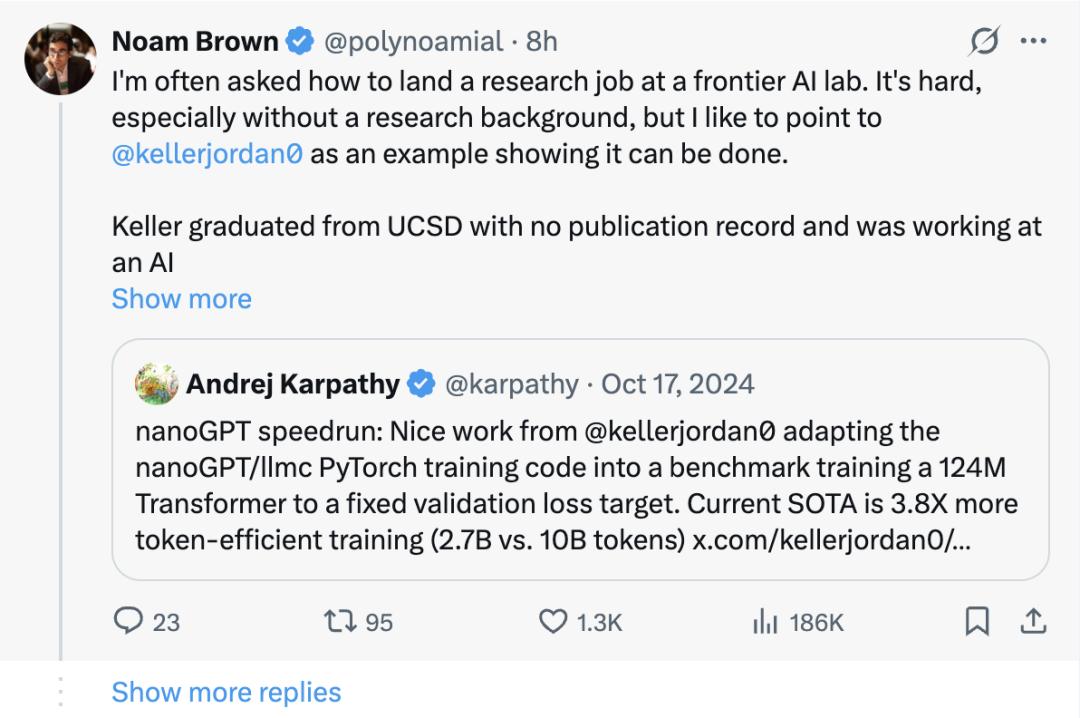
Core Insights - The article discusses the non-traditional paths taken by researchers in the AI field, emphasizing that a PhD is not a prerequisite for success in leading AI labs like OpenAI and Anthropic [1][44]. Group 1: Non-Traditional Researchers - Noam Brown highlights several atypical researchers who have made significant contributions to AI without a PhD, including Keller Jordan, Sholto Douglas, Andy Jones, and Kevin Wang [2][44]. - Common traits among these researchers include strong initiative, public research engagement, engineering skills, and a focus on practical contributions rather than titles [2][44]. Group 2: Keller Jordan's Journey - Keller Jordan, now at OpenAI, began his research career with a bachelor's degree and no publications, initially working at a startup focused on AI content moderation [3][6]. - He proactively reached out to a Google researcher with improvement ideas on a paper, leading to mentorship and a co-authored paper accepted at ICLR 2023 [6][8]. - His blog post on Muon, an optimizer for neural networks, and his GitHub experiments gained attention from industry leaders, ultimately leading to his position at OpenAI [8][11][14]. Group 3: Sholto Douglas's Experience - Sholto Douglas, who worked on the Gemini project at Google, also holds only a bachelor's degree and initially worked at McKinsey before pursuing research [17][19]. - He dedicated significant time to coding and research while working, and his inquiries on GitHub attracted the attention of a Google researcher, leading to an interview and subsequent hiring [21][22]. Group 4: Andy Jones's Contributions - Andy Jones, now at Anthropic, transitioned from a quant analyst to AI research, self-funding his computing resources and publishing impactful papers [23][30]. - His work on scaling laws in machine learning gained significant recognition, influencing testing paradigms in AI models [30][32]. Group 5: Kevin Wang's Entry into OpenAI - Kevin Wang, a recent graduate, was directly recruited by OpenAI due to a standout paper that caught the attention of the lab, demonstrating that exceptional work can lead to opportunities without a PhD [39][40]. - Recommendations from mentors play a crucial role in recruitment, as evaluating a candidate's true capabilities solely based on resumes or papers can be challenging [42]. Group 6: Changing Landscape of AI Research - The article emphasizes that a PhD is no longer a strict requirement for entering top AI labs, with many successful researchers coming from diverse educational backgrounds [44][47]. - The focus is shifting towards practical experience and demonstrable skills, as the industry increasingly values engineering capabilities over formal academic credentials [51].

不读博士,照样进OpenAI!o1核心成员现身说法了
量子位· 2026-01-25 03:34
Core Insights - The article discusses the non-traditional paths taken by researchers in the AI field, emphasizing that a PhD is not a prerequisite for success in leading AI labs like OpenAI and Anthropic [1][75]. Group 1: Non-Traditional Researchers - Noam Brown highlights several atypical researchers who have made significant contributions to AI without a PhD, including Keller Jordan, Sholto Douglas, Andy Jones, and Kevin Wang [2][6]. - These researchers share common traits such as strong initiative, public engagement in research, and engineering skills, rather than focusing solely on academic titles [6][75]. Group 2: Individual Stories - Keller Jordan, who only holds a bachelor's degree, initiated his research career by engaging with established researchers and eventually co-authored a paper accepted at ICLR 2023 [12][19]. - Sholto Douglas, also without a PhD, worked at McKinsey while conducting research at night, which led to an opportunity at Google after his work caught the attention of a senior researcher [34][40]. - Andy Jones, a former quantitative analyst, self-funded his research and published papers that gained significant recognition, ultimately leading to a position at Anthropic [45][49]. - Kevin Wang, who entered OpenAI directly after his undergraduate studies, stood out due to a remarkable paper that won the best paper award at NeurIPS 2025 [66][71]. Group 3: Insights on Hiring and Research - The article emphasizes that AI labs are increasingly valuing practical experience and demonstrable skills over formal academic qualifications [75][86]. - Recommendations from mentors and the ability to showcase research publicly are critical factors in hiring decisions within these organizations [72][82]. - The narrative suggests that early entry into the industry may be more beneficial than pursuing a PhD, as the landscape of AI research is rapidly evolving [85][88].

ICLR 2026出分,审稿员怒喷“精神病”,DeepMind研究员教你绝地求生
3 6 Ke· 2025-11-13 11:08
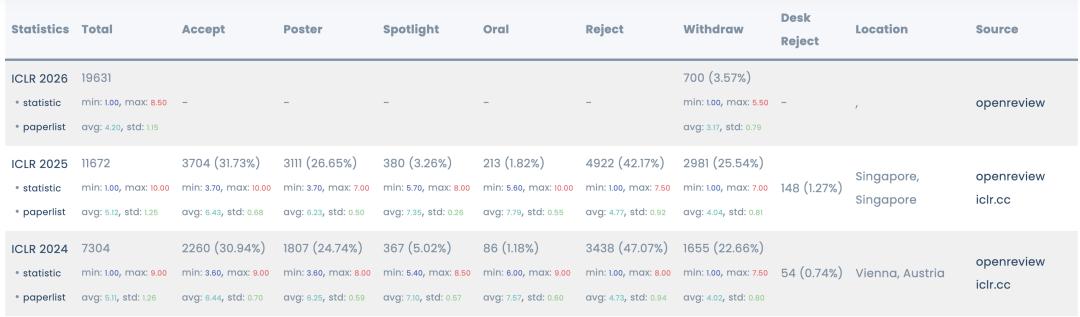
Core Insights - The ICLR 2026 review results reveal a significant increase in submission volume to nearly 20,000 papers, but a notable decline in average scores from 5.12 to 4.20, indicating concerns over paper quality, with some reviewers suggesting AI-generated content [1][12][32]. Submission Statistics - ICLR 2026 received a total of 19,631 submissions, a substantial increase from 11,672 in 2025, marking a historical high for the conference [1]. - The acceptance rate for ICLR 2026 is approximately 3.57%, with only 700 papers accepted [1]. - The highest score for ICLR 2026 was 8.5, compared to a maximum of 10 in 2025, while the average score dropped to 4.20 from 5.12 [1][12]. Reviewer Feedback - Reviewers have expressed frustration over the declining quality of submissions, with only about 9% of papers achieving an average score of 6 or above [15]. - A pattern was noted where higher submission IDs correlated with lower scores, suggesting a potential bias in the review process [24]. - Some reviewers reported spending more time understanding poorly written papers than the authors spent writing them, leading to calls for mechanisms to address frequent resubmissions of low-quality work [32][34]. Conference Context - ICLR 2026 is scheduled to take place from April 23 to 27, 2026, in Rio de Janeiro, Brazil, and is recognized as one of the three major conferences in the machine learning and AI research fields, alongside NeurIPS and ICML [10][11].
软银领投、OpenAI官宣400亿美元最新融资,投后估值达3000亿美元
Sou Hu Cai Jing· 2025-04-01 02:28
Group 1 - OpenAI raised $40 billion in a new funding round led by SoftBank, achieving a post-money valuation of $300 billion, marking one of the largest private financings in its history [1] - The funding will enhance OpenAI's AI research, expand its computing infrastructure, and support the growing user base of 500 million weekly ChatGPT users [1] - Approximately $18 billion of the funding will be allocated to the Stargate infrastructure project, aimed at establishing a network of AI data centers in the U.S. to improve computing capacity and service quality [1] Group 2 - OpenAI expects its revenue to more than double this year to $12.7 billion, up from $3.7 billion last year, with continued rapid growth projected for next year, reaching $29.4 billion [2] - Despite revenue growth, OpenAI faces significant costs related to the development of AI systems, including chips, data centers, and talent [4] - OpenAI is experiencing intense competition, particularly from Anthropic, which recently completed a $3.5 billion Series E funding round, raising its post-money valuation to $61.5 billion [4]