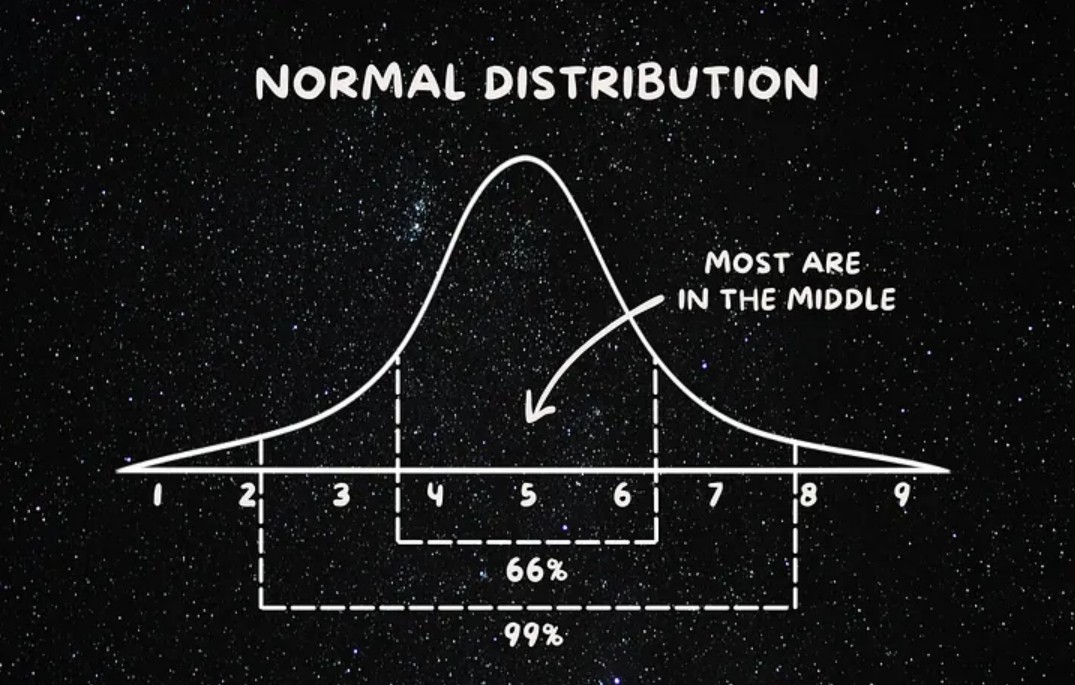
正态分布

Search documents
幂律分布,复利投资最优解的又一个数学必然!
雪球· 2026-03-26 08:10
Core Viewpoint - The optimal investment strategy is to focus on high-odds, long-term, and high-certainty investments, as derived from the nature of compound interest and the power law distribution of returns [17][25]. Group 1: Investment Dynamics - In the real investment world, a small number of assets contribute the majority of total returns, while most assets contribute little to negative returns [6]. - The process of compounding returns is multiplicative, leading to extreme differentiation where winners continue to win and losers continue to lose [9][10]. - Market dynamics such as network effects, scale effects, and brand effects amplify the advantages of leading assets, marginalizing followers [11][12]. Group 2: Cognitive Limitations - Market participants have limited cognitive bandwidth, making it impossible to deeply understand all assets simultaneously [13][14]. - Only a few individuals can identify extreme values, while most follow trends or make guesses, further concentrating returns [15]. Group 3: Investment Strategy - The investment return distribution follows a power law, where a few extreme values account for the majority of total returns, making it essential to pursue high-odds opportunities [16][18]. - Selecting a small number of high-potential assets is crucial, as spreading investments too broadly dilutes overall returns [20]. - High conviction in selected assets is necessary; low allocation to identified extreme values results in minimal contribution to total returns [21]. Group 4: Time Horizon - Extreme values require time to fully materialize; thus, a long-term investment horizon is essential to realize the full potential of these assets [23]. - The conclusion emphasizes that in a power law distribution, diversification leads to systematic dilution of value, while concentration allows for precise capture of value [24]. Group 5: Conclusion - The findings converge on the idea that high-conviction, long-term investments in high-odds opportunities are not merely a preference but a mathematical necessity under power law dynamics [25][26].


ICLR 2026出分,审稿员怒喷“精神病”,DeepMind研究员教你绝地求生
3 6 Ke· 2025-11-13 11:08
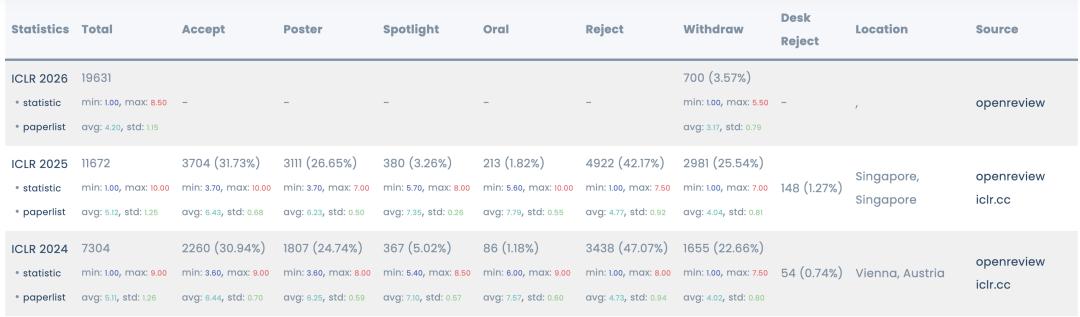
Core Insights - The ICLR 2026 review results reveal a significant increase in submission volume to nearly 20,000 papers, but a notable decline in average scores from 5.12 to 4.20, indicating concerns over paper quality, with some reviewers suggesting AI-generated content [1][12][32]. Submission Statistics - ICLR 2026 received a total of 19,631 submissions, a substantial increase from 11,672 in 2025, marking a historical high for the conference [1]. - The acceptance rate for ICLR 2026 is approximately 3.57%, with only 700 papers accepted [1]. - The highest score for ICLR 2026 was 8.5, compared to a maximum of 10 in 2025, while the average score dropped to 4.20 from 5.12 [1][12]. Reviewer Feedback - Reviewers have expressed frustration over the declining quality of submissions, with only about 9% of papers achieving an average score of 6 or above [15]. - A pattern was noted where higher submission IDs correlated with lower scores, suggesting a potential bias in the review process [24]. - Some reviewers reported spending more time understanding poorly written papers than the authors spent writing them, leading to calls for mechanisms to address frequent resubmissions of low-quality work [32][34]. Conference Context - ICLR 2026 is scheduled to take place from April 23 to 27, 2026, in Rio de Janeiro, Brazil, and is recognized as one of the three major conferences in the machine learning and AI research fields, alongside NeurIPS and ICML [10][11].
为什么你很努力,却依然平庸?别赖运气,你只是用错了统计学
3 6 Ke· 2025-09-07 00:04
Core Insights - The article emphasizes the importance of focusing on the critical few rather than the trivial many to achieve extraordinary results, suggesting that success often stems from strategic adjustments rather than sheer effort [2][10][22] Group 1: Statistical Distributions - Normal distribution is commonly used to summarize data, but it often leads to misconceptions about the nature of success and outcomes [3][5][6] - Pareto distribution, or the 80/20 rule, illustrates that a small percentage of actions often leads to the majority of results, highlighting the need to concentrate resources on the most impactful areas [7][10][12] Group 2: Practical Applications - Personalized marketing efforts yield better results than mass marketing, as targeted communications resonate more with potential customers [11][12] - Investing in relationships with key individuals can provide greater returns than broad advertising strategies, emphasizing the value of quality over quantity in networking [13][18] Group 3: Customer Focus - Companies should prioritize their most valuable customers, as they contribute significantly to growth and success, rather than spreading resources thinly across all clients [14][15][16] - The concept of having a few deep, meaningful relationships is more beneficial than having numerous superficial connections [18][21] Group 4: Value of Unconventional Thinking - The article argues that true value lies in areas often overlooked by others, where small, intelligent actions can yield disproportionately large returns [22][23][25] - The perception of "luck" is framed as the result of being prepared and strategically positioned to seize opportunities when they arise [25][26]