人民币避险属性

Search documents
人民币中间价“破7” 国际化进程迈入新窗口期
2 1 Shi Ji Jing Ji Bao Dao· 2026-01-26 12:16
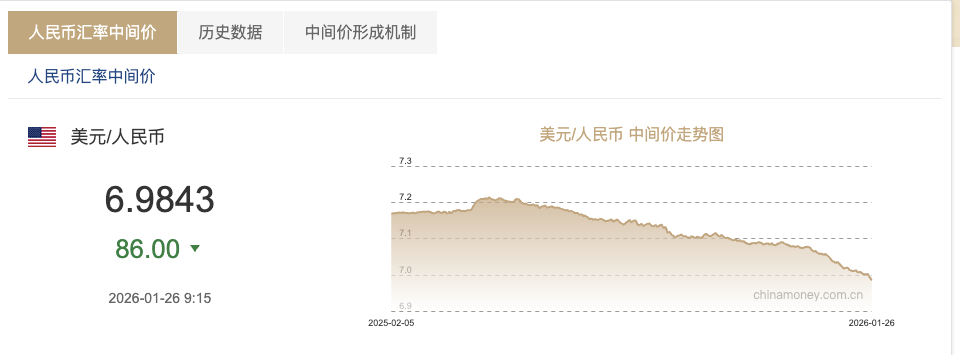
Core Viewpoint - The recent appreciation of the Renminbi (RMB) against the US dollar, with the central parity rate surpassing 7, reflects a combination of factors including a weakening US dollar, increased corporate demand for currency settlement, and improvements in China's economic fundamentals [1][4]. Group 1: RMB Exchange Rate Dynamics - On January 26, the People's Bank of China announced the RMB central parity rate at 6.9843 against the US dollar, an increase of 86 basis points from the previous day's rate of 6.9929, marking a new high since May 2023 [1]. - The RMB's appreciation impacts both individuals and businesses, reducing costs for cross-border consumption, education, and travel, while potentially diminishing the value of dollar-denominated assets for residents [3]. - Export-oriented companies may face reduced price competitiveness due to the stronger RMB, while manufacturing firms reliant on imported materials could benefit from lower import costs [3]. Group 2: Factors Influencing RMB Appreciation - Key drivers for the RMB's recent strength include the ongoing weakening of the US dollar, rising corporate demand for currency settlement at year-end, and an overall improvement in China's economic conditions, with positive factors expected to persist until 2026 [4]. - The RMB has shown a stable appreciation trend since Q4 2025, indicating its emerging status as a safe-haven currency amid global market volatility [5]. Group 3: Enhancing RMB's Safe-Haven Status - The RMB's recent performance suggests it is gaining safe-haven attributes, which could increase its attractiveness to foreign investors [5][6]. - If the RMB is recognized as a safe-haven currency, it could enhance its role in global investment portfolios, reduce volatility from short-term capital flows, and increase its usage in cross-border trade and financial pricing [6]. Group 4: Policy Support for RMB Internationalization - The People's Bank of China announced an increase in the RMB Business Facility in Hong Kong from 100 billion to 200 billion, aimed at enhancing offshore RMB liquidity [7]. - The central bank plans to improve financial market connectivity and expand liquidity management tools for foreign investors, which will support the internationalization of the RMB [8][9]. - The ongoing efforts to promote RMB internationalization include enhancing cross-border payment systems and increasing the issuance of offshore RMB bonds to meet foreign investor demand [9][10]. Group 5: Long-term Outlook for RMB Internationalization - The RMB's internationalization is expected to progress significantly in the coming years, driven by both economic fundamentals and policy initiatives aimed at reducing reliance on the US dollar [10][11]. - The trend of diversifying foreign exchange reserves among central banks globally, coupled with the weakening of the US dollar's credibility, provides favorable conditions for the RMB to enhance its status as a reserve currency [11].

人民币汇率中间价创32个月新高
21世纪经济报道· 2026-01-26 11:46
Core Viewpoint - The recent appreciation of the Renminbi (RMB) against the US dollar, with the central parity rate surpassing 7, is influenced by various factors including the weakening of the US dollar, increased demand for currency settlement by enterprises, and improvements in China's economic fundamentals [1][6][12]. Group 1: RMB Exchange Rate Dynamics - The RMB's central parity rate against the US dollar was set at 6.9843 on January 26, 2023, marking an increase of 86 basis points from the previous day and reaching the highest level since May 2023 [1][3]. - The appreciation of the RMB affects both individuals and businesses, reducing costs for cross-border consumption, study, and travel, while potentially diminishing the value of dollar-denominated assets for residents [3][6]. - Approximately 60% of foreign trade is minimally affected by exchange rate fluctuations, as many enterprises conduct cross-border trade settlements in RMB [3][10]. Group 2: Economic Influences and Predictions - Factors contributing to the RMB's appreciation include the ongoing weak dollar environment, anticipated interest rate cuts by the Federal Reserve, and an overall improvement in China's economic conditions [6][12]. - Predictions suggest that the RMB will continue to exhibit a stable appreciation trend, with the potential for a more balanced exchange rate movement through 2026 [6][8]. Group 3: RMB as a Safe-Haven Currency - The RMB has begun to demonstrate safe-haven characteristics amid global market volatility, with its exchange rate stability reflecting its growing appeal as a secure asset [8][9]. - If the RMB is recognized as a safe-haven currency, it could enhance its attractiveness to foreign investors and increase its usage in cross-border trade and financial pricing [9][10]. Group 4: Support for Offshore RMB Market - The People's Bank of China (PBOC) announced an increase in the RMB Business Facility in Hong Kong from 100 billion to 200 billion, aimed at enhancing offshore RMB liquidity [10][11]. - The PBOC plans to improve financial market connectivity and provide more tools for liquidity management and risk hedging for foreign investors [10][12]. Group 5: RMB Internationalization Efforts - The Chinese government is actively promoting RMB internationalization to reduce reliance on the US dollar and enhance the stability of its financial system [12][14]. - The ongoing diversification of foreign exchange reserves by central banks globally, along with improvements in cross-border payment systems, supports the RMB's potential rise as a reserve currency [14].