
人民币国债

Search documents
一个挺劲爆的小作文
表舅是养基大户· 2026-03-18 13:34
Group 1 - The article discusses the recent surge in oil prices and the drop in gold prices due to renewed conflicts in the Middle East, indicating ongoing market volatility [1] - It emphasizes the importance of a long-term perspective in investment strategies, particularly in light of current geopolitical tensions [2] - A notable piece of information circulating in the bond market is that the Brazilian central bank is purchasing Chinese 5-year government bonds, which serves as a starting point for discussing various perspectives on the bond market [3] Group 2 - A key data point mentioned is that the proportion of enterprises using currency hedging tools and the use of RMB in cross-border trade payments has reached 30%, collectively exceeding 60% [5] - The proportion of RMB settlement in China's foreign trade has doubled over the past five years, increasing from 15% to 30% [5] - The article provides a table showing the RMB settlement proportion in goods trade from 2020 to 2026, indicating a steady increase [6] Group 3 - Brazil is highlighted as a significant case study due to its status as China's largest trading partner since 2009, with bilateral trade nearing $160 billion in 2024 [9] - In 2023, Brazil's exports to China surpassed $100 billion, showcasing the complementary nature of the trade relationship [11] - The article notes that if the RMB proportion in trade continues at an average of 30%, it represents a substantial amount of money that Brazil will need to invest or spend [11] Group 4 - The article mentions BYD's expansion in Brazil, which has garnered attention from the U.S., indicating the significance of this development in the context of international trade and competition [12][15] - Brazil's strategy of reducing U.S. Treasury holdings over the years is discussed, with a total reduction exceeding $70 billion over five years, aligning with the increasing trade volume with China [18] Group 5 - The article raises the question of how foreign entities will invest the RMB they acquire through trade, suggesting that there is a growing need for RMB-denominated assets [19] - It outlines several measures taken by the Chinese central bank to facilitate the use of RMB, including issuing offshore RMB bonds and enhancing the RMB yield curve in Hong Kong [20][21][22] Group 6 - The article discusses the concept of security premiums in investment, suggesting that regions with geopolitical stability and strong military presence should be given more weight in investment decisions [27] - It highlights the recent volatility in Dubai's real estate market, which dropped nearly 40% amid regional conflicts, questioning the resilience of financial centers in times of crisis [28] Group 7 - The article notes that the RMB central parity rate has reached a new high, reflecting the currency's strength amid external uncertainties [35][36] - It suggests that the current global financial landscape is undergoing a rebalancing, where the weight of various currencies and markets is being adjusted to better reflect their economic capabilities [41][42] Group 8 - The article concludes with observations on the A-share market, noting a significant rebound in the technology sector and the cautious trading behavior observed in the market [45][52] - It mentions Tencent's quarterly report meeting expectations, while also highlighting the challenges faced by Tencent Music amid increasing competition [56][57]




财政部将于2月份在香港发行140亿元人民币国债
Zheng Quan Ri Bao Wang· 2026-02-04 11:43
Group 1 - The Ministry of Finance announced the issuance of the first phase of RMB government bonds for 2026, scheduled for February 11 in the Hong Kong Special Administrative Region [1] - The issuance scale is set at 14 billion RMB [1] - Specific issuance arrangements will be published in the Central Maturity Unit (CMU) of the Hong Kong Monetary Authority's debt instruments [1]
从“概念市场”到万亿枢纽 澳门债券市场实现超200倍增长
2 1 Shi Ji Jing Ji Bao Dao· 2026-01-27 16:49
Core Insights - The Macau bond market has rapidly developed from a nascent stage to surpassing 1 trillion MOP in just a few years, driven by infrastructure connectivity, the accumulation of RMB assets, and innovations in green finance [1][2]. Group 1: Market Growth and Development - The total scale of bonds listed by the Macau (MOX) has increased from less than 5 billion MOP at its inception in 2018 to 10,638.73 billion MOP by 2025, representing over 200 times growth with a compound annual growth rate exceeding 100% [1]. - The number of bond issuances has surged from 24 in 2020 to 322 by 2025, an increase of 298 issuances over five years [1]. - The Macau bond market has transitioned from a "concept market" to one that is understandable and usable by international investors, laying a foundation for future scalable development [2]. Group 2: Infrastructure and Connectivity - The Macau Central Securities Depository (CSD) has been operational for four years and successfully connected with Hong Kong's Central Moneymarkets Unit (CMU) by 2025, facilitating 100 billion MOP in settlement amounts across over 140 transactions [3]. - Approximately 50% of the bonds issued by the Macau government in 2025 were subscribed by CMU members through bilateral connectivity, enhancing international investor participation [3]. - The CSD and CMU connection has created conditions for cross-market allocation and secondary trading, contributing to a more liquid market [3]. Group 3: Regulatory and Legal Framework - The new Investment Fund Law, effective from January 1, 2026, aims to align with international regulatory standards and remove barriers to fund management, thereby creating a conducive environment for market development [4]. - The issuance of RMB-denominated bonds by the Ministry of Finance in Macau has become a regular practice, enhancing market credibility and providing quality asset supply [5]. Group 4: Product Innovation - The stock of green bonds in Macau reached 1,772.36 billion MOP, with 36 new issuances in 2025, reflecting a 16.1% year-on-year growth [6]. - The Macau government has established a certification committee for technology innovation bonds, which are aimed at supporting tech enterprises and investment institutions [6]. - Future product innovations will focus on expanding green bonds and technology innovation bonds, as well as exploring asset securitization products [7]. Group 5: Market Participation and Structure - The issuer base has diversified beyond government entities to include enterprises from various provinces, with Shandong leading in bond issuance at 587.26 billion MOP [8]. - The investor structure is becoming more international and institutional, with significant participation from international hedge funds and asset management companies through the CMU [8]. - The market is striving for a balance between economic and social benefits, contributing to the stability of the international financial market [8]. Group 6: Challenges and Future Directions - Current challenges include weak liquidity in the secondary market and the need for a more internationalized and institutionalized investor structure [9]. - Macau is positioned to leverage its unique advantages in cross-border financing and sustainable finance, aiming to become a financial bridge for Portuguese-speaking countries and Belt and Road Initiative partners [9]. - The Chief Executive of Macau has prioritized the cultivation of the bond market in the 2026 policy report, indicating a commitment to enhancing issuance processes and legal frameworks [10].
央行多举措推进香港离岸人民币市场建设 探索拓展将人民币债券作为离岸合格担保品的机制
Shang Hai Zheng Quan Bao· 2026-01-26 19:16
Core Viewpoint - The People's Bank of China (PBOC) is committed to supporting the development of Hong Kong as a major offshore RMB business hub, with several initiatives aimed at enhancing liquidity and market infrastructure for offshore RMB transactions [1][2]. Group 1: Liquidity Support - The PBOC supports the Hong Kong Monetary Authority in increasing the RMB business funding arrangement from 100 billion to 200 billion, providing more liquidity for the offshore market [2]. - The PBOC encourages Hong Kong RMB clearing banks to obtain RMB liquidity through various means, including issuing interbank certificates of deposit and account financing [2]. Group 2: Financial Market Connectivity - The PBOC aims to enhance financial market connectivity, enriching liquidity management and risk hedging tools for overseas investors by improving mechanisms like Bond Connect and Swap Connect [2]. - The PBOC plans to explore the use of RMB bonds as offshore eligible collateral and to promote the listing of RMB government bond futures in Hong Kong [2]. Group 3: Offshore RMB Government Bonds - The PBOC will work with relevant departments to increase the annual issuance of offshore RMB government bonds to meet the demand from foreign investors for quality RMB assets [2][3]. - A market-making mechanism for the offshore market will be established to enhance trading activity and improve RMB pricing capabilities [2]. Group 4: Gold Market Development - The PBOC supports the Shanghai Gold Exchange in participating in the construction of Hong Kong's gold clearing system, aiming to strengthen Hong Kong's position as an international gold trading center [3]. - The establishment of a delivery warehouse by the Shanghai Gold Exchange in Hong Kong has enriched the offshore RMB asset allocation tools [4]. Group 5: Cross-Border Use of RMB - The RMB's status as the second-largest trade financing currency and the third-largest payment currency globally has been further solidified, with its weight in the IMF Special Drawing Rights (SDR) basket ranking third [4]. - The Bond Connect has significantly enhanced Hong Kong's global hub function, with over 800 foreign institutions investing in the mainland bond market through the "Northbound" channel, holding a total of 810 billion RMB [3].
人民币中间价“破7” 国际化进程迈入新窗口期
2 1 Shi Ji Jing Ji Bao Dao· 2026-01-26 12:16
Core Viewpoint - The recent appreciation of the Renminbi (RMB) against the US dollar, with the central parity rate surpassing 7, reflects a combination of factors including a weakening US dollar, increased corporate demand for currency settlement, and improvements in China's economic fundamentals [1][4]. Group 1: RMB Exchange Rate Dynamics - On January 26, the People's Bank of China announced the RMB central parity rate at 6.9843 against the US dollar, an increase of 86 basis points from the previous day's rate of 6.9929, marking a new high since May 2023 [1]. - The RMB's appreciation impacts both individuals and businesses, reducing costs for cross-border consumption, education, and travel, while potentially diminishing the value of dollar-denominated assets for residents [3]. - Export-oriented companies may face reduced price competitiveness due to the stronger RMB, while manufacturing firms reliant on imported materials could benefit from lower import costs [3]. Group 2: Factors Influencing RMB Appreciation - Key drivers for the RMB's recent strength include the ongoing weakening of the US dollar, rising corporate demand for currency settlement at year-end, and an overall improvement in China's economic conditions, with positive factors expected to persist until 2026 [4]. - The RMB has shown a stable appreciation trend since Q4 2025, indicating its emerging status as a safe-haven currency amid global market volatility [5]. Group 3: Enhancing RMB's Safe-Haven Status - The RMB's recent performance suggests it is gaining safe-haven attributes, which could increase its attractiveness to foreign investors [5][6]. - If the RMB is recognized as a safe-haven currency, it could enhance its role in global investment portfolios, reduce volatility from short-term capital flows, and increase its usage in cross-border trade and financial pricing [6]. Group 4: Policy Support for RMB Internationalization - The People's Bank of China announced an increase in the RMB Business Facility in Hong Kong from 100 billion to 200 billion, aimed at enhancing offshore RMB liquidity [7]. - The central bank plans to improve financial market connectivity and expand liquidity management tools for foreign investors, which will support the internationalization of the RMB [8][9]. - The ongoing efforts to promote RMB internationalization include enhancing cross-border payment systems and increasing the issuance of offshore RMB bonds to meet foreign investor demand [9][10]. Group 5: Long-term Outlook for RMB Internationalization - The RMB's internationalization is expected to progress significantly in the coming years, driven by both economic fundamentals and policy initiatives aimed at reducing reliance on the US dollar [10][11]. - The trend of diversifying foreign exchange reserves among central banks globally, coupled with the weakening of the US dollar's credibility, provides favorable conditions for the RMB to enhance its status as a reserve currency [11].
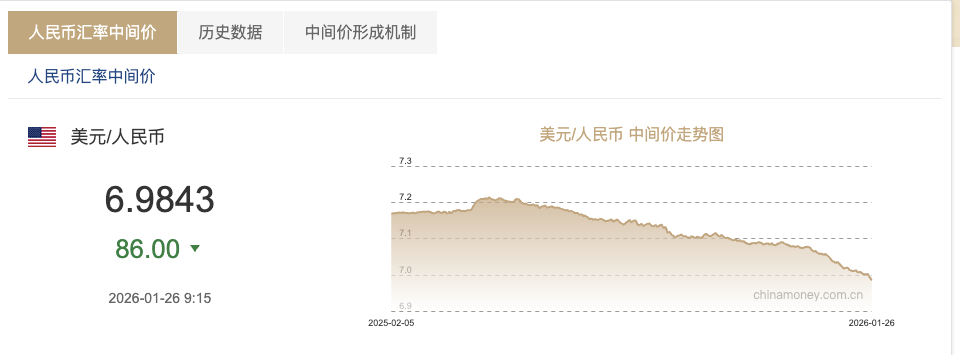
人民币汇率中间价创32个月新高
21世纪经济报道· 2026-01-26 11:46
Core Viewpoint - The recent appreciation of the Renminbi (RMB) against the US dollar, with the central parity rate surpassing 7, is influenced by various factors including the weakening of the US dollar, increased demand for currency settlement by enterprises, and improvements in China's economic fundamentals [1][6][12]. Group 1: RMB Exchange Rate Dynamics - The RMB's central parity rate against the US dollar was set at 6.9843 on January 26, 2023, marking an increase of 86 basis points from the previous day and reaching the highest level since May 2023 [1][3]. - The appreciation of the RMB affects both individuals and businesses, reducing costs for cross-border consumption, study, and travel, while potentially diminishing the value of dollar-denominated assets for residents [3][6]. - Approximately 60% of foreign trade is minimally affected by exchange rate fluctuations, as many enterprises conduct cross-border trade settlements in RMB [3][10]. Group 2: Economic Influences and Predictions - Factors contributing to the RMB's appreciation include the ongoing weak dollar environment, anticipated interest rate cuts by the Federal Reserve, and an overall improvement in China's economic conditions [6][12]. - Predictions suggest that the RMB will continue to exhibit a stable appreciation trend, with the potential for a more balanced exchange rate movement through 2026 [6][8]. Group 3: RMB as a Safe-Haven Currency - The RMB has begun to demonstrate safe-haven characteristics amid global market volatility, with its exchange rate stability reflecting its growing appeal as a secure asset [8][9]. - If the RMB is recognized as a safe-haven currency, it could enhance its attractiveness to foreign investors and increase its usage in cross-border trade and financial pricing [9][10]. Group 4: Support for Offshore RMB Market - The People's Bank of China (PBOC) announced an increase in the RMB Business Facility in Hong Kong from 100 billion to 200 billion, aimed at enhancing offshore RMB liquidity [10][11]. - The PBOC plans to improve financial market connectivity and provide more tools for liquidity management and risk hedging for foreign investors [10][12]. Group 5: RMB Internationalization Efforts - The Chinese government is actively promoting RMB internationalization to reduce reliance on the US dollar and enhance the stability of its financial system [12][14]. - The ongoing diversification of foreign exchange reserves by central banks globally, along with improvements in cross-border payment systems, supports the RMB's potential rise as a reserve currency [14].
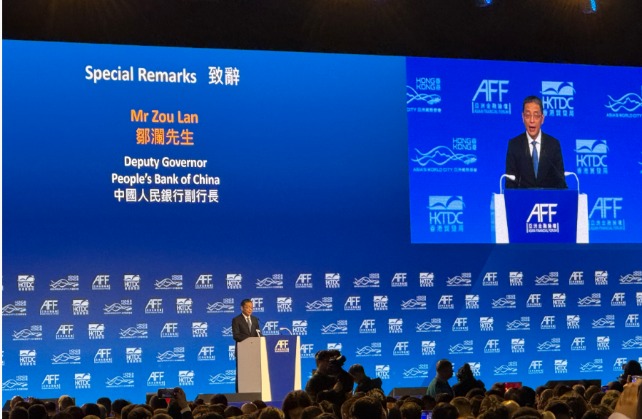
央行副行长邹澜:支持香港金管局将人民币业务资金安排规模增加至2000亿元
Sou Hu Cai Jing· 2026-01-26 08:30
Core Insights - The People's Bank of China (PBOC) emphasizes the rapid development and global influence of China's financial markets, highlighting the interconnectivity between mainland and Hong Kong markets [1][2] Group 1: Bond Market Developments - The "Bond Connect" has significantly enhanced Hong Kong's role as a global financial hub, with over 800 foreign institutions investing in mainland bonds through the "Northbound" channel, holding a total of 810 billion RMB, which accounts for 25% of foreign holdings in Chinese bonds [1] - The total trading volume for 2025 is projected to reach 9.7 trillion RMB, representing over 60% of the market [1] - The "Southbound" channel has facilitated mainland investors in acquiring Hong Kong dollar, US dollar, and RMB bonds, with current holdings nearing 1.2 trillion RMB [1] Group 2: Stock Market Developments - The Stock Connect mechanism continues to expand, with mainland investors holding over 60 billion HKD in Hong Kong stocks through the "Hong Kong Stock Connect," while global investors hold over 2.5 trillion RMB in mainland stocks via the "Shenzhen-Hong Kong Stock Connect" [1] Group 3: Currency and Liquidity Management - The PBOC and Hong Kong Monetary Authority have launched offshore and cross-border RMB repurchase agreements, with 34 foreign institutions engaging in offshore repurchase totaling 119.1 billion RMB, and 46 new institutions participating in cross-border repurchase of 150.3 billion RMB, enhancing liquidity in the Hong Kong RMB market [2] - The "Swap Connect" has seen 87 foreign investors accessing the mainland derivatives market, with a cumulative nominal principal of over 9.9 trillion RMB in interest rate swaps [2] Group 4: Gold Market Developments - The Shanghai Gold Exchange has established a delivery warehouse in Hong Kong and listed related contracts, enriching offshore RMB asset allocation tools [2] - The PBOC supports the development of Hong Kong's gold market, aiming to strengthen its position as an international gold trading center [4] Group 5: Future Initiatives - The PBOC plans to increase the RMB funding arrangement scale for Hong Kong's offshore market from 100 billion to 200 billion RMB to enhance liquidity [3] - Continued efforts will be made to improve financial market connectivity and expand risk management tools for foreign investors [3] - The PBOC will also increase the supply of offshore RMB government bonds to meet foreign investors' demand for quality RMB assets [3]
中国人民银行副行长邹澜:深化互联互通 坚定支持离岸人民币市场建设
Shang Hai Zheng Quan Bao· 2026-01-26 08:05
Core Viewpoint - The People's Bank of China (PBOC) emphasizes the rapid development and global influence of China's financial markets, highlighting the ongoing efforts to enhance the connectivity between mainland China and Hong Kong's financial markets [1][2]. Group 1: Bond Market Developments - The "Bond Connect" has significantly enhanced Hong Kong's role as a global financial hub, with over 800 foreign institutions investing in mainland China's bond market through the "Northbound" channel, holding a total of 810 billion RMB, which accounts for 25% of foreign holdings in Chinese bonds [1] - The total trading volume for 2025 is projected to reach 9.7 trillion RMB, representing over 60% of the market [1] - The "Southbound" channel has facilitated mainland investors in acquiring Hong Kong dollar, US dollar, and RMB-denominated bonds, with current holdings nearing 1.2 trillion RMB [1] Group 2: Stock Market Developments - The Shanghai-Hong Kong Stock Connect mechanism continues to expand, with mainland investors holding over 60 billion HKD in Hong Kong stocks through the "Hong Kong Stock Connect," while global investors hold over 2.5 trillion RMB in mainland stocks via the "Shanghai-Hong Kong Stock Connect" [1] Group 3: Currency and Liquidity Management - In February and October 2025, the PBOC and the Hong Kong Monetary Authority launched offshore and cross-border RMB repurchase agreements, with 34 foreign institutions engaging in offshore repurchase transactions totaling 119.1 billion RMB, and 46 new institutions participating in cross-border repurchase agreements amounting to 150.3 billion RMB, enhancing liquidity in the Hong Kong RMB market [2] - The "Swap Connect" has seen 87 foreign investors accessing the mainland derivatives market through Hong Kong, with a cumulative nominal principal of over 9.9 trillion RMB in interest rate swap transactions [2] Group 4: Gold Market Developments - The Shanghai Gold Exchange has established a delivery warehouse in Hong Kong and listed related contracts, enriching the offshore RMB asset allocation tools [2] - The PBOC supports the construction of Hong Kong's gold market, aiming to strengthen its role as an international gold trading center [4] Group 5: Future Initiatives - The PBOC plans to increase the RMB business funding arrangement scale for Hong Kong's offshore market from 100 billion to 200 billion RMB to enhance liquidity [3] - Continued efforts will be made to improve financial market connectivity and expand liquidity management and risk hedging tools for foreign investors [3] - The PBOC will also increase the annual issuance of offshore RMB government bonds to meet the demand for quality RMB asset allocation from foreign investors [3]
央行加码支持香港离岸人民币市场 资金安排规模倍增至2000亿
2 1 Shi Ji Jing Ji Bao Dao· 2026-01-26 05:11
Group 1 - The People's Bank of China (PBOC) announced an increase in the offshore RMB funding arrangement for Hong Kong from 100 billion to 200 billion RMB to enhance liquidity [2] - The RMB has become the second largest trade financing currency and the third largest payment currency globally, with its weight in the IMF's Special Drawing Rights (SDR) basket ranking third [2] - The PBOC and the Hong Kong Monetary Authority (HKMA) will promote offshore RMB bond repurchase and cross-border repurchase operations in Hong Kong in 2024, with participation from 34 offshore institutional investors totaling 119.1 billion RMB [3] Group 2 - The PBOC plans to increase the supply of offshore RMB government bonds to meet the demand for quality RMB assets from foreign investors [4] - A cooperation agreement was signed between Hong Kong and the Shanghai Gold Exchange to enhance the offshore RMB market and support the establishment of a gold delivery warehouse in Hong Kong [4] - The PBOC will continue to improve financial market connectivity and enhance risk management tools for offshore investors, including the steady promotion of RMB government bond futures listings in Hong Kong [3][4]
澳门MCSD成立四周年 债券市场托管规模超1100亿
2 1 Shi Ji Jing Ji Bao Dao· 2026-01-22 08:36
Group 1 - The Macau government is promoting the development of the modern financial industry and strengthening the bond market infrastructure to enhance the ecosystem of the Macau bond market [1] - The Central Securities Depository (CSD) in Macau is undergoing a comprehensive upgrade, with the new Investment Fund Law effective from January, which aims to protect investors' rights and boost confidence in the bond market [1] - MCSD, as the core infrastructure operator of the Macau bond market, is committed to providing secure and robust financial services to market participants, aiming for high-quality and sustainable development [1] Group 2 - By 2025, the Ministry of Finance has issued RMB government bonds in Macau for four consecutive years, increasing the issuance scale and introducing long-term bond varieties [2] - The CSD in Macau has directly connected with the Central Moneymarkets Unit (CMU) in Hong Kong, facilitating international investors' participation in the Hong Kong-Macau bond market [2] - The settlement amount for the CSD and CMU connection reached 10 billion Macau Patacas by the end of 2025, with over 140 transactions completed, indicating significant growth in trading data [2] Group 3 - The direct connection has significantly increased the issuance and subscription scale of Macau bonds, with about 50% of the investment subscriptions coming from CMU members through bilateral connections [3] - The collaboration between CSD and CMU has led to a substantial increase in market participation and activity, enhancing the integration of financial infrastructures between Hong Kong and Macau [3] - The ongoing cooperation is expected to promote the prosperity of the Guangdong-Hong Kong-Macau Greater Bay Area and strengthen the competitive advantage of Hong Kong and Macau as international financial hubs [3]