
代谢组学

Search documents
直播预告 | 质谱解码代谢组学:小分子大视界
仪器信息网· 2026-03-10 09:02
Core Viewpoint - The article highlights the importance of mass spectrometry and metabolomics in the context of systems biology, emphasizing the advancements in mass spectrometry technology that are driving deeper applications in proteomics and metabolomics research [2][3]. Group 1: Event Overview - The "Mass Spectrometry and Omics" series of live broadcasts is organized by Instrument Information Network, focusing on the key technological chain from sample to data [1][4]. - The first session will specifically address "Mass Spectrometry and Metabolomics," featuring discussions with experts, manufacturers, and practical experience sharing [3][4]. Group 2: Importance of Metabolomics - Metabolomics plays a crucial role in systems biology, aiming for comprehensive qualitative and quantitative analysis of small molecule metabolites to reveal dynamic changes in life activities and the molecular mechanisms of disease development [3]. - The field has shown significant potential in areas such as biomarker discovery, drug development, precision medicine, nutritional science, and environmental science [3]. Group 3: Challenges in Metabolomics - The article outlines several challenges in metabolomics research, including issues in experimental design, sample preprocessing, mass spectrometry detection, and data analysis, where any deviation can impact the final results [3]. - Key questions raised include how to improve preprocessing efficiency, balance instrument performance with throughput, and extract valuable insights from large datasets [3]. Group 4: Live Broadcast Topics - The live broadcast will cover several topics, including the increasing importance of metabolomics in the multi-omics era, technological innovations driving its development, and future directions involving AI, standardization, and clinical translation [12][15].


许国旺:勇闯代谢组学“无人区”
Xin Lang Cai Jing· 2026-02-24 23:26
Core Viewpoint - Xu Guowang, a researcher at the Dalian Institute of Chemical Physics, has made significant contributions to chromatography and metabolomics, becoming the first Chinese recipient of the Martin Award from the British Chromatography Society, highlighting his dedication to advancing separation science in response to national needs [1]. Group 1: Achievements in Chromatography - In the 1980s, China faced a critical issue with the reliance on imported gas chromatography columns, which limited industrial production. Xu took on the challenge of domesticating these columns while pursuing his PhD [2]. - Xu developed a gas chromatography expert system to support the design and manufacture of domestic columns, leading to a robust methodology for selecting these columns [2]. - He successfully implemented domestic columns in a major petrochemical project, significantly reducing costs and downtime associated with imported columns [3]. Group 2: Advancements in Metabolomics - In the mid-1990s, Xu recognized the potential of chromatography in clinical medicine and shifted his research focus to metabolomics, becoming a pioneer in this field in China [4]. - The concept of targeted metabolomics was developed by Xu's team, addressing the challenges of low metabolite concentrations and interference in complex biological samples [5]. - Xu's innovative approach combined non-targeted and targeted methods, leading to the development of a new paradigm in metabolomics, which was published in a leading journal in 2020 [6][7]. Group 3: Mentorship and Talent Development - Xu has played a crucial role in advancing China's separation science, fostering a new generation of researchers, and emphasizing the importance of nurturing young talent for the future of scientific research [7][8]. - He has been rigorous in mentoring students, ensuring high standards in their research and publications, and encouraging them to engage with the broader scientific community [8].
4天质谱大会,处处揭示这3个质谱仪发展趋势
仪器信息网· 2025-12-18 09:02
Core Insights - The iCMS 2025 conference highlighted the transformative potential of mass spectrometry technology across various fields, including life sciences, AI-driven intelligence, and applications in national strategic industries [2][3][12] - A significant trend observed is the shift from merely increasing detection coverage to enhancing the depth of structural information, quantitative stability, and mechanistic interpretation in mass spectrometry [4] Group 1: Advances in Life Sciences - The focus in omics research has evolved towards higher demands for precision and clarity in mass spectrometry, particularly in metabolomics and proteomics [4] - New technologies, such as the ISO-star developed by Peking University, enhance the efficiency of capturing low-abundance functional peptides, facilitating systematic studies in functional proteomics [6] - AI is becoming integral in mass spectrometry, improving data analysis efficiency and accuracy, and enabling a more automated and intelligent approach to omics research [5][7] Group 2: Applications in Strategic Industries - The conference showcased mass spectrometry's advancements in practical applications, particularly in food safety, environmental monitoring, and public safety, with a new focus on lithium battery technology [8][11] - Mass spectrometry is increasingly embedded in the lithium battery supply chain, addressing the growing demand for raw materials driven by the rapid development of the electric vehicle market [11] - The technology is evolving from laboratory tools to engineering analysis methods, capable of real-time monitoring and analysis of battery systems, enhancing quality control and safety [11][12] Group 3: Future Directions - The integration of AI and mass spectrometry is expected to lead to the development of highly integrated, automated laboratory processes, resembling "black box laboratories" [5] - The ongoing advancements in mass spectrometry are set to redefine its role in various industries, making it an indispensable tool for high-quality development in sectors like semiconductors and photovoltaics [12][13]

诺禾致源(688315):整体业务稳中有升,利润略有承压
Haitong Securities International· 2025-11-03 13:36
Investment Rating - The investment rating has been downgraded to "Outperform" [1][4] Core Insights - The company reported a revenue of RMB 1.58 billion for the first nine months of 2025, a 4.05% increase from RMB 1.52 billion in the same period of 2024. Q3 2025 revenue was RMB 541 million, up 3.47% year-on-year. However, net profit for the same period was RMB 116 million, down 17.34% year-on-year, with a net profit margin of 7.31%. Q3 2025 net profit was RMB 34 million, down 40.90% year-on-year. The forecasted EPS for 2025-2027 is RMB 0.44, 0.50, and 0.60 respectively, with a target price of RMB 15.36 based on a PE of 35X for 2025. The downgrade is attributed to the anticipated slow growth in gene sequencing services [4][11][12]. Financial Summary - Total revenue projections are as follows: - 2023A: RMB 2,002 million - 2024A: RMB 2,111 million - 2025E: RMB 2,197 million - 2026E: RMB 2,441 million - 2027E: RMB 2,716 million - Net profit (attributable to the parent) is projected as: - 2023A: RMB 178 million - 2024A: RMB 197 million - 2025E: RMB 183 million - 2026E: RMB 210 million - 2027E: RMB 249 million - The net profit margin is expected to fluctuate, with a decrease in 2025E [3][6][11]. R&D and Strategic Investments - The company has maintained high R&D investment, with R&D expenses reaching RMB 119 million from January to September 2025, a 50.48% increase year-on-year, accounting for 7.51% of revenue. Q3 2025 R&D expenses were RMB 56.10 million, focusing on emerging fields such as single-cell, spatial omics, and proteomics [12][13]. - The company is also investing in global expansion and customer engagement, which has led to increased R&D expenses and fluctuations in gross profit margin [12][14]. Sales and Marketing Expenses - Sales expenses have slightly increased due to global localization and marketing upgrades, with a sales expense ratio of 20.38% from January to September 2025, up 0.76 percentage points year-on-year. The Q3 2025 sales expense ratio was 21.06%, up 1.43 percentage points year-on-year [14].

诺禾致源20251023
2025-10-23 15:20
Summary of the Conference Call for 诺禾致源 (Nuohe Zhiyuan) Company Overview - **Company**: 诺禾致源 (Nuohe Zhiyuan) - **Period**: January to September 2025 Key Financial Metrics - **Total Revenue**: 15.81 billion CNY, up 4.05% year-on-year [2][3] - **Q3 Revenue**: 5.41 billion CNY, up 3.47% year-on-year [3] - **Overseas Revenue**: 7.92 billion CNY, up 4.1% year-on-year, accounting for 50.09% of total revenue [2][3] - **Q3 Overseas Revenue**: 2.58 billion CNY, down 0.48% year-on-year [3] - **Domestic Revenue**: 7.89 billion CNY, up 4% year-on-year [2] - **Q3 Domestic Revenue**: 2.82 billion CNY, up 7.37% year-on-year, and up 8.61% quarter-on-quarter [5] - **Gross Margin**: 41.9%, down 0.7 percentage points year-on-year [10] - **Net Profit**: 1.16 billion CNY, down 10.17% year-on-year, with a net profit margin of 7.31% [11] - **R&D Investment**: 56.1 million CNY in Q3, focusing on emerging fields [12] Revenue Breakdown by Market - **Americas**: Q3 revenue down 12% due to changes in research funding and policy impacts [4] - **EMEA**: Q3 revenue down 12%, affected by project completion and funding transitions [4] - **Europe**: Q3 revenue up 19%, indicating strong performance [4] - **Customer Segmentation**: 70% of revenue from universities and research institutions, 30% from hospitals and enterprises [6] Product and Service Performance - **Life Sciences Research Services**: Revenue of 5.52 billion CNY, up 6.21% year-on-year [7] - **Monitoring and Sequencing Platform Services**: Revenue of 7.7 billion CNY, up 3.23% year-on-year, but Q3 revenue down 3.42% [7] - **Emerging Business Contributions**: Approximately 32% of total revenue, up 4 percentage points year-on-year, with a growth of about 20% [8] R&D and Innovation - **R&D Focus Areas**: Single-cell genomics, spatial genomics, proteomics, metabolomics, epigenetics, and long-read sequencing [12][18] - **AI Integration**: Progress in AI applications, particularly in omics data analysis and virtual cell modeling [20][28] Market Challenges and Strategies - **Domestic Market Competition**: Increased competition leading to a 30% price drop; company aims to reduce competition through mergers and acquisitions [16][23] - **Geopolitical Impact**: U.S. market affected by geopolitical tensions, but the company maintains strong relationships in key regions [21] - **Cash Flow Management**: Operating cash flow was negative 87 million CNY for the first nine months, but turned positive in Q3 at 77 million CNY [14] Future Outlook - **Expansion Plans**: Continued investment in overseas markets, including new laboratories in Singapore and Europe [30] - **Focus on NGS and AI**: Anticipated growth in NGS applications and AI integration to enhance research capabilities [24][28] Additional Insights - **Customer Base Growth**: Stable customer structure with a slight increase in contributions from universities and research institutions [6] - **Cash Flow Volatility**: Short-term fluctuations in cash flow due to proactive risk management strategies [14] - **Regulatory Environment**: Ongoing adjustments to align with changing policies in the domestic and international markets [26][27]
Bruker (BRKR) 2025 Conference Transcript
2025-06-04 22:30
Summary of Bruker (BRKR) 2025 Conference Call Company Overview - **Company**: Bruker Corporation (BRKR) - **Event**: 2025 Conference Call held on June 04, 2025 Key Industry Insights - **Industry**: Mass Spectrometry and Proteomics - **Market Trends**: The mass spectrometry market is experiencing significant innovation, particularly in proteomics and metabolomics, with a focus on high sensitivity and throughput solutions [3][10][12] Core Product Innovations 1. **TIMS Ultra and AIP**: - New product launched to enhance MSMS sensitivity and bandwidth, allowing for more peptides and proteins to be analyzed [5][7] - Significant advancements in single-cell proteomics, enabling analysis of smaller cells than previously possible [8] 2. **TIMS Metabo Instrument**: - Aimed at the high-resolution accurate mass market for small molecules, targeting applications in PFAS research, toxicology, and metabolomics [11][12] - Expected to double the market opportunity for Bruker, potentially reaching a $200 million market share [15] 3. **TIMS Omni**: - A revolutionary mass spectrometer combining TIMS technology with Omni Trap, enabling top-down proteomics and functional proteomics [17][18] - Positioned to create a new category in mass spectrometry with no direct competition [19] Financial Outlook - **Revenue Guidance**: Anticipated moderate growth in 2026, with expectations of organic growth between 6% to 8% [32] - **Cost Management**: Bruker is implementing cost-cutting measures, including reducing operational costs in European sites and optimizing R&D spending [33][35] Market Dynamics - **Academic Market**: Anticipated decline in academic spending by 20-25% due to budget constraints, impacting overall revenue [22][30] - **Defense and Homeland Security**: Notable growth in the detection business for radiological and chemical threats, with potential revenue increases of $20 million next year [38][39] Emerging Markets and Opportunities - **Semiconductor and AI**: Strong demand in metrology for high-performance computing and AI applications, expected to grow from 8% to potentially 12% of total revenue [45][46] - **China Market**: Potential for stimulus-driven growth in high-end research tools, although timing remains uncertain [51][52] Strategic Developments - **Cell Analysis and Diagnostics**: Launch of a new benchtop product aimed at broadening market access for antibody discovery and cell line selection [54][55] - **Spatial Biology**: Continued investment in spatial biology technologies, enhancing capabilities in multi-omics and improving throughput and detection efficiency [61][62] Conclusion - Bruker is positioned for growth through innovative product offerings in mass spectrometry and proteomics, despite facing challenges in academic funding and market uncertainties. The company is strategically focusing on high-growth areas such as biopharma, diagnostics, and advanced manufacturing technologies.

【行业深度】洞察2025:中国精准非靶标代谢组学市场规模及竞争格局(附市场规模、竞争格局等)
Qian Zhan Wang· 2025-05-29 01:53
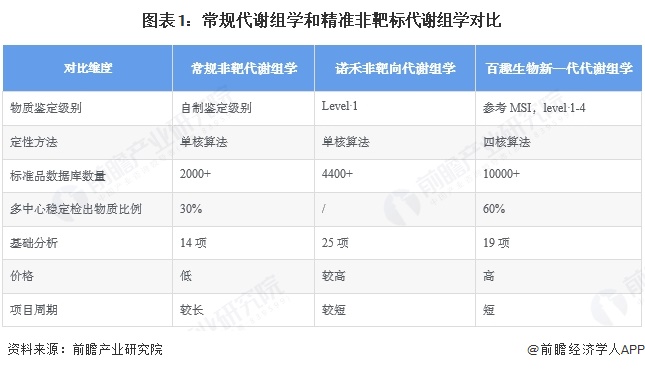
Core Insights - The global non-targeted metabolomics market is experiencing significant growth, with the market size expected to reach approximately $390 million by 2024, up from $190 million in 2021, reflecting a compound annual growth rate (CAGR) of 10.8% [8][6][13] - In China, the precision non-targeted metabolomics market is also expanding, with projected market sizes of $160 million in 2022, $200 million in 2023, and $240 million in 2024 [13][15] - The demand for precision non-targeted metabolomics is driven by advancements in biomedical research and the need for high-accuracy data in biomarker discovery and precision medicine [8][13] Market Overview - The global metabolomics market has grown from $1.72 billion in 2020 to an expected $2.59 billion by 2024, indicating a robust growth trajectory [6] - The precision non-targeted metabolomics segment is gaining traction, with its share of the overall metabolomics applications increasing from 10% in 2021 to an estimated 12% by 2024 [8] Competitive Landscape - Major players in the Chinese precision non-targeted metabolomics market include Baichu Bio, Zhongke New Life, and Nuohe Zhiyuan, indicating a concentrated market structure [15] - The new generation of metabolomics technology, particularly from Baichu Bio, shows significant advantages in substance identification levels and database size compared to traditional methods [2][3] Technological Advancements - The new generation metabolomics technology offers enhanced capabilities, including a larger standard substance database and improved detection stability across multiple centers [3] - The integration of high-throughput technologies and multi-omics approaches is expanding the applications of precision non-targeted metabolomics in various fields, including precision medicine and disease mechanism exploration [8][13]
A股收评 | 股指齐调整!大消费逆势活跃
智通财经网· 2025-05-15 07:19
Market Overview - The market experienced a weak fluctuation, with all three major indices closing down. The consumer sector showed resilience, while over 3,800 stocks declined [1][3] - Goldman Sachs raised the 12-month targets for the MSCI China Index and the CSI 300 Index to 84 points and 4,600 points, respectively, indicating potential upside of 11% and 17%. They maintain an overweight rating on Chinese stocks and suggest focusing on multiple themes for excess returns [1] Sector Performance - New hotspots emerged in the market, particularly in the ergot sulfur concept, with Chuaning Biological hitting a 20% limit up. Other sectors such as beauty care and medical aesthetics also saw significant gains [1] - The food and beverage sector rebounded in the afternoon, with several stocks, including Xiwang Food, hitting the limit up. The shipping and port sector continued its upward trend, with Nanjing Port achieving three consecutive limit ups [1] - The textile and apparel sector showed recovery, with Huafang Co. achieving six limit ups in eight days. Other sectors like coal, chemicals, synthetic biology, rare earths, and ST stocks also performed well [1] Individual Stock Movements - A total of 1,407 stocks rose, while 3,856 stocks fell, with 149 stocks remaining flat. There were 78 stocks hitting the limit up and 12 stocks hitting the limit down [3] - The Shanghai Composite Index fell by 0.68% to 3,380.82 points, with a trading volume of 461.3 billion yuan. The Shenzhen Component Index dropped by 1.62% to 10,186.45 points, with a trading volume of 688.7 billion yuan. The ChiNext Index decreased by 1.91% to 2,043.25 points [3] Fund Flow - Main funds focused on sectors such as chemical pharmaceuticals, small metals, and passenger vehicles, with notable net inflows into stocks like BYD, Chuaning Biological, and Shenghe Resources [4] Regulatory Developments - The China Securities Regulatory Commission (CSRC) is expediting the introduction of a comprehensive policy package to deepen reforms in the Sci-Tech Innovation Board and the ChiNext, aiming to enhance the inclusiveness and adaptability of the system [5] Industry Insights - The anti-aging industry is divided into medical and non-medical tracks, with the former focusing on basic medical research and the latter encompassing various fields such as sociology and artificial intelligence [2] - The China Academy of Sciences has made breakthroughs in the electro-catalytic reforming of waste plastic PET to produce biodegradable plastic PGA, with projected market demand reaching millions of tons [6] Economic Outlook - Analysts from Minsheng Securities suggest that China's asset resilience may be higher than that of overseas markets, with a focus on consumption sectors and undervalued financial stocks [9] - Huazhong Securities indicates that the market will continue to experience fluctuations until significant improvements in the macroeconomic fundamentals are observed [10]