伪智能

Search documents
是“神器”还是“摆设”?智能家居“伪智能”现象调查
Yang Guang Wang· 2026-01-21 02:38
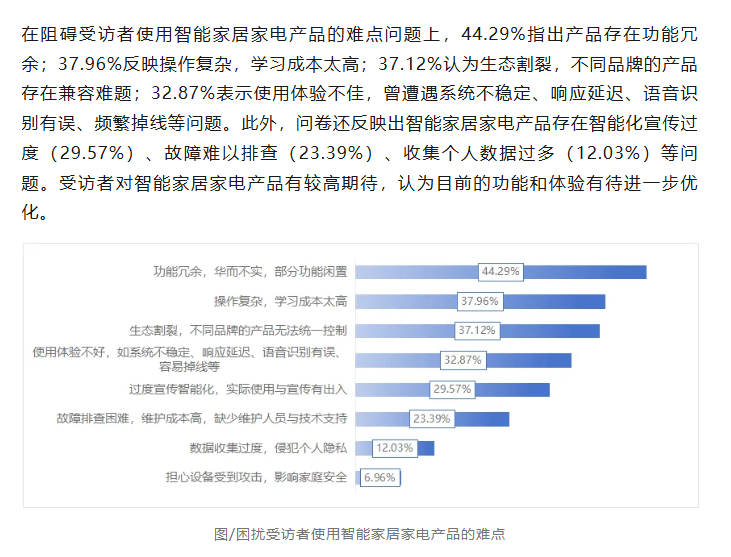
Core Insights - The rapid development of technology has led to increased consumer interest in smart home appliances, with sales data reaching new highs, but there are significant discrepancies between consumer experiences and marketing claims [1][5] - A recent consumer survey by the Jiangsu Consumer Protection Committee highlighted issues with "pseudo-intelligence" in smart home products, indicating a need for improved functionality and user experience [5][12] Consumer Feedback - Many consumers report that smart appliances, such as robotic vacuum cleaners, do not perform as advertised, with issues like poor obstacle avoidance and inability to return to charging stations [2][7] - Complaints about smart appliances often focus on exaggerated claims of intelligence and functionality, leading to dissatisfaction among users [2][5] Industry Challenges - The survey identified that 47.76% of complaints were related to robotic vacuum cleaners and washing machines, with 34.60% concerning smart washing machines and 28.12% regarding smart locks, indicating a significant prevalence of issues in these categories [7] - Compatibility issues among different brands' products require users to manage multiple apps, contradicting the convenience that smart home technology aims to provide [7][12] Regulatory Developments - The National Market Supervision Administration has approved new national standards for smart appliances, set to take effect in May 2026, which will define "smart capabilities" and establish a framework for product development and consumer understanding [11][12] - The new standards will categorize smart appliances into five levels of intelligence, providing clarity for consumers and setting benchmarks for manufacturers [11][12] Future Outlook - Experts believe that the smart home appliance industry is still in the functional development stage and has the potential for significant growth as technology evolves [8][12] - There is a call for the industry to focus on genuine user needs, improve core algorithms, and enhance service quality to transition from "pseudo-intelligence" to true smart technology [12]

功能夸大、操作复杂……这些“伪智能”家居需严监管
Xin Lang Cai Jing· 2026-01-21 01:01
Core Insights - The rapid development of technology has led to increased consumer interest in smart home appliances, but there are concerns regarding the actual performance versus advertised capabilities [1][2] - A significant portion of smart home products are identified as "pseudo-smart," with issues such as exaggerated functionalities and compatibility problems [2][3] Group 1: Consumer Feedback - A consumer in Shanghai reported that a robot vacuum purchased for over 4000 yuan did not meet the advertised smart capabilities, failing to return to its base and accurately identify areas [1] - Complaints about smart appliances, particularly robot vacuums and washing machines, are prevalent, with 47.76% of complaints related to these products [2] Group 2: Industry Standards and Regulations - The market regulatory authority has approved two national standards for smart appliances, set to be implemented on May 1, 2026, focusing on "smart capabilities" and "scenario effects" [3] - The establishment of a smart appliance certification system is essential for promoting industry health and addressing the "pseudo-smart" phenomenon [3] Group 3: Technical Challenges - Many smart home products are still in the "function" development stage and have not yet transitioned into a new AI ecosystem, leading to a reliance on marketing rather than actual technological advancement [3] - Compatibility issues among different brands require users to manage multiple apps, contradicting the convenience that smart home technology aims to provide [2][3]
别让“伪智能”钻空子
Hai Nan Ri Bao· 2026-01-16 01:36
Core Insights - The article highlights the issue of "pseudo-intelligence" in smart home appliances, where products like smart cooking machines and washing machines require frequent human intervention, failing to meet consumer expectations for automation [2] - The phenomenon reflects a trend among some companies prioritizing short-term gains over quality, leading to exaggerated marketing claims about their products' capabilities [2] - The lack of stringent industry standards allows subpar products to be labeled as "smart," necessitating improved regulations to protect consumers and ensure market integrity [2] Industry Analysis - The prevalence of "pseudo-intelligent" products indicates a growing market for smart home appliances, but also reveals significant consumer dissatisfaction due to unmet promises [2] - Companies are urged to adopt a more responsible approach to product development and marketing, focusing on genuine innovation rather than misleading claims [2] - Strengthening industry standards is essential for effective market regulation and to prevent inferior products from entering the market, thereby enhancing consumer trust [2]

“伪智能”需要真监管(纵横)
Ren Min Ri Bao· 2026-01-14 23:04
Group 1 - The core issue highlighted is the prevalence of "pseudo-intelligent" home appliances that fail to meet consumer expectations, often requiring frequent manual intervention and not delivering on their promised convenience [1][2] - The rapid development of artificial intelligence has led some manufacturers to exaggerate the capabilities of their products, misleading consumers and ignoring real user pain points [1] - The long-term viability of these "pseudo-intelligent" products is questioned, as they lack genuine technological innovation and may harm consumer trust while stifling market space for innovative companies [1] Group 2 - Strengthening regulatory measures is essential to combat the "pseudo-intelligent" phenomenon, with calls for improved laws and standards in the smart home appliance sector to ensure effective enforcement [1][2] - Companies are urged to adhere to ethical business practices, focusing on genuine product development and user needs rather than resorting to deceptive marketing tactics [1] - Consumers are encouraged to make informed purchasing decisions through legitimate channels and to support high-quality products rather than being swayed by the allure of "black technology" concepts [1][2]
智能家居市场规模超6800亿 行业如何破解“伪智能”困局
Bei Jing Shang Bao· 2025-08-11 14:36
Core Insights - Haier Smart Home and Jomoo Group have formed a strategic partnership to collaborate in four key areas: smart living, technology interconnectivity, scenario co-creation, and service ecosystem [1] - The smart home market in China is projected to reach a scale of 682.1 billion yuan by 2024, indicating significant growth potential [4][6] - Despite market expansion, the smart home industry faces challenges such as interoperability issues, complex user experiences, and the prevalence of "pseudo-smart" products [8][9] Market Expansion - The smart home market is becoming increasingly popular due to advancements in IoT, cloud computing, big data, and AI technologies, with the national technology contract transaction volume expected to reach 6.8 trillion yuan in 2024, growing by 11.2% year-on-year [3] - Companies like Kingboard Home and Beijing Lier are establishing new subsidiaries focused on smart technology, indicating a trend of businesses entering the smart home sector [1][4] Consumer Demand - There is a growing consumer interest in smart home products, particularly among younger demographics who seek convenience and enhanced living standards [6][7] - The Z generation, as digital natives, shows a high acceptance of smart products, shifting their consumption focus from functionality to emotional and experiential satisfaction [6][7] Challenges in the Industry - The smart home market is plagued by "pseudo-smart" products that do not deliver genuine smart functionalities, leading to consumer dissatisfaction and market confusion [8][9] - The lack of standardization and interoperability among different smart home ecosystems hinders consumer experience and market growth [9] Future Directions - To address the "pseudo-smart" issue, companies need to shift their focus from mere connectivity to creating seamless, intuitive user experiences that integrate various smart devices into cohesive living environments [9] - The future competition in the smart home market will revolve around ecosystem integration rather than individual product offerings, emphasizing the importance of creating comprehensive solutions for consumers [9]