
估值低位

Search documents
茅台再涨近2%!吃喝板块逆市猛攻,食品饮料ETF华宝(515710)上探1.84%!机构:白酒底部愈发清晰
Xin Lang Cai Jing· 2026-02-05 12:36
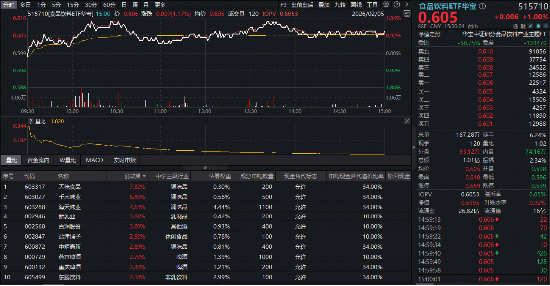
Core Viewpoint - The food and beverage sector continues to show strong performance, with the Huabao Food and Beverage ETF (515710) experiencing a notable increase, reflecting positive market sentiment in this industry [1][9]. Market Performance - The Huabao Food and Beverage ETF opened with a rapid rise, achieving an intraday peak increase of 1.84%, and closing with a 1% gain [1][9]. - Among the constituent stocks, consumer goods led the gains, with Tianwei Food surging over 7% and Qianhe Flavor rising more than 6%. Major liquor brands also performed well, with Kweichow Moutai increasing nearly 2% and Wuliangye and Yanghe also showing slight gains [1][9]. Industry Insights - According to the Hurun Research Institute, Kweichow Moutai ranks second in brand value at 795 billion yuan, maintaining its position as the top Chinese brand. The top three liquor brands are Kweichow Moutai, Wuliangye, and Guojiao 1573, with a total of 30 liquor brands listed [2][12]. - Open-source securities indicate that the demand for Moutai remains strong despite increased supply, with traditional wholesale prices rebounding to over 1,600 yuan, signaling a potential bottom for the liquor sector [3][11]. - The food and beverage sector is currently at a low valuation, with the price-to-earnings ratio of the ETF's underlying index at 20.93, positioned at the 11.74% percentile over the past decade, highlighting attractive long-term investment opportunities [3][11]. Future Outlook - Aijian Securities suggests that the liquor industry is entering a phase of rapid performance recovery, with demand expected to gradually improve as policy pressures ease and consumption expands [4][12]. - The industry is anticipated to see clearer trends in performance recovery, with leading companies increasing dividend payouts, enhancing their attractiveness for investment [4][12]. - The Huabao Food and Beverage ETF is recommended for investors looking to gain exposure to core assets in the food and beverage sector, with approximately 60% of its portfolio allocated to leading high-end and mid-range liquor stocks [5][12].


茅台动销逆势倍增!食品ETF(515710)接连回调,近10日获资金狂买超1.2亿元!左侧布局信号显现?
Xin Lang Ji Jin· 2025-09-29 02:47
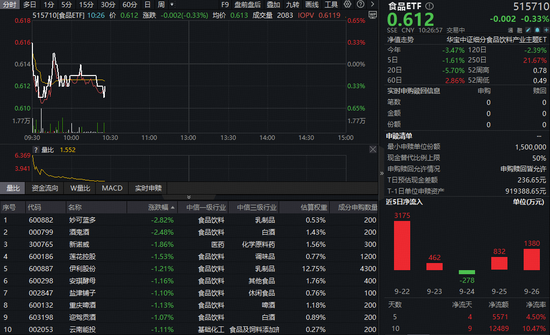
Group 1 - The food and beverage sector continues to experience a pullback, with the Food ETF (515710) showing a decline of 0.33% as of the latest update [1] - Major consumer goods and some liquor stocks have underperformed, with stocks like Miaokelan and Jiugui Liquor dropping over 2%, and others like Lianhua Holdings and Yili falling more than 1% [1] - Despite the overall market weakness, Kweichow Moutai has shown strong sales performance, with a significant increase in terminal sales in September, growing approximately 100% month-on-month and over 20% year-on-year [3] Group 2 - The Food ETF (515710) has seen substantial net subscriptions, with over 55 million yuan in net purchases in the last five trading days and more than 124 million yuan in the last ten days [3] - The current valuation of the food and beverage sector is at a low point, with the food index's price-to-earnings ratio at 20.21, indicating a favorable long-term investment opportunity [4] - Analysts suggest that the recent policy adjustments and the promotion of high-quality development may lead to a recovery in the low-end liquor and dining chains, with Moutai's prices expected to rebound [5] Group 3 - The third quarter has shown some improvement in liquor sales, although they still face year-on-year declines due to ongoing policy impacts on business consumption [6] - The food ETF (515710) primarily invests in leading high-end and mid-range liquor stocks, with about 60% of its portfolio allocated to these sectors [6]
茅台高层调研透露稳价决心!吃喝板块震荡下探,板块大跌背后暗藏良机?
Xin Lang Ji Jin· 2025-09-22 05:42
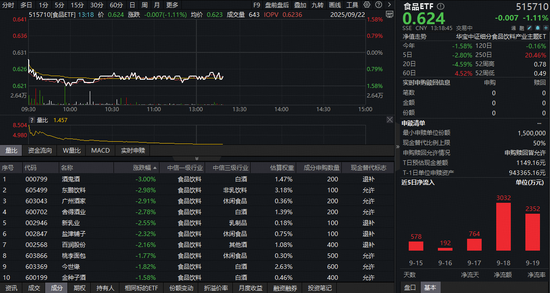
Group 1 - The food and beverage sector is experiencing a low-level fluctuation, with the Food ETF (515710) down by 1.11% as of the report time [1] - Key stocks in the sector, including liquor and consumer goods, are underperforming, with notable declines such as a 3% drop in JiuGuiJiu and over 2% declines in DongPeng Beverage and SheDe Liquor [1] - The overall valuation of the food and beverage sector is at a low point, suggesting a potential good time for investment, with the food ETF's price-to-earnings ratio at 20.74, which is in the 7.06% percentile of the last decade [3] Group 2 - Pacific Securities indicates that the liquor sector is at a dual bottom of fundamental stabilization and low valuation, with demand expected to show weak recovery as the Mid-Autumn Festival and National Day approach [3] - Xiangcai Securities suggests focusing on high-quality stocks with alpha opportunities, emphasizing the importance of innovation in categories, channels, and consumption scenarios [4] - The management of Moutai Group is committed to maintaining a price above 1800 yuan, emphasizing a balance between volume and price, which may positively impact the liquor market [1][4]
联合电话会议:如何看待大金融板块走势的分化?
2025-06-30 01:02
Summary of Conference Call on Financial Sector Trends Industry Overview - The banking sector is viewed as a core dividend asset, with strong consensus formed from 2022 to 2024, attracting long-term capital and showing an upward trend. Recent adjustments in monetary policy expectations and quarter-end rebalancing have led to a slight pullback in bank stocks [1][2]. Key Points on Banking Sector - **Dividend Yield and Stability**: The weighted average dividend yield of state-owned banks is 4.07%, making them attractive for capital allocation, especially from insurance funds. The decline in funding costs also opens up space for bank stock appreciation [1][7]. - **Profit Growth**: The overall profit growth rate for listed banks is projected at 2.35% for 2024, with stable growth expected in 2025, supported by self-owned bond gains, investment income, and provisions [1][9]. - **Net Interest Margin (NIM)**: The decline in NIM is expected to narrow, benefiting bank performance. For instance, the NIM fell by 9 basis points in Q1 2025, an improvement from a 13 basis point decline in Q1 2024, aided by deposit rate cuts [1][11]. - **Capital Flows**: Since 2025, there has been a continuous increase in southbound capital allocation to Hong Kong bank stocks, with public funds increasing their allocation to the financial sector in mainland markets to 3.75% [1][12][14]. Non-Bank Financial Sector Insights - **Divergence in Performance**: The non-bank financial sector has shown downward volatility, reflecting market uncertainties and economic weakness, contrasting with the upward trend in the banking sector [2][4]. - **Structural Market Conditions**: Structural rallies in the non-bank sector typically occur with rapid economic improvements or heightened expectations for financial market reforms. Current low valuations and significant underweight positions by institutions support potential rallies in this sector [4][16]. Market Dynamics and Future Outlook - **Market Sentiment**: Recent market movements, including three consecutive large bullish candles, have shifted perceptions of the non-bank sector, although immediate convergence with bank stocks is not anticipated [3][4]. - **Key Factors to Monitor**: Upcoming factors include tariff changes, interest rate expectations, domestic policy developments, and mid-year earnings reports, which are critical for market strategies moving forward [18][19]. - **Investment Recommendations**: Focus on sectors showing strong breakout potential, such as brokerage, lithium batteries, and military industries, while also considering semiconductor stocks that have shown signs of reversal [21][22]. Conclusion - The banking sector remains a stable and attractive investment due to its dividend yield and predictable earnings, while the non-bank sector may present opportunities if economic conditions improve. Continuous monitoring of capital flows and policy changes will be essential for navigating market uncertainties [1][5][19].