茅台

Search documents
春糖反馈暨食品饮料最新观点-白酒筑底-大众品关注成本传导
2026-03-30 05:15
Summary of Key Points from Conference Call Records Industry Overview - The white liquor industry is currently in a bottoming phase, with 2026 designated as a year for price stabilization, shifting focus towards C-end operations and repurchase cultivation [1][2][3] - The liquor market is experiencing a transition from competition for traffic to user operation and repurchase cultivation, with leading companies focusing on precise connections at main venues [2][3] Key Insights on White Liquor - Moutai's price has stabilized at 1,600 RMB, showing double-digit growth during the Spring Festival, while Wuliangye plans to maintain prices above 800 RMB in Q2 [1][2] - The white liquor sector is expected to see improved forecasts after financial report pressures are released by the end of April [1] - Inventory reduction and channel profit changes will be key focuses in the first half of 2026, with companies that adjust first likely to see marginal improvements in the second half [2][3] Performance of Major Brands - **Moutai**: Expected annual growth rate of 7.5% during the 14th Five-Year Plan, with a controlled sales volume providing a solid price floor [2] - **Wuliangye**: Achieved double-digit growth during the 2026 Spring Festival compared to 2024, with plans to reduce volume and tighten channel policies to push prices back up [4] - **Luzhou Laojiao**: Adopted a price maintenance strategy, with a decline in high-end product sales but stable low-end product performance [4] - **Fenjiu**: Experienced better-than-expected sales during the Spring Festival, with a focus on mid-range products showing resilience [5] Market Dynamics and Investment Strategies - The overall market sentiment among distributors is calm, with expectations of weak sales being accepted [3] - The investment strategy for the white liquor sector suggests continued pressure in March and April, with potential for recovery post-financial report disclosures [2][9] - Key recommended stocks include Moutai and Wuliangye, with Fenjiu also being highlighted for its potential rebound [10] Other Beverage and Food Industry Insights - The dairy sector is seeing a recovery in demand, with moderate price increases benefiting leading companies like Yili and Mengniu [1][13] - The restaurant supply chain is benefiting from improved demand, with companies like Haitian and Yihai showing double-digit growth in early 2026 [1][12] - The beer sector remains stable, with Yanjing Beer showing growth driven by its U8 product [10][11] Conclusion - The white liquor industry is on the verge of recovery, with key players like Moutai and Wuliangye positioned to benefit from price stabilization and improved market conditions in 2026 [9][10] - The overall investment landscape in the beverage and food sectors is promising, with specific focus on companies that can adapt to changing consumer demands and market conditions [12][20]



食品饮料行业周报:茅台代售政策落地,坚定看好公司市场化改革-20260316
Shenwan Hongyuan Securities· 2026-03-16 12:13
Investment Rating - The report maintains a positive outlook on the food and beverage sector for 2026, particularly focusing on cyclical opportunities in the liquor and restaurant supply chain [3][7]. Core Views - The report indicates a recovery in demand for various sub-sectors, including liquor, restaurant chains, dairy, convenience foods, and meat products, with a cautious optimism about the sustainability of this recovery [3][7]. - The liquor sector is expected to stabilize, with Moutai prices maintaining above 1500 yuan, indicating a potential turning point in the current cycle [3][7]. - The industry is anticipated to experience consolidation, with a shift from "big fish eating small fish" to "big fish eating big fish," leading to significant differentiation among listed companies [3][7]. - The report highlights two types of companies to watch: those capable of deep national expansion and those with regional consolidation potential [3][7]. Summary by Sections Food and Beverage Weekly Insights - The food and beverage sector saw a 0.27% increase last week, with liquor stocks outperforming the market [6]. - The liquor sector, particularly Moutai, is expected to maintain stable pricing, with recent prices reported at 1570 yuan for loose bottles and 1605 yuan for boxed products [8][21]. Liquor Sector - Moutai's pricing strategy includes a new consignment policy aimed at stabilizing prices and reducing financial pressure on distributors [8][21]. - The report emphasizes the importance of this policy in enhancing channel efficiency and adapting supply and demand [8][21]. Consumer Goods Sector - The consumer goods sub-sector is showing structural improvements, with a shift in competition from price to quality, leading to a gradual balance in supply and demand [3][7]. - Companies with cyclical attributes and long-term growth potential are expected to recover, with recommendations including Anjui Foods, Hai Tian Flavoring, and Yili Group [3][7]. Market Performance - The food and beverage industry outperformed the Shenwan A index by 0.77 percentage points, with beer and liquor sectors leading the performance [36][38]. - The report notes that the overall valuation for the food and beverage sector is at a dynamic PE of 19.55x, indicating a premium of 13% [21].
食品饮料行业周报:批价维持合理,估值吸引力提升-20260307
Shenwan Hongyuan Securities· 2026-03-07 14:57
Investment Rating - The report maintains a positive outlook on the food and beverage sector for 2026, particularly focusing on cyclical opportunities in the liquor and restaurant supply chain [3][8]. Core Insights - The report indicates a recovery in demand for various sub-sectors including liquor, restaurant chains, dairy, convenience foods, and meat products during January and February, with a cautious optimism for sustained recovery [3][8]. - The liquor sector is expected to stabilize after a high price adjustment, with Moutai prices maintaining above 1500 RMB, indicating a potential turning point in the current cycle [3][9]. - The industry is experiencing a trend of consolidation, with larger companies gaining market share at the expense of smaller ones, leading to a bifurcation in performance among listed companies [3][8]. - Key recommendations for liquor include Moutai, Luzhou Laojiao, Shanxi Fenjiu, and Wuliangye, while for consumer goods, companies like Anjijia, Haitian Flavoring, and Yili are highlighted [3][8][10]. Summary by Sections 1. Weekly Perspective on Food and Beverage - The food and beverage sector saw a decline of 2.48% last week, with liquor down 3.32%, underperforming the broader market [7]. - The top performers in the sector included Zhongxin Niya and New Dairy, while the biggest losers were ST Yanshi and Jiu Gui Jiu [7]. 2. Market Performance of Food and Beverage Sub-sectors - The report notes that the food and beverage industry underperformed the Shenwan A index by 0.14 percentage points, with beer and seasoning outperforming the index [45]. 3. Liquor Sector Analysis - Moutai's price for loose bottles is reported at 1590 RMB, with a weekly decrease of 60 RMB, while the price for a case is 1610 RMB, down 70 RMB [9][23]. - The overall sales volume for the liquor industry during the Spring Festival is estimated to have decreased by 10%-20% year-on-year, slightly better than market expectations [9]. - High-end liquor brands, particularly Moutai, are expected to see significant sales growth, with Moutai's sales projected to increase by over 30% year-on-year during the Spring Festival [9]. 4. Consumer Goods Sector Analysis - The consumer goods sub-sector is showing structural improvements, with competition shifting from price to quality, and a gradual balance in supply and demand [10]. - Key recommendations include Anjijia, Tianwei Food, and Haitian Flavoring, with expectations of double-digit revenue growth for Anjijia due to seasonal effects [10][11]. 5. Dairy Sector Insights - The dairy supply-demand landscape is expected to improve, with long-term growth potential in processed products and low-temperature milk [11]. - Companies like Yili and New Dairy are recommended, with a focus on the domestic replacement potential for processed dairy products [11]. 6. Cost and Pricing Trends - The average price of fresh milk is reported at 3.03 RMB per kilogram, showing a year-on-year decrease of 1.9% [24][43]. - The report highlights the current valuation levels of the food and beverage sector, with a dynamic PE of 19.47x and a premium rate of 12% [24].



食品饮料行业周报 20260223-20260227:节后茅台批价保持坚挺,继续看好白酒及餐饮链头部标的-20260301
Shenwan Hongyuan Securities· 2026-03-01 13:19
Investment Rating - The report maintains a positive outlook on the food and beverage sector for investment opportunities in 2026, focusing on cyclical white liquor and restaurant supply chains [7][8]. Core Insights - The white liquor sector is expected to see a recovery, with Moutai prices stabilizing in the first quarter and maintaining strength post-Spring Festival. The industry is entering a phase of consolidation, with a trend of larger companies acquiring smaller ones. Despite a shrinking overall market, leading companies are anticipated to have growth potential [7][8]. - The report highlights two types of companies to watch: those capable of deep national expansion and those with regional consolidation opportunities. If the fundamentals recover as expected, a dual boost in valuation and performance is anticipated by the end of 2026 to 2027 [7][8]. - The consumer goods sub-sector is showing structural improvement, with competition shifting from price to quality. The supply-demand balance is gradually improving, and food CPI is expected to improve quarterly. Companies with cyclical attributes and low valuations are likely to see recovery [7][9]. Summary by Sections 1. Food and Beverage Weekly Insights - The food and beverage sector experienced a decline of 1.54% last week, with the liquor segment down 2.26%, underperforming the market [6][31]. - The report notes that the overall sales volume in the liquor industry during the Spring Festival decreased by 10%-20% year-on-year, which was slightly better than market expectations [8]. 2. Market Performance of Food and Beverage Sectors - The report indicates that the food processing, beer, and seasoning sectors underperformed relative to the market index, with white liquor and beverage dairy sectors showing significant declines [31][32]. - The report emphasizes the importance of monitoring leading brands in the liquor sector, as they are expected to see a turnaround in fundamentals [8][9]. 3. Key Recommendations - For the liquor sector, key recommendations include Moutai, Luzhou Laojiao, Shanxi Fenjiu, and Wuliangye, with a focus on Jinhuijiu [7][8]. - In the consumer goods sector, recommended companies include Anjijia Food, Qianhe Flavoring, Tianwei Food, and Yili Group, among others [7][9].


食品饮料行业周报:节后茅台批价保持坚挺,继续看好白酒及餐饮链头部标的-20260301
Shenwan Hongyuan Securities· 2026-03-01 12:41
Investment Rating - The report maintains a positive outlook on the food and beverage sector for 2026, particularly focusing on cyclical opportunities in the liquor and restaurant supply chain [2][6]. Core Insights - The liquor sector is expected to see a recovery, with Moutai prices stabilizing in the first quarter, indicating a turning point in the current cycle. The report anticipates a concentration trend in the industry, favoring leading companies capable of national expansion and those with regional consolidation potential [2][6]. - The report highlights a structural improvement in the mass food sub-sector, with competition shifting from price to quality, and a gradual balance in supply and demand. It predicts a sequential improvement in food CPI [2][6][8]. Summary by Sections Liquor Sector - As of March 1, Moutai's bottle price is 1650 RMB, and the case price is 1680 RMB, remaining stable post-Spring Festival. The overall sales volume for the liquor industry during the Spring Festival is expected to decline by 10%-20% year-on-year, slightly better than market expectations [7]. - The report notes significant differentiation and concentration in the market, with high-end liquor performing exceptionally well. Moutai's sales volume is projected to increase by over 30% year-on-year during the Spring Festival, while Wuliangye is expected to see a 5%-10% increase [7]. - The industry is entering a significant destocking phase, with leading brands' inventory levels notably lower than the previous year. The report concludes that the fundamentals for top brands (Moutai, Wuliangye, Luzhou Laojiao, and Shanxi Fenjiu) have bottomed out [7]. Mass Food Sector - The mass food sub-sector is showing structural improvements, with companies expected to recover due to their cyclical attributes and low valuations. Key recommendations include companies in the restaurant supply chain, such as Anjijia Food, Qianhe Flavoring, and Tianwei Food [8][9]. - The dairy industry is anticipated to see further optimization in supply and demand dynamics, with long-term growth potential in deep-processed products and low-temperature milk. Recommended companies include Yili and New Dairy [9]. Market Performance - The food and beverage sector underperformed the market, with a decline of 1.54% last week, while the liquor segment fell by 2.26%. The report ranks the food and beverage sector 29th among 31 sub-sectors [5][28]. - The report provides a detailed analysis of various sub-sectors, indicating that the liquor sector has faced significant challenges, with white liquor underperforming the market by 5.06 percentage points [28].
食品饮料周观点:春节消费信号积极,关注啤酒接力修复
GOLDEN SUN SECURITIES· 2026-03-01 08:24
Investment Rating - The report maintains an "Increase" rating for the food and beverage industry, indicating a positive outlook for the sector [4]. Core Insights - The report highlights a positive consumption signal during the Spring Festival, with a focus on the recovery of the beer sector as it follows the recovery of the dining chain [1][3]. - The white liquor sector is expected to see gradual improvement, with the Spring Festival sales providing a solid foundation for the year ahead [2]. - The report emphasizes the importance of monitoring core product pricing trends and the quarterly performance of liquor companies in 2026 [2]. Summary by Sections White Liquor - The Spring Festival sales are stabilizing and improving, with a focus on the performance of leading brands like Moutai and Wuliangye [2]. - The report suggests that the white liquor sector is currently undervalued, presenting a good opportunity for investment [2]. - Key recommendations include short-term investments in brands with strong demand during the Spring Festival and long-term investments in leading companies [1][2]. Beer and Beverage - The beer sector is recommended for investment, with a focus on companies like Yanjing Beer and Zhujiang Beer, which are expected to benefit from the recovery of the dining chain [3]. - Zhujiang Beer reported a revenue of 5.88 billion yuan in 2025, showing a year-on-year increase of 2.56%, indicating a stable performance [3]. - The beverage sector is competitive, with companies encouraged to innovate and expand their product offerings to capture market share [3]. Consumer Trends - The report notes a significant increase in consumer spending during the Spring Festival, with major retail enterprises reporting a 24% year-on-year increase in daily sales [7]. - The overall consumer confidence is expected to continue improving post-holiday, which may benefit sectors like dairy and dining [7].
2026年白酒行业:春节白酒动销全景——茅五亮眼,结构分化-中信建投
Sou Hu Cai Jing· 2026-02-26 15:31
Core Insights - The core keywords for the Chinese liquor industry during the 2026 Spring Festival are "differentiation" and "bottoming out," with overall sales slightly declining but in line with expectations. Leading liquor companies face reduced risks, while cross-regional consumer movement and retail dining data show strong performance, suggesting investment opportunities in leading and regional liquor companies [1][6]. Group 1: Industry Performance - The overall sales performance of the liquor industry during the Spring Festival showed slight decline but was expected, with leading brands like Moutai and Wuliangye exceeding expectations [2][6]. - The average daily cross-regional movement increased by 5.56% year-on-year in the first 20 days before the Spring Festival, indicating a positive consumer base [1][10]. - Key retail and dining enterprises reported an average daily sales increase of 8.6% year-on-year during the first four days of the holiday, supporting the liquor consumption environment [1][12]. Group 2: Differentiation in the Market - The differentiation in the liquor market is evident in four aspects: brand and price differentiation, pricing strategy differentiation, consumption scenario differentiation, and clear signs of industry bottoming out [2][6]. - Moutai and Wuliangye showed strong sales performance, while mid-tier brands faced pressure, with the segment below 300 yuan showing structural growth [2][21]. - Pricing strategies varied, with Moutai and Wuliangye opting for price reductions to maintain market share, while brands like Guojiao and Fenjiu chose to maintain prices to enhance brand value [2][25]. Group 3: Regional Insights - Grassroots visits to eight cities confirmed the differentiation characteristics, with markets like Chengdu and Dazhou showing strong performance for leading brands, while regions like Zaozhuang and Anqing highlighted the dominance of local brands [2][29]. - In Beijing, Moutai and Fenjiu performed well, with strong demand for bottled liquor, while in Xinjiang, local brand Yilite dominated the market under 300 yuan [2][29]. - Each region exhibited a pattern of strong performance for high-end brands like Moutai and Wuliangye, pressure on mid-tier brands, and stability in the lower price segment [2][21].



茅台不够卖,中间档卖不动,今年春节,没人再为“面子酒”买单了?
Sou Hu Cai Jing· 2026-02-25 09:32
Core Insights - The Chinese liquor industry is undergoing a significant transformation, moving from "symbolic consumption" to "experiential value" in consumer behavior [3] Group 1: Market Feedback - High-end liquor, particularly Moutai, is experiencing a supply shortage, with prices increasing from 1500 yuan to 1700 yuan due to high demand [2] - The 100-300 yuan price range for "popular liquor" is seeing structural growth, with products like Tianzhilan and Langpai Tequ being sold out in stores [2] - The mid-range 300-800 yuan segment is struggling, with sales declining by 14%-20% as business banquets have not fully returned and consumers find it unappealing [2] Group 2: Consumer Behavior Changes - The shift in consumer spending indicates that liquor must be consumed rather than just purchased for status, as evidenced by a 400% increase in the opening rate of Qinghua Lang during the Spring Festival [3] - Instant retail services like Meituan and JD Daojia are becoming the norm, with consumers opting for quick deliveries rather than bulk purchases [3] - The year 2026 is viewed as the beginning of a long bottoming process for the liquor industry, reflecting a return to the true essence of liquor consumption [3]
春节,关税与AI
2026-02-25 04:14
Summary of Conference Call Notes Company/Industry Involved - The discussion revolves around the macroeconomic environment, particularly focusing on the Chinese market and its interactions with global markets, including the U.S. and Japan. Key Points and Arguments Macroeconomic Changes - The U.S. Supreme Court's decision to overturn Trump's tariffs based on the EPA has created a notable impact, although the overall market reaction has been muted due to prior expectations of such a ruling [1][7][11]. - The performance of major asset classes during the Spring Festival period showed that commodities, particularly oil and gold, performed relatively well, while the Hong Kong stock market, especially the Hang Seng Tech Index, lagged significantly [1][2][3]. Market Performance - The U.S. stock market, particularly small-cap stocks, has shown resilience, while tech stocks have struggled to regain their footing after recent adjustments [2][3]. - The Hong Kong market has been characterized by a significant underperformance of tech stocks, attributed to concerns over the differentiation between new and old technology companies [2][3]. Capital Flows - There has been a notable inflow of foreign capital into the Chinese market, particularly from the Asia-Pacific region, although this has not been reflected in the performance of the Hong Kong market [4][5]. - The inflow of foreign capital has been sustained for six consecutive weeks, indicating a growing preference for Chinese assets, despite a slowdown in the pace of inflows recently [4][5]. U.S. Tariff Policies - The recent changes in U.S. tariff policies, particularly the Supreme Court's ruling, have led to a slight decrease in the overall tariff rate, which is now approximately 13.4% [11][12]. - The implications of these tariff changes are complex, as they may lead to further negotiations and adjustments in trade policies, creating uncertainty in the market [9][12]. Economic Indicators - U.S. GDP growth for the fourth quarter was reported at an annualized rate of 1.4%, significantly lower than the previous quarter's 4.4%, influenced by government shutdowns and trade dynamics [17][18]. - The PCE data released showed slight inflationary pressures, but overall, inflation is not expected to pose a significant threat to the Federal Reserve's monetary policy [19][20]. Chinese Economic Outlook - The Chinese financial data indicates a mixed picture, with M1 growth reflecting a recovery in the capital market, but overall credit demand remains weak [24][25]. - Consumer spending during the Spring Festival showed moderate growth, with expectations for continued recovery, but structural issues in consumer spending power remain [26][27]. Future Considerations - The upcoming Two Sessions and the visit from Trump are anticipated to be critical events that could influence market dynamics and policy directions [28]. - The overall outlook for the Hong Kong market remains cautious, with expectations of a potential slowdown in the credit cycle in the second quarter of the year [25][29]. Other Important but Possibly Overlooked Content - The differentiation in performance between various sectors, particularly in technology, highlights the need for investors to focus on specific companies and their competitive positioning within the market [30][31]. - The discussion emphasizes the importance of understanding the underlying economic fundamentals rather than solely relying on capital flow data, which can be lagging indicators [6][19]. This summary encapsulates the key insights and data points from the conference call, providing a comprehensive overview of the current market landscape and future expectations.
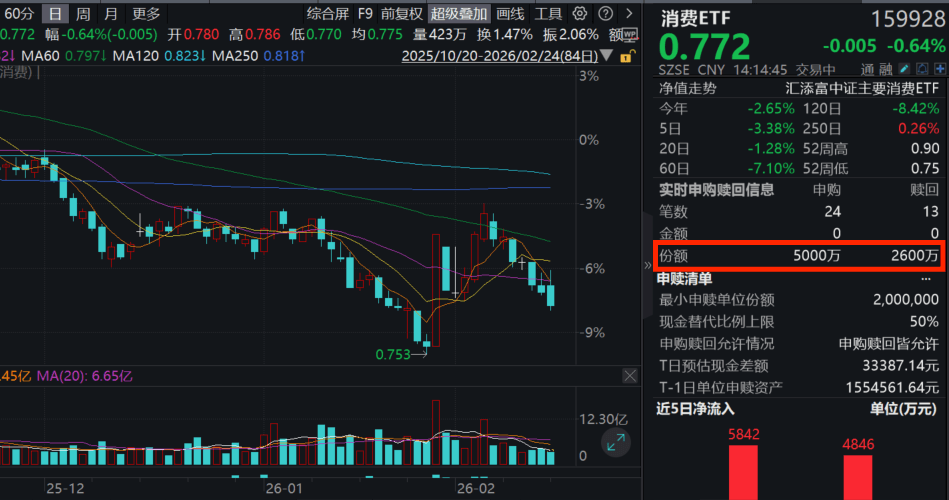
春节消费开门红!消费ETF(159928)冲高回落,盘中获2400万份净申购!机构:春节白酒反馈略好于预期
Xin Lang Cai Jing· 2026-02-24 06:57
Core Viewpoint - The consumer sector experienced a strong start during the Spring Festival, with significant growth in consumption demand, particularly in services and travel, despite some weaknesses in the film box office [3][6][9]. Group 1: Market Performance - The leading consumer ETF (159928) initially rose over 1% but later fell by 0.64%, with a trading volume exceeding 360 million yuan and a net subscription of 24 million shares during the day [1]. - The consumer ETF's latest scale surpassed 22.3 billion yuan, maintaining a leading position among its peers [1]. Group 2: Consumption Trends - The Spring Festival saw a notable increase in travel and service consumption, with a record number of cross-regional movements expected to reach 9.5 billion people, marking a historical high [6][7]. - Restaurant bookings for the New Year's Eve dinner increased by 105% year-on-year, with significant growth in demand from lower-tier cities [7]. - The demand for pre-packaged food is accelerating, driven by new national standards and retail channel transformations [8]. Group 3: Alcohol Consumption Insights - High-end liquor brands, particularly Moutai, showed better-than-expected performance, with sales expected to increase by 10-20% year-on-year during January and February [9][10]. - The overall liquor market is experiencing a recovery, with high-end brands gaining market share while lower-tier brands face challenges [10]. Group 4: Policy and Economic Environment - The government is implementing zero-tariff measures for 53 African countries and enhancing support for rural enterprises to access multi-level capital markets [3]. - The market is expected to see a positive start post-Spring Festival, with historical trends indicating a strong "Spring Festival effect" in A-shares [3].