住房公积金制度改革

Search documents
“沉睡”的10万亿元公积金
吴晓波频道· 2026-03-28 00:21
Core Viewpoint - The article discusses the ongoing reforms of China's housing provident fund system, highlighting the need for increased flexibility and broader usage of the fund beyond just housing purchases, as well as addressing the challenges faced by users in different regions [2][14]. Group 1: Historical Context and Current Issues - The housing provident fund system was established in 1991 in Shanghai and officially recognized in 1999, aimed at providing housing security through mandatory savings and low-interest loans [4][8]. - Over the years, the fund has become less effective, with many users unable to utilize their savings for purposes other than housing, leading to a significant amount of idle funds [8][11]. - As of 2024, 46.10% of contributors have withdrawn their provident fund, indicating that over half of the contributors do not utilize their savings [11][13]. Group 2: Recent Reforms and Policy Changes - In 2023, over 30 regions in China have optimized their housing provident fund policies, focusing on making the fund more accessible and useful for various needs [16][17]. - Key reforms include increasing loan limits, lowering interest rates, and allowing for more flexible usage of the funds, such as for property maintenance and other living expenses [17][21]. - For example, Shanghai has raised the maximum loan limit for first-time homebuyers to 240 million yuan, with potential increases under certain conditions [17][19]. Group 3: Future Directions and Recommendations - There are suggestions to expand the fund's usage to include broader living expenses, while still maintaining its primary focus on housing [21][22]. - Proposals include integrating the provident fund with pension accounts to enhance its utility and investment options, although this requires careful consideration of liquidity and tax implications [23][24]. - The article emphasizes the importance of improving the equity of the provident fund system, particularly for flexible employment sectors, and suggests that reforms should consider the operational costs for businesses [27][28].


一个月8地!广东多地密集优化住房公积金政策
券商中国· 2026-03-27 00:56
Core Viewpoint - Guangdong Province is actively promoting housing provident fund policy measures to support housing consumption, with eight cities implementing new policies in the past month [1][3]. Group 1: Policy Measures - The measures include increasing housing provident fund loan limits, enhancing support for families with multiple children, and easing the application conditions for converting commercial housing loans to provident fund loans [2][3]. - Specific adjustments in loan limits include: - Huizhou: maximum loan of 900,000 yuan for dual contributors and 500,000 yuan for single contributors - Jiangmen: maximum loan of 800,000 yuan for dual contributors and 400,000 yuan for single contributors - Yangjiang: maximum loan of 750,000 yuan for dual contributors and 500,000 yuan for single contributors - Zhaoqing: maximum loan of 800,000 yuan for dual contributors and 500,000 yuan for single contributors - Qingyuan: maximum loan of 700,000 yuan for dual contributors and 500,000 yuan for single contributors [4]. Group 2: Additional Support for Families - Multiple cities are implementing additional policies for families with multiple children, such as: - Huizhou: loan limit can increase by 20%, reaching up to 1,080,000 yuan - Jiangmen: maximum loan for families with multiple children purchasing their first home can reach 1,400,000 yuan - Yangjiang: loan limit for purchasing prefabricated buildings can increase by 20% - Zhaoqing: families with multiple children can add up to 150,000 yuan to the maximum loan limit, reaching 950,000 yuan - Qingyuan: families with multiple children can increase the loan limit by 100,000 yuan, with a maximum of 960,000 yuan [4]. Group 3: National Trends - Over 30 regions nationwide have optimized housing provident fund policies this year, with a focus on adjusting loan policies to promote housing consumption [5]. - The trend of expanding the use of provident fund withdrawals to cover various housing-related expenses is expected to enhance the efficiency of fund usage and lower housing costs for residents [5]. Group 4: Future Expectations - The government work report emphasizes the need to deepen the reform of the housing provident fund system, with expectations for more detailed policies by 2026, including flexible adjustments to contribution policies and improved fund utilization efficiency [6].

一个月8地!广东多地密集优化住房公积金政策
证券时报· 2026-03-26 14:48
Core Viewpoint - Guangdong province is actively promoting housing provident fund policy measures to support housing consumption and reduce the financial burden on contributors, with eight cities implementing new policies in the past month [1][3]. Group 1: Policy Adjustments - Eight cities in Guangdong, including Shenzhen, Huizhou, and Zhongshan, have released new housing provident fund policies aimed at increasing loan limits and supporting families with multiple children and those purchasing green or prefabricated buildings [1][3]. - Shenzhen has revised its housing provident fund management regulations to allow individual entrepreneurs and freelancers to contribute and use the fund, with a voluntary contribution cap of 12% [3][4]. Group 2: Loan Limits and Support - Huizhou has raised the maximum housing provident fund loan limit for first-time homebuyers to 900,000 yuan for dual contributors and 500,000 yuan for single contributors [4]. - Other cities have also adjusted their loan limits, with Jiangmen allowing up to 800,000 yuan for dual contributors and 400,000 yuan for single contributors, and Yangjiang increasing the limit to 750,000 yuan for dual contributors [4]. - Additional support measures include increased loan limits for families with multiple children and specific incentives for purchasing green buildings, with some cities allowing loan amounts to be raised by up to 20% [4]. Group 3: National Trends - Over 30 cities nationwide have optimized their housing provident fund policies this year, with a focus on expanding the range of uses for the fund, such as covering taxes and property management fees [6]. - The trend of broadening the use of housing provident funds is expected to enhance efficiency and lower housing costs, thereby stimulating housing consumption [6]. - The government has indicated a commitment to deepening housing provident fund reforms, with expectations for more detailed policies by 2026 [6].

10.9万亿元公积金大松绑
经济观察报· 2026-03-24 10:06
Core Viewpoint - The article discusses the recent reforms in the housing provident fund system across various cities in China, highlighting the challenges and limitations that prevent it from becoming the main tool for housing mortgages despite increased loan limits and expanded usage scenarios [1][2]. Group 1: Policy Adjustments - On March 16, the Shenzhen government issued new regulations allowing flexible employment individuals to contribute to and utilize the housing provident fund, with voluntary increases in personal contribution rates [2]. - Multiple cities, including Shanghai and Chengdu, have raised the maximum loan amounts for housing provident fund loans, with Shanghai's limit reaching 240 million yuan, potentially up to 324 million yuan for certain families [5]. - The reforms are driven by the central government's call for deepening housing provident fund system reforms, as stated in the 2025 Central Economic Work Conference and the 2026 government work report [2]. Group 2: Expanded Usage Scenarios - The reforms have broadened the scenarios in which the provident fund can be used, including property fees, heating fees, and renovation costs, with Ordos becoming one of the cities with the widest coverage for fund withdrawals [6][7]. - New policies in cities like Fuzhou and Chengdu have introduced additional withdrawal scenarios, such as for home renovations and major medical expenses, enhancing the fund's utility for families [6]. Group 3: Coverage and Accessibility - The reforms aim to include flexible employment individuals, allowing self-employed and freelance workers to participate in the provident fund system, with contribution rates potentially rising to 12% [8]. - The reforms also emphasize intergenerational support mechanisms, allowing family members to assist each other in fund withdrawals for housing-related expenses [8]. Group 4: Efficiency and Challenges - Despite the increased nominal loan limits, actual loan amounts remain constrained by factors such as account balance, contribution duration, and repayment ability, limiting the fund's role in housing mortgages [12][13]. - The article notes that the overall efficiency of the provident fund has been limited due to strict approval processes and long loan disbursement cycles, with a current balance of 10.9 trillion yuan but a low loan issuance rate of 74% [11][17]. Group 5: Historical Context and Future Outlook - The housing provident fund system has evolved over three decades, initially established to support housing market reforms and has since facilitated significant housing loans and withdrawals [15][16]. - The ongoing reforms are expected to release over 500 billion yuan in funds, potentially stimulating consumption and addressing the issue of underutilized funds within the system [18].

超30地密集调整公积金政策
21世纪经济报道· 2026-03-12 11:09
Core Viewpoint - The housing provident fund policy is entering a significant adjustment window, with the government emphasizing the need for reform after a decade, aiming to activate over 10 trillion yuan in dormant funds to stabilize the real estate market and facilitate the transition of industry dynamics [1][5][11]. Group 1: Policy Adjustments - More than 30 regions in China have adjusted their housing provident fund loan policies this year, focusing on increasing loan support, expanding usage scenarios, and enhancing family mutual assistance functions [1][8]. - Chengdu announced on March 10 that it plans to raise the maximum loan limit for housing provident funds and phase out restrictions on the number of loans [1][11]. - Fuzhou has expanded the scope of interest rate discounts for provident fund loans and included inter-city provident fund loans in its support policies [1][11]. Group 2: Strategic Positioning - Analysts suggest that the key to breaking through the current limitations of the provident fund system lies in redefining its strategic positioning in response to fundamental changes in housing supply and demand [2][9]. - The current system has primarily focused on supporting home purchases, but there is a growing need to extend its functions to cover a broader range of housing consumption scenarios, including rental support and home improvement [9][10]. Group 3: Challenges and Recommendations - Despite a substantial accumulated balance of 10.9 trillion yuan in housing provident funds, the utilization efficiency remains low due to high thresholds and restrictions on usage [6][10]. - Recommendations include revising the Housing Provident Fund policy at the national level to remove restrictive regulations, such as the minimum down payment ratio and limitations on loan types for multi-child families [10][11]. - Establishing a dynamic interest rate adjustment mechanism and promoting inter-regional mutual recognition of loans are also suggested to enhance the operational efficiency of the provident fund [10].

事关1.7亿人的钱包,公积金这次为何被单独点名
经济观察报· 2026-03-05 09:45
Core Viewpoint - The reform of the housing provident fund system is crucial for addressing the housing needs of over a billion people, aiming to improve the living conditions of countless families [1]. Summary by Sections Historical Context - The housing provident fund system in China began in the 1990s, with Shanghai introducing it in 1991, followed by other cities in 1992, and a nationwide implementation starting in 1994 [2]. - The first mention of the provident fund in government work reports occurred in 1997, with subsequent mentions in 2007-2009 highlighting the need for improved management and oversight [4][5][6]. Recent Developments - The 2026 government work report explicitly calls for "deepening the reform of the housing provident fund system," a phrase not seen in the past decade [2]. - The emphasis on the housing provident fund has increased significantly, with multiple mentions in recent central economic meetings and housing construction conferences [8]. Current Status and Challenges - As of 2024, the total contributions to the housing provident fund exceeded 3.6 trillion yuan, with over 176 million contributors, and the total balance reached 10.9 trillion yuan [9]. - The current loan limits of around 120,000 yuan are insufficient for the high property prices in first- and second-tier cities, especially as commercial loan rates have decreased, reducing the competitive advantage of the provident fund loans [9]. Changing Housing Needs - There is a shift in housing demand from merely having a home to the quality of housing, necessitating an expansion of the provident fund's applicability beyond just home purchases to include rental, renovation, and improvement of living conditions [10][11]. - In 2024, 22.57 million people withdrew funds for rental purposes, with a total of 272 billion yuan withdrawn, indicating a growing trend in using the fund for rental needs [11]. Inclusion of New Employment Forms - The reform must also address the needs of flexible employment workers, such as delivery personnel, who often cannot participate in traditional provident fund contributions [11]. - Pilot programs have been initiated in several cities to allow flexible employment workers to contribute to the provident fund, with over 1 million participants by the end of 2024 [12]. Key Focus Areas for Reform - The reform will focus on increasing loan limits, expanding the coverage of contributors, enriching the usage scenarios of the fund, and improving the efficiency of fund withdrawals [12].

时隔11年政府工作报告再提公积金改革
第一财经· 2026-03-05 07:47
Core Viewpoint - The article emphasizes the recent reforms in the housing provident fund system in China, highlighting its significance in supporting housing demand and stimulating consumption, particularly in the context of the government's focus on real estate stability and high-quality development [3][4]. Summary by Sections Housing Provident Fund Reforms - The housing provident fund has been mentioned twice in the government work report this year, marking a significant focus on its reform since it was last included in 2015 [3]. - The central economic work conference at the end of last year called for deepening the reform of the housing provident fund system, which is now seen as crucial for stabilizing the real estate market [3][4]. Financial Impact and Policy Adjustments - Recent reforms are expected to release approximately 515.1 billion yuan in funds, which could theoretically boost consumption by 360.6 billion yuan and increase the consumption growth rate by 0.7 percentage points [3][8]. - In 2024, the total amount of housing provident fund contributions reached 36,317.83 billion yuan, with 8,127.04 million people withdrawing 27,654.84 billion yuan [4]. Local Policy Initiatives - Various cities have implemented new policies to optimize housing provident fund loans, such as increasing loan limits and supporting families with multiple children [5]. - For instance, Shanghai has adjusted its housing provident fund policies to enhance loan amounts and conditions, while Tianjin has raised the maximum loan limit for families with two or more children [5]. Expert Recommendations for Future Reforms - Experts suggest that the housing provident fund should continue to support home purchases and explore diversified uses to enhance its effectiveness in meeting housing needs [7][8]. - Recommendations include increasing the efficiency of fund management, expanding the scope of fund usage, and supporting rental payments and property fees [9]. Structural Changes in Real Estate Financing - The reform of the housing provident fund is viewed as a structural adjustment to align with the new development model of the real estate market, shifting from "incremental expansion" to "stock operation" [8]. - The potential for increased consumption through expanded rental withdrawals and broader usage of funds for home improvement and utility payments is highlighted as a key area for future growth [8].

时隔十年公积金改革写入政府工作报告,10万亿存量迎盘活契机
21世纪经济报道· 2026-03-05 05:12
Core Viewpoint - The government work report emphasizes the need to deepen the reform of the housing provident fund system, marking its significance in the current economic context and the real estate market adjustment [2][4]. Group 1: Background and Context - The last mention of housing provident fund reform in the government work report was in 2015, indicating a renewed focus on this issue as the market transitions [2][7]. - The housing provident fund has over 10 trillion yuan in stock, which can be leveraged through reforms to enhance its role in the housing market [2]. Group 2: Recent Developments - Recent months have seen increased discussions from regulatory bodies regarding the housing provident fund, suggesting imminent reforms [4]. - The Central Economic Work Conference in December 2025 highlighted the need for reform, marking the first time the fund was specifically mentioned in nearly a decade [4]. Group 3: Policy Optimization - In 2025, over 630 real estate policies were introduced nationwide, with approximately 280 focused on optimizing housing provident fund loan policies, indicating a high frequency of related policy changes [5]. - Key optimization measures include increasing loan limits, adjusting loan recognition criteria, and expanding the use of provident funds for various housing-related expenses [5]. Group 4: Future Directions - Experts suggest that the reform may focus on removing unreasonable restrictions, such as the requirement for consistency between the provident fund deposit location and the property purchase location [8]. - Anticipated adjustments in 2026 may include systematic changes to the provident fund policies, expanding its usage, and supporting flexible employment participation in the system [8].

“加强初婚初育家庭住房保障”首次写入政府工作报告
第一财经· 2026-03-05 05:05
Core Viewpoint - The article emphasizes the Chinese government's commitment to enhancing housing security for newly married and childbearing families, as well as supporting multi-child families in improving their housing needs. This initiative is part of a broader strategy to address demographic challenges and promote a birth-friendly society while stabilizing the real estate market [3][4]. Group 1: Housing Support Policies - The government report highlights the importance of housing as a fundamental guarantee for family stability and child-rearing, focusing on the rigid housing needs of newly married and multi-child families [3]. - Specific measures proposed include the development of well-equipped rental and affordable housing to alleviate housing concerns for newly married families, and the creation of better housing options for multi-child families [4]. - Policies may include subsidies, loan interest reductions, and increased housing fund loan limits tailored to the needs of young people and new citizens [4][5]. Group 2: Housing Fund System Reform - The article discusses the deepening reform of the housing provident fund system, which is seen as a crucial task for establishing a long-term housing financial security system [6]. - Recommendations include increasing loan limits and relaxing restrictions on loan frequency, as well as expanding the coverage of the housing fund to include more flexible employment groups [6]. - The report also emphasizes the need to stabilize the real estate market by boosting housing consumption and addressing inventory issues, while integrating these efforts with the construction of quality housing and urban renewal projects [6].

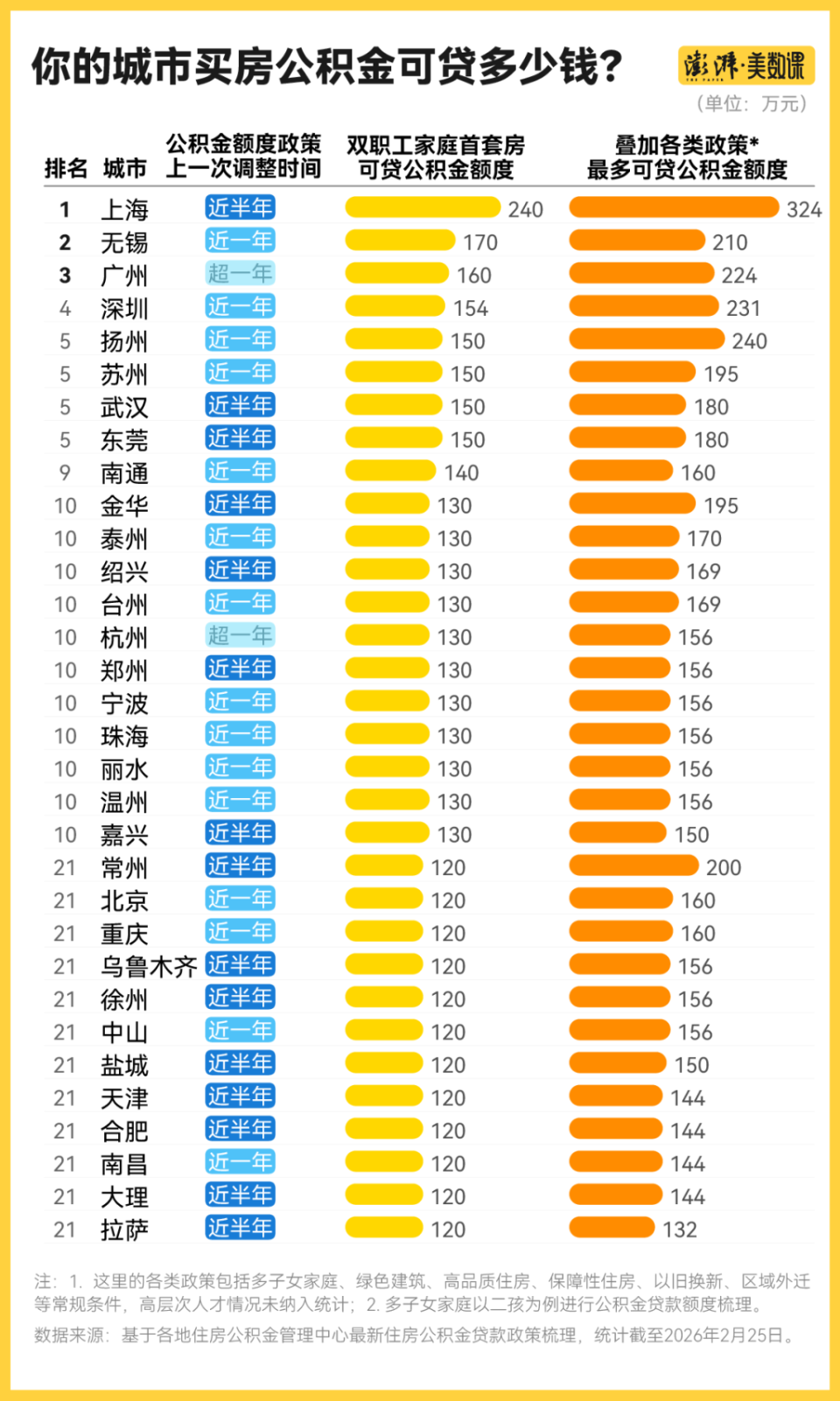
上海公积金贷款家庭额度升至最高324万,各地能贷多少?
Feng Huang Wang· 2026-02-27 02:36
Core Viewpoint - The new policy issued by Shanghai's housing authorities aims to optimize real estate regulations, focusing on purchase restrictions, public housing fund loans, and property taxes to support both rigid and improved housing demands [1] Group 1: Public Housing Fund Loan Adjustments - The maximum public housing fund loan for first-time homebuyers has been increased from 1.6 million yuan to 2.4 million yuan [1] - For families with multiple children and those purchasing qualifying green buildings, the loan limit can be raised by 20% and 15% respectively, with a combined maximum increase of 35%, allowing for a total loan of up to 3.24 million yuan, the highest in the country [1] - This adjustment reflects a significant response to the high housing prices in Shanghai, where the public housing fund loan previously covered only 36% of the price of a typical 90 square meter second-hand apartment, now increased to 53% [5] Group 2: Broader Trends in Public Housing Fund Policies - At least 32 cities across China have raised their public housing fund loan limits for dual-income families to 1.2 million yuan or more, with eight cities reaching 1.5 million yuan [4] - The increase in public housing fund loan limits is part of a broader trend, with approximately 280 policies introduced in 2025 aimed at optimizing public housing fund regulations [4] - The cumulative total of public housing fund deposits reached 32.79 trillion yuan by the end of 2024, with a year-on-year growth of 8.61% [5] Group 3: Implications for Real Estate Market - The adjustments in Shanghai's public housing fund loan policies signal a shift from merely supporting basic housing needs to promoting improved housing conditions, indicating a more systematic approach to real estate policy [8] - Shanghai's experience with the public housing fund system, initiated in 1991, has been influential and is now being adapted to meet current market demands, suggesting a potential for greater impact on domestic demand in the future [8]