
信用利差修复

Search documents
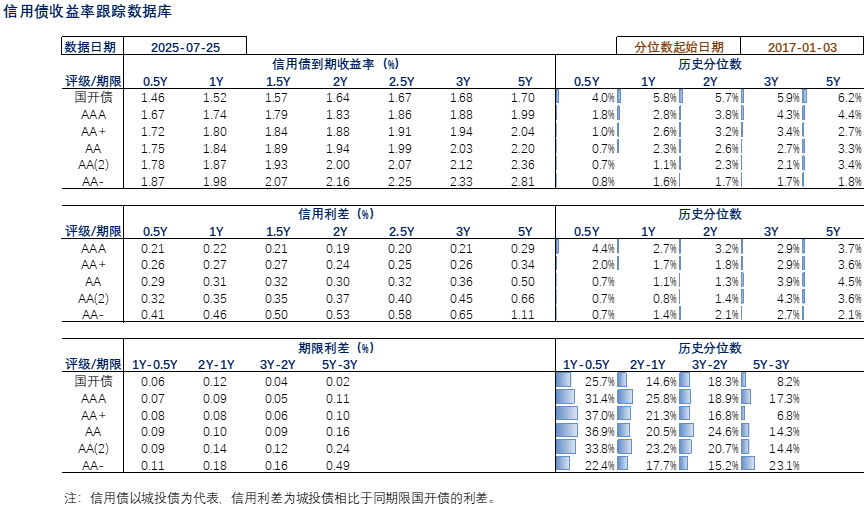
债市回调整固,公司债ETF(511030)回撤可控、净值稳定、流动性好备受关注
Sou Hu Cai Jing· 2025-07-30 02:42
Core Viewpoint - The bond market experienced adjustments last week, with spreads widening, particularly in the 1-3 year segment, which returned to historical levels below 3%, indicating potential for further adjustments [1] Group 1: Market Adjustments - The ordinary commercial bond spreads have also widened, with the 1-5 year segment within the 20% historical percentile [1] - The secondary and perpetual credit spreads have shown some recovery, with the 3-year segment returning to approximately 15% of its historical percentile, highlighting improved value [1] Group 2: Yield and Spread Data - As of July 25, 2025, the yield data for various credit ratings and maturities shows the following: - National Development Bonds yield ranges from 1.46% (0.5Y) to 1.70% (5Y) with historical percentiles of 4.0% to 6.2% [2] - AAA-rated bonds yield ranges from 1.67% (0.5Y) to 1.88% (3Y) with historical percentiles of 1.8% to 4.4% [2] - AA-rated bonds yield ranges from 1.75% (0.5Y) to 2.20% (5Y) with historical percentiles of 0.7% to 3.3% [2] Group 3: Economic Indicators - The recent bond market pullback is attributed to inflation logic following previous stock market gains and rapid commodity price increases, indicating a short-term adjustment [4] - The June profits of large industrial enterprises have declined for two consecutive months, but the rate of decline has narrowed, suggesting limited upward space for the stock market and downward space for the bond market [4] - Key indicators to monitor include the central bank's support for liquidity and the Shanghai Composite Index's performance above 3600, which would reduce negative impacts on the bond market [4] Group 4: Credit Market Insights - The credit market has shown slow valuation adjustments, indicating a resilient nature, but the credit spreads remain low, suggesting a need to monitor opportunities in the technology innovation bond ETF market [4]

负Carry修复,渐进式布局正当时
Changjiang Securities· 2025-03-25 01:38
1. Report Industry Investment Rating No relevant content provided. 2. Core Viewpoints of the Report - The bond market currently shows a pattern of short - end repair and long - end differentiation. Short - term high - grade credit bonds are performing well, while long - term low - grade credit bonds still have room for spread repair. [2][6][15] - The liability - side stability of the wealth management market provides support for credit bond allocation. The net - loss ratio is low, and the scale fluctuation is narrowing. [7] - After the cross - month point, the capital market sentiment has eased, and the selling pressure on credit bonds has weakened. Different institutional behaviors have reshaped the market structure. [8] - It is recommended to adopt a progressive allocation strategy from short to long along the yield curve. [9][15] 3. Summary by Related Catalogs 3.1 Short Credit Repair, Long - Duration Waiting for Progressive Layout - From March 10th to 14th, short - term credit bonds showed relative advantages. The 1 - year - below AAA credit bond index rose by 0.05%, while the 10 - year - above treasury bond full - price index adjusted by - 1.12%. [16] - The short - end repair is in progress, but the long - end low - grade credit bond yield curve and spread repair are still lagging. As of the latest point, the yield of AA - rated 5 - year bonds has increased by about 10 basis points compared with the end of September last year, and the 5 - year AA - credit spread has widened by about 31 basis points. [17] 3.2 Wealth Management Net - Loss Ratio Shows Structural Differentiation and Seasonal Repair Characteristics - The current net - loss ratio of wealth management products is generally controllable. The net - loss ratios of state - owned and joint - stock wealth management subsidiaries are around 3%, and those of city and rural commercial banks are around 3.5% and 5% respectively. [19] - The scale of joint - stock wealth management subsidiaries has been gently expanding. The actual redemption pressure is controllable as the average redemption yield is higher than the lower limit of the performance benchmark. [21] 3.3 Capital Sentiment Eases, Credit Bond Selling Pressure Alleviates - After the cross - month point, the capital market sentiment index gradually declined. The selling pressure on credit bonds in the second half - week of March 10th - 14th decreased significantly, with the GVN of credit bonds dropping from 9156 on March 11th to 6322. [27][29] 3.4 Short - End Repair Momentum Strengthens and Long - End Spread Structure Adjusts in Parallel - The short - end pricing pressure of the bond market has been significantly relieved. For example, the yield of 1 - month commercial bank secondary capital bonds has decreased by 9 basis points from March 7th to 14th, and the yield of 1 - month urban investment bonds has decreased by 8 basis points. [34] - The medium - and long - term note market shows a term - differentiation feature. The yield of 3 - year varieties has decreased by 1 basis point, but the spread of 10 - year varieties has widened by 10 basis points. [34] 3.5 Medium - and Long - Duration Credit Bond Allocation Momentum Increases Structurally - Wealth management products show a characteristic of extending duration. From March 10th to 14th, the net purchase of 3 - year and 5 - year credit bonds was 340 million yuan and 260 million yuan respectively, and the purchase of 5 - year bonds increased by 150 million yuan compared with the previous week. [43] - Insurance institutions have increased their allocation of ultra - long - term bonds, with the net purchase of 10 - year credit bonds remaining at around 3 billion yuan. [43] - There is a game pattern of "insurance extending duration, funds shortening duration" among institutions. [45] 3.6 Progressive Allocation Strategy to Deal with Market Disagreements - Short - term high - grade credit bonds can provide an operation space for trading - type funds. Medium - term 3 - 5 - year varieties are suitable for allocation - type funds for bottom - position layout. Long - term oversold bonds need to select urban investment bonds in regions with strong fiscal strength. [9] - It is recommended to maintain a neutral portfolio duration and keep a dynamic balance between treasury bonds and credit bonds. [9]