信用转移

Search documents
不一样的全球牛市
Shang Hai Zheng Quan Bao· 2025-11-04 19:09
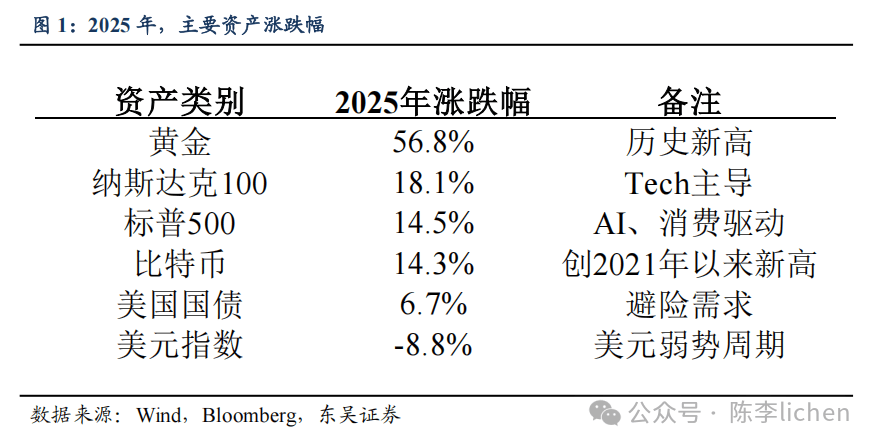
Core Viewpoint - Despite global economic slowdown and geopolitical uncertainties, various asset classes including stocks, bonds, gold, and cryptocurrencies have experienced a rare simultaneous rise in 2023, challenging traditional investment logic [2] Group 1: Global Liquidity and Monetary Policy - Global liquidity remains abundant, serving as a foundation for rising asset prices, with global M2 reaching $117.6 trillion as of August 2025, an increase of $9.37 trillion from the previous year [3] - Major economies like the US and EU are entering a rate-cutting cycle, which lowers risk-free rates and encourages capital flow into various assets [3] - The Federal Reserve has implemented its second rate cut of the year, with expectations of continued cuts into 2026, potentially lowering the federal funds rate target to between 3.00% and 3.25% [3] Group 2: Changes in Investment Logic and Risk Appetite - The weakening of dollar credit has led to a global asset reallocation, driving up asset prices, as the dollar index has fallen nearly 9% this year [4] - There is a simultaneous reduction in dollar exposure by global central banks and private sectors, with a significant increase in gold holdings [4] - The current market is characterized as a "credit transfer" phenomenon, driven by the erosion of confidence in the dollar's long-term purchasing power and political neutrality [4] Group 3: Technology Sector and Market Dynamics - The tech stock boom, catalyzed by AI transformations, has significantly boosted asset prices, with major tech companies contributing approximately 41% to the S&P 500 index's gains this year [4] - The concentration of investments in tech stocks has reached its highest level since the internet bubble, indicating a shift in market dynamics [4] Group 4: Market Sentiment and Future Outlook - Discussions around whether the current market represents an opportunity or a bubble are ongoing, with some analysts noting similarities to historical bubbles but asserting that the current rise is fundamentally driven [5] - The primary risk identified is the potential for earnings to fall short of expectations, which could lead to significant market corrections [5]

陈李:全球牛市幻象——信任的重新分配,对美元的信用质疑会持续吗?
Sou Hu Cai Jing· 2025-10-28 06:03
Core Viewpoint - The current global financial market is experiencing an unusual "comprehensive bull market," where major assets are rising in tandem despite economic slowdown and geopolitical tensions, driven by a reassessment of asset values due to weakening confidence in the dollar's long-term purchasing power and political neutrality [1]. Group 1: Global Asset Bull Market - Since 2025, major stock market indices have risen, with notable increases in European and Japanese markets, although these improvements alone do not fully explain the global asset price surge [2][9]. - Asset price increases are not driven by accelerated global economic growth, as the IMF predicts a decline in global growth rates for 2025 compared to 2024 [9]. - The rise in asset prices is not a result of further easing of global liquidity, as the marginal increase in global M2 has not significantly exceeded 2024 levels, despite a total M2 of $113 trillion by July 2025 [12][16]. Group 2: Factors Behind Asset Price Increases - The asset price increase is not primarily driven by a technology cycle, such as artificial intelligence, as traditional sectors like finance, consumption, and real estate are also experiencing gains [19][20]. - Geopolitical tensions have not eased; instead, they have intensified, with ongoing trade disputes and tariffs being implemented, contrasting with the rising asset prices [20]. Group 3: Dollar Credit Threats - The weakening dollar reflects structural changes in market confidence regarding its long-term credit and political neutrality, influenced by narrowing interest rate differentials and economic growth expectations [23][27]. - The dollar's decline is not due to actual economic weakness but rather a correction in growth expectations between the U.S. and Europe, with the latter benefiting from aggressive monetary policies [27][28]. - The dollar faces a trust crisis stemming from political, financial, and fiscal dimensions, including the U.S.'s unilateral actions and increasing national debt, which raise concerns about its long-term purchasing power [32][34]. Group 4: Future Outlook for Dollar Credit - The recovery of dollar credit will depend on the return of policy certainty, sustained economic improvement, and the robust operation of monetary policy [41][42][43]. - Changes in the international environment, such as underperformance of other major economies or easing geopolitical tensions, could enhance the dollar's attractiveness [44]. - Long-term improvements in structural issues, including manufacturing return and debt control, are necessary for the restoration of dollar credit [45]. Group 5: Investment Perspective - The current global bull market may represent a redistribution of trust rather than wealth creation, indicating a paradigm shift in investment logic where credit valuation becomes more critical than traditional economic growth metrics [46][47].