
信用重构

Search documents
贵金属狂飙,山东黄金等股价创新高,花旗:3个月内金价冲5000美元
Xin Lang Cai Jing· 2026-01-14 08:57
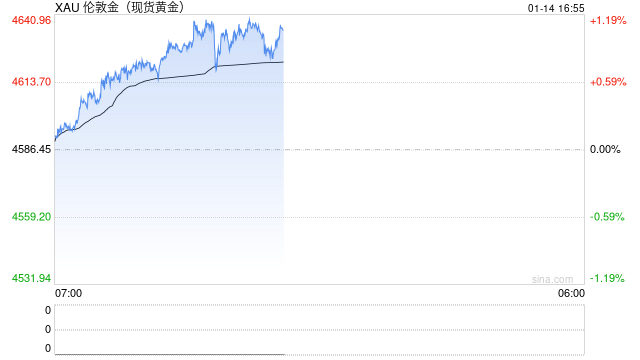
Core Viewpoint - The A-share precious metals sector experienced a significant surge, with multiple leading stocks reaching historical highs, driven by global market dynamics and rising gold and silver prices [2][11]. Group 1: Market Performance - On January 13, the A-share precious metals index rose by 2.69%, with notable gains from stocks such as Xiaocheng Technology (up 8.52%) and Hunan Silver (up 7.64%) [5][14]. - The London gold price reached a historical high of $4630.24 per ounce on January 12, while silver peaked at $86.247 per ounce, both setting new records [2][11]. - As of January 13, London gold was priced at $4593.90 per ounce, reflecting a year-to-date increase of 6.38%, while London silver was at $85.64 per ounce, with a year-to-date rise of 19.65% [2][6]. Group 2: Investment Outlook - Multiple international investment banks have raised their forecasts, with Citigroup predicting gold could reach $5000 per ounce and silver $100 per ounce within three months under a bullish scenario [2][7]. - The current market is characterized by a "credit reconstruction" phase, influenced by geopolitical tensions, concerns over the independence of the Federal Reserve, and increased central bank gold purchases [3][12]. - Analysts suggest that while gold and silver have long-term investment value due to ongoing demand for safe-haven assets, short-term volatility risks should be monitored closely [7][16]. Group 3: Risk Management - The Chicago Mercantile Exchange announced adjustments to margin requirements for gold and silver to mitigate market volatility risks [6][15]. - The Shanghai Gold Exchange issued a risk warning, advising members to closely monitor market changes and prepare for potential volatility [6][15]. - Investment strategies should focus on asset allocation and risk management, emphasizing the importance of understanding market trends and maintaining discipline in trading [8][17].


2025贵金属“狂飙”背后:一场逻辑重构的牛市
Sou Hu Cai Jing· 2025-12-29 02:20
Core Viewpoint - The global precious metals market experienced an unprecedented rally in 2025, with gold rising by 72.72%, silver soaring over 170%, and platinum and palladium reaching historical highs, driven by a clear underlying logic [1] Group 1: Market Performance - At the beginning of 2025, gold was trading between $2600 and $3000 per ounce, while silver fluctuated between $28 and $32 [2] - In March, gold broke the $3000 mark with a quarterly increase of 19%, followed by platinum's significant rise of 36.58% in Q2 [2] - The peak occurred in September when gold surged by 11.92% in one month, reaching $3857, and silver saw a quarterly increase of over 29% [2] - By the end of December, silver's quarterly increase reached 70%, with platinum and palladium both rising over 50%, and gold increasing by 17.49% [2] - On December 24, all four precious metals hit historical highs, with gold briefly touching $4549.96 and silver surpassing $79 [2] Group 2: Upward Logic - Traditionally, precious metal prices rise due to a combination of a weaker dollar and declining real interest rates; however, in 2025, the driving forces shifted fundamentally [3] - Notably, there were instances of rising U.S. Treasury yields coinciding with increasing gold prices, indicating a shift in gold pricing logic from being solely interest rate-sensitive to a reassessment of the monetary credit system [3] Group 3: 2026 Outlook - Despite long-term support factors such as ongoing central bank gold purchases, anticipated Fed rate cuts, and unresolved geopolitical risks, the market has entered a new phase [4] - Current prices reflect favorable conditions, leading to a short-term overvaluation; structural market differentiation is expected in 2026 [4] - Gold is likely to be supported by central bank holdings, making it "hard to drop," but its growth may slow; silver may face challenges due to slowing photovoltaic demand, while platinum group metals could emerge as the biggest winners due to unique supply-demand dynamics in the new energy sector [4] Group 4: Supporting Factors - Central banks have normalized gold purchases, with global net purchases reaching 634 tons in the first three quarters of 2025, and a record monthly increase of 53 tons in October [5] - Geopolitical tensions, such as the prolonged Russia-Ukraine conflict and heightened Middle Eastern tensions, have increased safe-haven demand, while persistent U.S. inflation and high fiscal deficits have weakened dollar credibility, enhancing gold's appeal as a "non-sovereign asset" [5] - Supply-demand imbalances persist, with silver facing shortages despite new production capacity, and platinum supply constrained by South Africa's energy crisis, while industrial demand for hydrogen fuel cells is surging [5]
银河证券:COMEX黄金价格中枢将稳步突破3300美元 不排除三季度WTI油价冲击75美元的可能
Xin Hua Cai Jing· 2025-06-29 06:10
Group 1 - The core viewpoint of the report indicates that COMEX gold prices are expected to steadily break through $3,300 per ounce, with a potential to reach $3,500 per ounce under extreme risk scenarios [1] - In the third quarter, if geopolitical tensions continue to escalate, WTI oil prices may hit $75 per barrel due to transportation bottlenecks and seasonal demand [1] - By the fourth quarter, as demand weakens and OPEC+ resumes supply increases, WTI oil prices are projected to return to around $60 per barrel [1] Group 2 - The report highlights three major uncertainties for the second half of 2025: first, tariff disruptions, where U.S. tariff policies may reshape international order and global power structures, leading to potential re-imposition of tariffs post-agreement [1] - Second, credit reconstruction is noted, with the U.S. debt reaching $36.1 trillion and over 30% of short-term external debt, raising liquidity risks and questioning the dollar's credit system [1] - Third, geopolitical risks are emphasized, particularly with the escalation of conflicts in the Middle East, which could lead to increased oil prices and global shipping costs, resulting in new structural re-evaluations of asset prices [1] Group 3 - In terms of global macroeconomic outlook, the report suggests that major economies are experiencing structural deceleration rather than typical recession, with the U.S. economy expected to transition slowly and steadily [2] - It is anticipated that the Federal Reserve may implement two rate cuts totaling 50 basis points in the second half of 2025, likely in September and December, unless inflation remains resilient or growth data is strong [2]

2025全球避险资产博弈图景:撕裂的秩序与资本的突围
Sou Hu Cai Jing· 2025-04-29 21:23
Group 1: Market Environment - The international political and economic environment in 2025 is characterized by "high volatility," influenced by fluctuating trade policies, geopolitical conflicts, and monetary policy uncertainties [1] - The acceleration of global debt monetization contributes to a "black swan matrix" in the market, reflecting deep-seated anxieties and strategic innovations in risk pricing [1] Group 2: Gold as an Investment - Gold's transformation from a "safe-haven asset" to a "credit hedge tool" is evident, with a price increase of over 25% in 2024 and a brief rise above $3,500 per ounce in Q1 2025 [2] - Central banks have purchased over 1,000 tons of gold for three consecutive years, with China's gold reserves at only 5%, indicating significant room for growth [2] - The correlation between gold and the US dollar is weakening, suggesting a shift towards a multipolar global currency system [2] - Short-term pressures from the Federal Reserve's hawkish stance may be offset by potential inflation mismatches and debt ceiling issues later in the year, creating a breakthrough window for gold prices [2] Group 3: US Treasury Bonds - US Treasury yields remain high at 4%-5%, but their safe-haven status is challenged by US fiscal risks [3] - In Q1 2025, record inflows into US Treasury ETFs reflect market pricing of recession expectations [3] - Long-term concerns arise from the potential erosion of the dollar's credit quality due to debt monetization, which may undermine the ultimate safe-haven status of US Treasuries [3] Group 4: Alternative Investment Strategies - The concept of "second identity planning" is evolving into a legal and tax firewall for asset allocation, allowing investors to mitigate single-market policy risks [4] - The surge in Caribbean investment immigration applications by 70% in Q1 2025 indicates a proactive response from wealthy individuals to political uncertainties [4] - Hong Kong insurance products are emerging as an "upgraded alternative" to gold, offering multi-currency hedging and long-term returns exceeding 6%-7% [5] - Defensive stocks, particularly low-volatility dividend assets, are gaining traction, with Hong Kong stocks showing an 8% dividend yield, surpassing Treasury returns [6] Group 5: Investment Opportunities - Key turning points in May 2025 include the Federal Reserve's interest rate decisions and US-China tariff negotiations, presenting tactical opportunities in three asset classes [7] - Tactical opportunities in gold may arise if prices dip below $3,000, supported by geopolitical catalysts [7] - Hong Kong low-volatility dividend assets are expected to benefit from policy and valuation boosts, attracting long-term capital [8] - Bitcoin is being viewed as "digital gold," especially amid concerns over dollar credit, although its high volatility necessitates cautious investment [10] Group 6: Investment Strategy - A core-satellite investment strategy is recommended, with a core allocation of 60% in stable assets like gold, US Treasuries, and Hong Kong dividend ETFs [11] - Satellite positions of 40% should include Bitcoin, Hong Kong insurance, and cash to capture event-driven opportunities [12] - Regular investments in gold ETFs are suggested to smooth costs and avoid emotional high-point purchases [13] - Planning for second identities and Hong Kong insurance should be initiated 3-5 years in advance to mitigate sudden policy risks [14] Group 7: Monitoring Signals - Monitoring macro indicators such as US TIPS yields and central bank gold purchases can provide signals for gold investment [15] - Geopolitical events like the intensity of the Russia-Ukraine conflict and tensions in the Taiwan Strait may trigger short-term trading opportunities in gold and defense stocks [16]