信用风险防控

Search documents
企查查获评信用风险防控行业标杆,助力大湾区信用建设
Yang Zi Wan Bao Wang· 2025-12-08 11:03
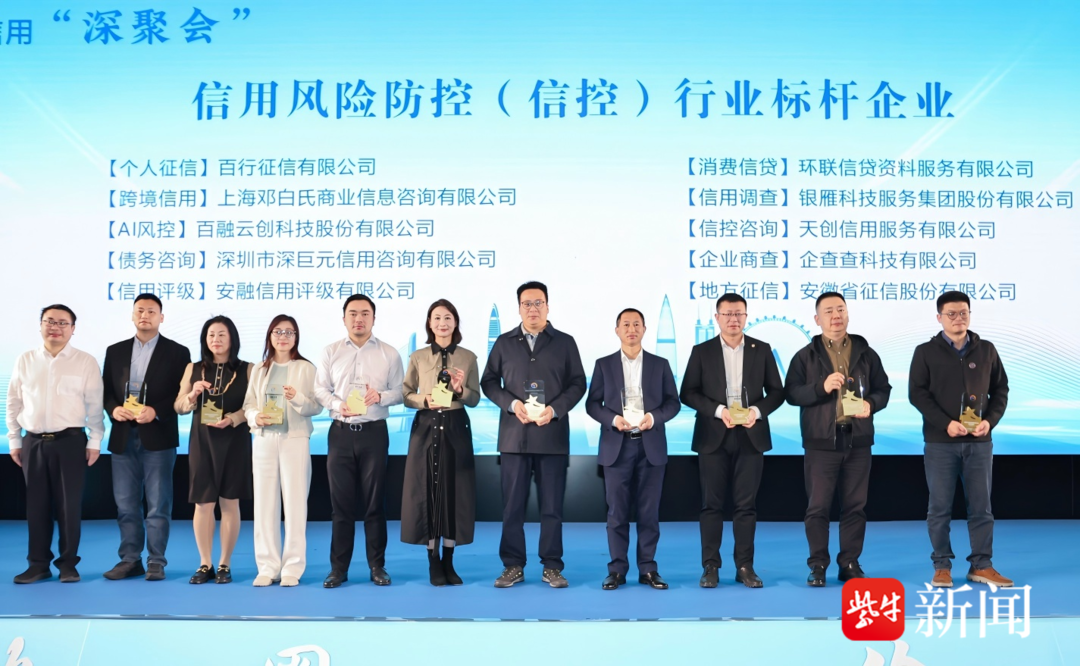
Core Viewpoint - The Guangdong-Hong Kong-Macao Greater Bay Area is advancing its social credit system, with a focus on innovation in credit services and the integration of data governance and collaborative mechanisms among various stakeholders [1][3]. Group 1: Event Overview - The second Credit "Deep Gathering" of the Guangdong-Hong Kong-Macao Greater Bay Area Credit Construction Development Alliance was successfully held in Shenzhen, attended by representatives from over 170 credit service institutions, data technology companies, research institutions, local credit centers, and industry associations [1]. - The event focused on discussions around credit service innovation, data compliance governance, and cross-domain collaboration mechanisms to create a new blueprint for credit system construction [1]. Group 2: Company Highlights - Qichacha, a leader in the enterprise credit investigation field, was awarded the title of "Benchmark Enterprise in Credit Risk Prevention and Control" for its outstanding performance in big data governance, AI applications, and risk control in non-financial scenarios [1][3]. - Qichacha's CEO emphasized the shift of credit services from static queries to dynamic intelligent risk control, particularly in non-financial areas such as cross-border trade and supply chain management, where credit data is crucial for reducing transaction costs and improving resource allocation efficiency [3]. Group 3: Technological Innovations - Qichacha has made significant advancements in big data and AI, developing innovative products like the "Hui Zhi" AI model, which allows users to obtain structured answers to inquiries about legal risks associated with companies [5]. - The integration of the deepseek model into Qichacha's "Third-Party Risk Screening System" has enabled one-click generation of enterprise risk assessments, transitioning risk control services from information retrieval to intelligent decision-making [5]. - Experts believe that the credit service industry is at a critical transition point from being "information intermediaries" to "intelligent hubs," with Qichacha's practices providing replicable and scalable solutions for cross-regional and cross-industry credit collaboration [5]. Group 4: Future Directions - As the framework for the social credit system continues to improve, credit services are expected to integrate deeply into various scenarios, including social governance, international trade, and public welfare [5]. - Qichacha plans to increase investment in technology research and development, aiming to enhance the value of data elements and empower the real economy with a higher level of credit infrastructure, contributing to the creation of a market-oriented, rule-of-law, and international business environment [5].

中诚信2026年信用风险展望年会在上海举行
Zheng Quan Ri Bao Wang· 2025-12-04 06:44
Core Insights - The conference organized by China Chengxin International Credit Rating Co., Ltd. focused on the outlook for credit risk in 2026, emphasizing the importance of optimizing economic structure and technological innovation for high-quality development during the 14th Five-Year Plan period [1][2] Group 1: Economic Outlook - The president of China Chengxin International highlighted that the ongoing optimization of economic structure and the steady transition of new and old growth drivers create favorable conditions for high-quality development [1] - The economic growth target for 2026 is likely to remain around 5%, with a relatively low difficulty in achieving this goal as the actual GDP growth rate in the fourth quarter only needs to reach 4.6% [3] Group 2: Risk Management and Technology - The integration of artificial intelligence and big data into financial services is crucial for enhancing risk management capabilities in a complex risk environment [2] - The development of index products is essential for risk identification, pricing, and diversification, providing objective benchmarks for efficient capital allocation [2] - A forward-looking, intelligent, and reliable credit risk prevention system is necessary for the healthy and stable operation of the credit market [2]
最新监管数据发布:银行业经营质效提升,总资产增近8%
Zheng Quan Shi Bao Wang· 2025-08-15 12:42
Core Viewpoint - The banking industry shows a strong resilience and improved operational efficiency, with total assets increasing by nearly 8% year-on-year, indicating a stable and positive trend in the sector [1] Group 1: Asset Growth and Financial Stability - As of mid-2023, the total assets of banking financial institutions reached 467.3 trillion yuan, a year-on-year increase of 7.9%, with large commercial banks' assets growing by 10.4% to 204.2 trillion yuan [1] - The non-performing loan (NPL) ratio stands at 1.49%, a decrease of 0.02 percentage points from the previous quarter, reflecting overall stability in asset quality [5] Group 2: Support for the Real Economy - The balance of inclusive micro and small enterprise loans reached 36 trillion yuan, growing by 12.3% year-on-year, while inclusive agricultural loans increased by 1.1 trillion yuan to 13.9 trillion yuan [2] - Large commercial banks accounted for over 16 trillion yuan of the inclusive micro and small enterprise loans, with a year-on-year increase of 13.84%, leading the industry in loan growth [3] Group 3: Operational Efficiency and Cost Management - The cost-to-income ratio for commercial banks improved to 30.2%, a decrease of 5.3 percentage points compared to the previous year, indicating enhanced operational efficiency [4] - Non-interest income as a proportion of total income rose to 25.75%, an increase of 3.33 percentage points since the end of last year, showing a positive trend in diversifying income sources [4] Group 4: Credit Risk Management - The banking sector has proactively managed credit risks, with new provisions totaling 1.1 trillion yuan, an increase of 579 billion yuan year-on-year, and the disposal of non-performing assets reaching 1.5 trillion yuan, up by 1.236 trillion yuan [5] - Capital adequacy ratios improved, with the overall capital adequacy ratio at 15.58%, up 0.30 percentage points from the previous quarter [5] Group 5: Capital Expansion - The issuance of subordinated debt and perpetual bonds by commercial banks has exceeded 1 trillion yuan this year, indicating a strong push for external capital [6] - Major banks have issued total loss-absorbing capacity (TLAC) bonds to meet regulatory requirements, with total issuance amounts of 800 billion yuan for Bank of China and Agricultural Bank of China, and 700 billion yuan for Bank of Communications [6]
南通农商银行分类施策筑牢信用风险“防火墙”
Jiang Nan Shi Bao· 2025-07-15 13:13
Core Viewpoint - Nantong Rural Commercial Bank has implemented a comprehensive risk prevention system focusing on "understanding the situation, targeted measures, and dynamic management" to effectively address credit risk issues this year [1][2] Group 1: Large Risk Management - The bank has established a "one customer, one strategy" approach for large risk loans, with each executive responsible for two high-risk clients, ensuring targeted risk resolution through personalized exit plans [1] - The management team actively engages with key clients to collaboratively discuss risk mitigation strategies [1] Group 2: Small Loan Management - Since the establishment of the small non-performing loan operation center in September 2024, the bank has centralized management of non-performing loans under 1 million, recovering or revitalizing 517 cases amounting to 98.46 million yuan [1][2] - The integration of "Feiyu Good Loan" into centralized management aims to enhance operational efficiency and focus on revitalizing small loans [1] Group 3: Key Institution Oversight - The bank has implemented a "key institution responsibility system" for 19 branches with high levels of non-performing loans, where each executive oversees at least two branches, ensuring dynamic monitoring and accountability [2] - Monthly reports to the party committee facilitate a closed-loop management process, enhancing proactive risk management capabilities [2] Group 4: Asset Management Strategies - In the area of heavy asset business, the bank employs a dual approach of support and deterrence, assisting struggling enterprises while taking legal action against malicious debt evasion [2] - The bank has successfully recovered multiple non-performing assets through legal means, contributing to financial order stability [2] Group 5: Future Outlook - The bank aims to deepen the construction of long-term mechanisms to contribute to the stable development of regional financial security [2]
青岛银行(002948) - 2025年5月16日投资者关系活动记录表
2025-05-16 09:52
Group 1: Financial Performance - In Q1 2025, Qingdao Bank achieved operating revenue of 4.047 billion CNY, an increase of 357 million CNY, representing a growth of 9.69% [3] - The net profit attributable to shareholders in Q1 2025 was 1.258 billion CNY, up by 177 million CNY, which is a growth of 16.42% [3] Group 2: Asset Quality - As of March 2025, the non-performing loan ratio was 1.13%, a decrease of 0.01 percentage points from the beginning of the year [4] - The provision coverage ratio improved to 251.49%, an increase of 10.17 percentage points compared to the start of the year [4] Group 3: Operational Strategies - The bank focused on expanding interest-earning asset scale and increasing the proportion of high-yield assets while achieving significant cost reduction on the liability side [2] - Non-interest income growth was driven by enhanced financial investment scale and timely bond profit-taking operations [2]