
指数类产品

Search documents
深度|银基合作,新打法来了!
Sou Hu Cai Jing· 2026-02-04 07:07
Core Viewpoint - The collaboration model between banks and fund companies in China is shifting from a focus on product sales to a more service-oriented approach, emphasizing long-term customer value and comprehensive capabilities [1][2][10]. Group 1: Changes in Collaboration Logic - The collaboration logic is being reshaped from a sales-driven approach to a comprehensive capability assessment, with banks focusing more on customer experience and operational efficiency [2][11]. - Banks are adopting "project-based" or "tender-based" cooperation models, evaluating fund companies based on multiple criteria such as product performance, research capabilities, and customer service [3][4]. - The shift is driven by the need for banks to enhance customer retention and operational efficiency in a competitive landscape [2][11]. Group 2: Customer Segmentation and Marketing Strategy - Banks are increasingly segmenting customers and focusing on retention rather than just sales volume, emphasizing post-investment services to improve customer experience [5][6]. - The marketing strategy has shifted to prioritize customer satisfaction and feedback from branch channels, influencing product selection [6][7]. Group 3: Differentiation Between Bank Types - There is a noticeable differentiation in collaboration focus between state-owned banks and joint-stock banks, with the former leaning towards specialized products and the latter focusing on retail customer needs [6][7]. - The internal power dynamics within banks are shifting, with more decision-making authority being delegated to branch levels, enhancing the importance of communication with fund companies [6][7]. Group 4: Focus on FOF Products - The FOF (Fund of Funds) category is becoming a focal point for collaboration, with banks adopting strict selection criteria for high-performing products [8][11]. - There is a reduced emphasis on "star fund managers," with banks focusing more on product systems and overall allocation logic [8][11]. Group 5: Drivers of Collaboration Model Adjustment - The adjustments in collaboration models are driven by three main factors: ongoing public fund reforms, changes in the industry ecosystem, and evolving investor demands [10][11]. - Banks are transitioning from a product sales model to a wealth management model, emphasizing risk matching and long-term customer value creation [11][12]. Group 6: Fund Companies' Strategic Adjustments - Fund companies are responding by adjusting their channel strategies, focusing on demand-driven product development and enhancing service capabilities [12][14]. - There is a shift from one-time sales to long-term partnerships, with fund companies aiming to provide comprehensive support to banks [12][14]. Group 7: Preference for Stable Investment Products - With a significant amount of deposits maturing, banks are likely to favor "deposit replacement" products that offer stable returns and lower volatility, such as "fixed income+" and low-volatility mixed products [15][16][17]. - The selection criteria for products are evolving from short-term performance to long-term configurability and operational capability [16][17].
中诚信2026年信用风险展望年会在上海举行
Zheng Quan Ri Bao Wang· 2025-12-04 06:44
Core Insights - The conference organized by China Chengxin International Credit Rating Co., Ltd. focused on the outlook for credit risk in 2026, emphasizing the importance of optimizing economic structure and technological innovation for high-quality development during the 14th Five-Year Plan period [1][2] Group 1: Economic Outlook - The president of China Chengxin International highlighted that the ongoing optimization of economic structure and the steady transition of new and old growth drivers create favorable conditions for high-quality development [1] - The economic growth target for 2026 is likely to remain around 5%, with a relatively low difficulty in achieving this goal as the actual GDP growth rate in the fourth quarter only needs to reach 4.6% [3] Group 2: Risk Management and Technology - The integration of artificial intelligence and big data into financial services is crucial for enhancing risk management capabilities in a complex risk environment [2] - The development of index products is essential for risk identification, pricing, and diversification, providing objective benchmarks for efficient capital allocation [2] - A forward-looking, intelligent, and reliable credit risk prevention system is necessary for the healthy and stable operation of the credit market [2]
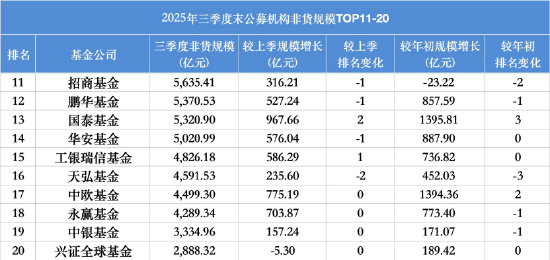
中部公募增速分化:国泰三季度规模增968亿逼近鹏华,招商跌出前十承压,兴证全球成TOP20唯一负增长
Xin Lang Ji Jin· 2025-10-30 10:09
Core Insights - The public fund industry continues to show a "stronger getting stronger" trend, with significant differentiation among firms, particularly in the non-monetary fund scale rankings as of Q3 2025 [1] Industry Overview - As of Q3 2025, there are 47 companies with over 100 billion in scale, 19 with over 300 billion, and 14 firms surpassing 500 billion [1] - The competition among firms ranked 11th to 20th is intense, with notable disparities in growth and ranking dynamics [1] Company Performance - **招商基金 (China Merchants Fund)**: Q3 scale growth of 316.21 billion, ranking dropped by 1 to 11th, and is the only firm in this tier with negative growth compared to the beginning of the year [3] - **国泰基金 (Guotai Fund)**: Achieved a remarkable growth of 967.66 billion in Q3, moving up 2 ranks to 13th, indicating strong expansion in index products [3] - **鹏华基金 (Penghua Fund)**: Experienced a growth of 527.24 billion, but its position is threatened by Guotai Fund, with the gap narrowing significantly [3] - **中欧基金 (China Europe Fund)**: Maintained stable ranking with a growth of 775.19 billion, showcasing strong internal growth momentum [4] - **永赢基金 (Yongying Fund)**: Also stable in ranking, with a growth of 703.87 billion, indicating robust performance [4] - **天弘基金 (Tianhong Fund)**: Had a modest growth of 235.60 billion, resulting in a drop of 2 ranks to 16th [4] - **兴证全球基金 (Xingzheng Global Fund)**: The only firm in the top 20 to experience a slight decline of 5.30 billion in scale, indicating increased pressure to maintain its position [4]

股指基差系列:风偏下行的双向波动可能持续
Guo Tai Jun An Qi Huo· 2025-10-10 11:14
1. Report Industry Investment Rating No relevant content provided. 2. Core Viewpoints of the Report - After the "Jiusan" consensus was fulfilled, the market entered a moderately shrinking rotation phase, with broad - based index gains narrowing. The basis showed significant two - way fluctuations, weakly correlated with daily index movements, and the divergence at the 1 - minute level increased, indicating weak and disordered risk sentiment in the futures market. The changes in neutral and CTA strategy products also reflected this. In the short term, the two - way basis fluctuations may continue, and in the long run, if the policy of reducing volatility is implemented, the central level of stock index futures discounts may narrow [5][15]. 3. Summary According to the Directory 3.1 Recent Basis Review - Market Conditions: After the "Jiusan" consensus was fulfilled, the market entered a moderately shrinking rotation phase. The ChiNext and STAR Market indices led the gains in September, while the gains of other indices narrowed, and the small - cap index declined. Domestic policies were relatively quiet, with a focus on "anti - involution" and potential future volatility - reduction policies. Overseas, the Fed cut interest rates by 25bp, and the A - share market reacted calmly to the Sino - US Madrid talks. Daily trading volume gradually decreased to around 2.2 trillion yuan [6]. - Basis Changes: At the beginning of September, the basis of each variety weakened with the index decline. Subsequently, it fluctuated up and down during the index recovery. By the end of the month, the basis of IF, IC, and IM strengthened. Overall, the basis of IH and IF decreased compared to the end of August, while that of IC and IM increased. As of September 30, the annualized basis rates of the four varieties' quarterly contracts had recovered to around the 20th percentile in the past three years. The daily - level basis changes were weakly correlated with index changes, and there was significant divergence at the 1 - minute level, indicating weak risk appetite [9]. - Product - end Performance: Index - related product scale was stable with a slight decline, and the number of newly issued public - offering index - enhanced products reached a new monthly high. The net value curve of neutral strategies flattened in the past two months, with a median annual return of around 5.5%, and both long and short positions decreased in September. The CTA strategy's leverage ratio for stock indices remained stable, but the net long position fluctuated significantly, reflecting disordered market sentiment [14]. 3.2 Performance Review of Long - Position Rollover - The annualized excess returns of the long - position rollover strategy for IF, IH, IC, and IM in the past 250 trading days were - 2.7%, 0.2%, 1.2%, and - 3.0% respectively. The benchmark portfolio was set as a weighted combination based on the previous trading day's contract positions, without considering transaction costs, and the trading price was the TWAP price in the first half - hour of trading [5][22]. 3.3 Performance Review of Short - Position Rollover - The annualized excess returns of the short - position rollover strategy for IF, IH, IC, and IM in the past 250 trading days were - 0.5%, - 0.3%, 2.2%, and 0.6% respectively [5][25].
