
AT1债券

Search documents
欧洲银行业担忧资本金上升,监管高官回应:改革须避免过度关注AT1问题
智通财经网· 2026-01-26 11:29
Core Viewpoint - The European Union's plan to simplify banking regulations must clarify future capital requirements and avoid excessive focus on Additional Tier 1 (AT1) debt [1][2] Group 1: Regulatory Changes - European banking regulators are discussing reforms to financial oversight to ensure that lending institutions are not at a disadvantage compared to U.S. counterparts, especially as the Trump administration reduces regulatory burdens in the U.S. [1] - The European Banking Authority's head, Jose Manuel Campa, emphasizes the need for clarity on how capital requirements will evolve over time [1] Group 2: AT1 Debt Concerns - Campa highlights the complexity of AT1 debt, which has become a focal point for regulators due to its implications for bank operations and capital structure [2] - The recent acquisition of Credit Suisse by UBS, where approximately 16 billion Swiss francs (about 17.2 billion USD) of AT1 bonds were fully written down while shareholders received compensation, has raised significant concerns about the traditional hierarchy of capital repayment [2] - This incident has led to market turmoil and legal challenges, exposing potential flaws in the European AT1 framework and prompting regulators to reassess its terms and clarity [2]
债市周度讨论会
2026-03-10 10:17
Summary of Key Points from the Conference Call Industry Overview - The conference call primarily discusses the bond market and its dynamics, particularly in the context of recent policy changes by the central bank and macroeconomic indicators [2][3][4]. Core Insights and Arguments - The central bank has restarted government bond trading to enhance the financial function of government bonds and to serve as a pricing benchmark for the yield curve, indicating a potential intention to regulate the yield curve and assist fiscal financing [2][5]. - The fourth quarter is expected to have a favorable fundamental and supply environment for interest rate trends, although macro trends remain unclear. Short-term data may show slight weakening, which could stimulate a wide monetary policy sentiment, providing a good window for the bond market [2][6]. - The manufacturing PMI for October was reported at 49, below expectations, indicating weakening demand that may lead to a slight decline in economic data for the fourth quarter, further supporting the bond market [2][8]. - Investment strategies suggest focusing on short-term rates, which are more certain, while taking trading opportunities in long-term and ultra-long-term bonds. The yield spread between 10-year and 30-year bonds is currently at a reasonable level [2][7]. Important but Overlooked Content - The TLAC non-capital tool is designed to enhance total loss-absorbing capacity and has a repayment order between ordinary bonds and AT1/AT2 instruments. It is crucial for investors to understand the complexities and risks associated with these instruments [2][10]. - The issuance of ordinary bonds globally amounts to approximately $6 trillion, primarily used for liability supplementation, with a significant portion issued in euros [2][9]. - The impact of Deutsche Bank and Credit Suisse events on the subordinate debt market highlights the credit risks associated with AT1 instruments, emphasizing the need for investors to be cautious regarding macroeconomic conditions and individual bank performance [2][13]. Additional Insights - The bond market's performance is influenced by various factors, including seasonal effects and holiday impacts, which investors should be aware of [2][8]. - The global banking sector's capital adequacy remains high, with core Tier 1 capital ratios around 14.52%, although there are regional variations in non-performing loans [2][17]. - Chinese institutions have a relatively low participation in the offshore subordinate debt market, with a significant portion of their debt being ordinary bank debt [2][12]. - The historical context of AT1 bond conversions and write-downs illustrates the potential risks and regulatory differences across jurisdictions, which can affect investment decisions [2][14][15].
业内专家:科技巨头“债务洪流”无虞,信贷市场足可消化
智通财经网· 2025-11-28 00:43
Group 1 - Concerns about oversupply in the credit market due to large-scale bond issuance by tech giants like Meta Platforms Inc. and Alphabet Inc. are considered premature [1] - The recent bond issuances are driven by significant AI-related investment needs, raising fears of a potential market sell-off due to rapid debt growth [1] - Iain Stealey from JPMorgan Asset Management noted that while there has been some market impact, the overall concerns are exaggerated, as these companies generate substantial annual revenues [1][2] Group 2 - Large tech companies have minimal debt, making them attractive credit targets, with Alphabet's credit rating being higher than that of France [2] - The entry of companies like Apple and Microsoft into the European market is expected to generate significant buying demand due to their high credit ratings [3] Group 3 - Overall optimism in the credit market is expressed, with expectations that bond yields and healthy balance sheets will provide support through 2026 [4] - The attractiveness of lower-rated bonds is questioned, as the risk-reward ratio does not justify seeking yield down the credit curve [4] - AT1 bonds have performed strongly this year, with expectations that this trend will continue into 2026 [4]


债券出海系列报告之六:境外银行债:风险、定价及展望
HTSC· 2025-10-30 03:51
1. Report Industry Investment Rating - No information provided in the content. 2. Core Viewpoints of the Report - Among overseas bank bonds, ordinary bank bonds have the largest outstanding volume, while AT1 and AT2 are subordinated bonds with higher yields. Subordinated bonds have had many credit risk events in history, reshaping the research framework and pricing for institutional investors. Ordinary bank bonds are mainly investment - grade, and their pricing is more affected by liquidity premium, while subordinated bonds are more affected by credit risk premium. In the future, considering the overall stable fundamentals of banks and the interest - rate cut cycle, opportunities for yield decline in medium - and short - duration ordinary bonds and subordinated bonds can be focused on. Chinese banks' overseas bonds, mainly US - dollar ordinary bonds issued by large banks, have higher coupons than domestic bonds, presenting allocation opportunities [1]. 3. Summary by Relevant Catalogs 3.1 Overseas Bank Bond Overview - **Types and Attributes**: Overseas bank bonds mainly include ordinary bank bonds, TLAC non - capital instruments, AT2, and AT1 bonds. Ordinary bank bonds have the best repayment order and are used to supplement general operating funds. TLAC non - capital instruments help global system - important banks meet TLAC regulatory indicators. AT1 and AT2 are used to supplement a bank's primary and secondary capital respectively, with subordinated, redemption, write - down, or conversion clauses [12]. - **Outstanding Amount**: As of October 20, the outstanding amounts of ordinary bank bonds, TLAC non - capital instruments, AT2, and AT1 bonds were 6.4, 2.0, 0.8, and 0.5 trillion US dollars respectively [2]. - **Ordinary Bank Bonds**: They are denominated mainly in euros, with the largest outstanding volume. European countries dominate in terms of issuance, and Germany has the largest outstanding amount. From 2010 - 2025, the overall issuance scale declined, and the financing situation shifted from net repayment to mild net financing. The issuance term is mainly 1 - 7 years, and the rated bonds are mainly of A grade. The lower the rating, the higher the interest rate [18][22][30]. - **AT1 Bonds**: They are denominated mainly in US dollars, with the largest outstanding amounts in the UK and the US. The market expanded significantly after 2014 and has developed steadily since then. The net financing amount has changed with the market rhythm. The issuance coupon is affected by the interest - rate environment and credit risk events. Bonds with ratings are mainly of Ba1 grade, and the lower the rating, the higher the coupon [35][40][52]. - **AT2 Bonds**: They are mainly issued by France, the US, etc., and are denominated mainly in US dollars, euros, and Australian dollars. The issuance scale fluctuated greatly from 2010 - 2025, mainly affected by the interest - rate cycle. The net financing amount has been mainly positive but showed a downward trend. Rated bonds are mainly of Baa1 grade, and the lower the rating, the higher the interest rate [54][59][66]. - **Chinese Banks' Overseas Bonds**: As of October 21, the outstanding amount was 7.6 billion US dollars, mainly ordinary bank bonds. US dollars are the main currency, and most of the rated bonds have high credit ratings. The financing rhythm is significantly affected by cost, and the net financing amount has been negative since 2022 [69][70]. 3.2 Review and Enlightenment of Credit Risks of Overseas Subordinated Bank Bonds - **Deutsche Bank's Interest Payment Risk in 2016**: The huge loss in 2015 led to concerns about its AT1 bond interest payment ability, causing a sharp decline in the European bank AT1 market. After Deutsche Bank announced a bond repurchase, market sentiment eased [83]. - **Deutsche Bank's Non - Redemption Cases in 2020 and 2025**: In 2020, it was due to the lower reset coupon compared to the refinancing cost; in 2025, it was to reduce exchange losses. Non - redemption may send a negative signal to the market [90][91]. - **UBS's Full Write - down of Credit Suisse's AT1 Bonds in 2023**: This event violated the traditional "debt before equity" repayment order, causing market concerns. It highlighted the importance of the "write - down clause" in AT1 bonds, regulatory powers, and regulatory differences [101][103][111]. - **Banco Popular Español's Case in 2017**: The bank's financial situation deteriorated rapidly. After being recognized as "failing or likely to fail" by the ECB, its AT1 bonds were first converted into shares and then fully written down, revealing the risk of regulatory judgment [112][115][118]. - **Banca Monte dei Paschi di Siena's Case in 2017**: After multiple self - rescue failures, the Italian government intervened. As a condition for state aid, the bank's AT1 bonds were forcibly converted into common shares, indicating that subordinated creditors will bear losses first in case of government assistance [119][123][124]. - **Bank of Jinzhou's Interest Payment Cancellation in 2019**: The direct reason was that the capital adequacy ratio did not meet regulatory requirements. After the cancellation, the bond price dropped, and it affected investors' confidence in other small and medium - sized Chinese banks' AT1 bonds [125][129]. 3.3 Pricing of Overseas Bank Bonds - **Pricing Drivers**: The pricing of overseas bank bonds is driven by the benchmark interest rate and credit spread. The spread of bank subordinated bonds is mainly affected by risk events, while that of ordinary bank bonds is dominated by liquidity premium [134]. - **Spread Composition**: The bank bond spread consists of liquidity premium and credit risk premium. Subordinated bonds such as AT1 and AT2 have a variety premium compared to ordinary bank bonds, which is an important part of the credit risk premium. Internationally, the spread between AT1, AT2, and ordinary bank bonds is larger, and AT1 is often classified as high - yield bonds [134].

危机的回音:美国区域银行再遭重创,市场重演硅谷银行恐慌剧本?
智通财经网· 2025-10-17 12:57
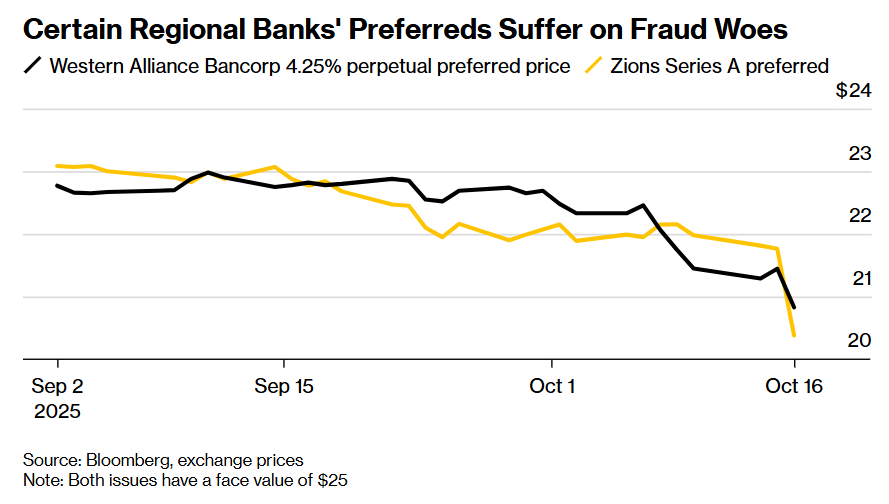
Core Viewpoint - Investors are concerned about a significant sell-off in the regional banking sector in the U.S., particularly affecting Zions Bancorp and Western Alliance Bancorp due to credit troubles, leading to a sharp decline in their preferred stocks [1][2] Group 1: Market Reaction - Zions Bancorp's preferred stock fell sharply, marking its largest drop since May 2023, reaching an 18-month low; Western Alliance's preferred stock also saw significant declines [1][5] - The sell-off was exacerbated by the disclosure of fraud in loans to distressed commercial mortgage funds, causing a 10% drop in the common stock of these banks [1][2] - The benchmark index tracking regional banks experienced its second-worst trading day since the collapse of Silicon Valley Bank in March 2023 [1] Group 2: Credit Quality Concerns - Zions Bancorp reported a $60 million provision for two loans and wrote off $50 million, which is about 5% of its expected earnings for 2025, highlighting ongoing credit quality issues [2] - The recent fraud cases, including those involving Tricolor Holdings and First Brands Group, have raised alarms about the credit quality across the sector, leading to heightened caution among investors [2][3] - Goldman Sachs noted that the market's reaction to a single borrower's disclosure seems excessive, but the accumulation of bad news has led to a sell-off mentality [2] Group 3: Preferred Stock Performance - Preferred stocks of smaller regional banks have been disproportionately affected, with Zions Bancorp's 4.819% perpetual preferred securities dropping 6.36% to $20.38, and Western Alliance's 4.25% preferred securities falling 2.87% to $20.83 [5][6] - In contrast, the preferred stocks of larger banks remained stable, indicating a divergence in market sentiment between large and small banking institutions [6][9] - The ongoing crisis has led to a significant sell-off in small lending institutions, while the preferred stocks of the "Big Six" banks have shown resilience [9]


关税风暴下的欧洲市场:央行降息周期开启,哪些板块最易受伤
Zhi Tong Cai Jing· 2025-06-05 23:14
Group 1: Global Economic Outlook - UBS expects global economic growth to gradually slow down in the second half of 2025, with healthy balance sheets and low default rates supporting spread stability [1] - The anticipated spread for EU investment-grade/high-yield bonds by December 2025 is projected at 100/325 basis points, despite potential market volatility from tariff news [1][2] - UBS's proprietary economic risk indicator has improved, challenging initial recession scenarios, although growth momentum is expected to fade later in the year [2] Group 2: ECB and Monetary Policy - UBS forecasts a 25 basis point rate cut by the ECB in June to 2.0%, aligning with market expectations, with another potential cut in July to 1.75% [3] - The ECB is expected to prioritize growth support while navigating inflation uncertainties, particularly in light of potential retaliatory tariffs from the EU [3] Group 3: Credit Market Dynamics - The Purchasing Managers' Index (PMI) showed a slowdown in May, but manufacturing activity remains positive, with private sector credit growth recovering [4] - Low default rates (approximately 1.5%) and strong fundamentals are supporting the resilience of credit spreads, despite ongoing trade uncertainties [4] Group 4: Sector-Specific Insights - Investment-grade financial bonds are seen as an ideal choice compared to corporate bonds, with energy and basic industries being the most sensitive to tariff news [1][7] - The capital goods and utilities sectors are viewed as defensive, while the technology sector is experiencing increased volatility due to specific risks [7] Group 5: Trade News Impact - Following the announcement of tariffs, credit spreads initially widened but did so in an orderly manner without panic selling [6] - UBS anticipates increased volatility around tariff news in the summer, particularly after the 90-day pause period ends [6] Group 6: Investment Opportunities - In the context of rising market volatility due to tariff news, opportunities in sensitive sectors are increasingly driven by individual stock performance rather than macro factors [8] - Companies with strong balance sheets and low breakeven points in the energy sector are better positioned, while those with high leverage face greater risks [8] Group 7: Credit Market Trends - The orderly widening of spreads around the "Liberation Day" reflects investor preparedness, with a significant amount of cash buffer available to manage tariff announcements [9] - UBS predicts a rotation of funds from U.S. to EU markets, with credit valuations remaining well-supported [9] Group 8: Financial Sector Performance - The financial sector has outperformed, supported by strong earnings from core European banks, despite some weakness in interest income and non-performing loans [10][11] - UBS maintains a constructive but cautious outlook on the financial sector, anticipating moderate issuance in the investment-grade primary market [11] Group 9: Technical Market Conditions - Investment-grade corporate bond issuance reached a historical high of 56% in May, driven by positive tariff news and strong investor demand [13] - UBS expects a healthy supply dynamic for financial bonds, particularly in AT1 and T2 bonds, supporting the market's technical backdrop [13] Group 10: Private Credit Market Outlook - UBS notes unique supportive factors in the European private credit market, including stronger EBITDA growth compared to the U.S. and improving interest coverage ratios [14] - The European private credit market is expected to remain resilient, with ample dry powder available to support liquidity and mitigate hard defaults [14]