
信贷资产证券化

Search documents
信贷资产证券化 2025 年度运营报告与 2026 年度展望:信贷 ABS 发行规模止跌回稳,NPL 成为发行及交易主力;产品发行利率走势出现分化;零售资产拖欠率高位波动;需对消费信贷及行业政策保持关注
Zhong Cheng Xin Guo Ji· 2026-01-23 06:25
1. Report's Industry Investment Rating - The document does not mention the industry investment rating. 2. Core Viewpoints of the Report - In 2025, influenced by the significant increase in NPL product issuance, the number and scale of credit - asset - backed securities issuances rebounded. The secondary - market trading volume also rebounded, with NPL products and sub - grade securities becoming the main trading components. The spreads of normal - class products continued to decline, while those of NPL products showed differentiation. Retail asset delinquency rates fluctuated at high levels, and the real recovery of NPL products continued to decline [6][7][55]. - In 2026, the credit asset securitization market is expected to be dominated by NPL products. The issuance spreads of other product types are expected to remain low, and the trading proportion of NPL and sub - grade securities in the secondary market is expected to further increase. Retail asset performance is unlikely to improve significantly in the short term, and the actual recovery of NPL products will continue to face pressure. Attention should be paid to the impact of consumer credit and industry policies [6][55]. 3. Summary by Relevant Catalogs 3.1 Issuance - In 2025, a total of 238 credit - asset - backed securities were issued, with a total issuance scale of 291.522 billion yuan, representing a year - on - year increase of 23.96% in the number of issuances and 7.82% in scale. NPL products accounted for 74.79% of the issuance number and 28.15% of the scale, both reaching historical highs [6][7]. - Auto ABS: 32 issues were issued, with a total scale of 118.543 billion yuan, a year - on - year decrease of 8.58% in scale. Green Auto ABS accounted for 17.62% of the total Auto ABS issuance scale, a decrease of 8.67 percentage points compared to 2024 [10]. - NPL: 178 issues were issued, with a total scale of 82.057 billion yuan, a year - on - year increase of 36.92% in the number of issuances and 61.32% in scale, and a cumulative disposal of 519.086 billion yuan in non - performing assets [10]. - Micro - enterprise loan ABS: 10 issues were issued, with a total scale of 58.645 billion yuan, a year - on - year decrease of 23.08% in the number of issuances and 10.49% in scale [12]. - Personal consumption - loan ABS: 18 issues were issued, with a total scale of 32.277 billion yuan, a year - on - year increase of 5.88% in the number of issuances and 32.70% in scale [13]. 3.2 Issuance Interest Rate - In 2025, the issuance interest rate of normal - class asset credit ABS remained low, while the NPL product issuance interest rate deviated from the benchmark interest rate at the end of the year. The issuance interest rates of Auto ABS, personal consumption - loan ABS, and micro - enterprise loan ABS decreased in the first half of the year and then remained stable, while the NPL issuance interest rate increased significantly in the fourth quarter [17]. - The average spread of AAAsf - rated products and the benchmark interest rate was 56bp, and that of AA + sf - rated products was 48bp, a decrease of 2bp and 18bp respectively compared to 2024. The spreads of different types of products all declined to varying degrees, with NPL products still at a relatively high level [20]. 3.3 Secondary Market - By the end of 2025, the credit - asset - backed securities' outstanding scale decreased by 11.85% to 435.812 billion yuan. The trading volume increased by 4.38% to 130.514 billion yuan, the number of transactions increased by 27.90% to 2,388, and the turnover rate increased by 8.83 percentage points to 28.06% [23][25][26]. - NPL products were the main trading variety, with a trading volume of 53.206 billion yuan, accounting for 40.77% of the total trading volume. Auto ABS trading volume was 48.574 billion yuan, accounting for 37.22% of the total trading volume [28]. 3.4 Credit Performance - Auto ABS: The cumulative default rate of recently issued products increased significantly, the delinquency rate increased, and the prepayment rate showed a slow upward trend, with the fluctuation center between 8% - 10% [31][33][35]. - Personal consumption - loan ABS: The performance was significantly differentiated, the delinquency rate fluctuated, and the prepayment rate continued to rise [38][40][43]. - RMBS: The cumulative default rate remained low, the delinquency rate first increased and then decreased, and the prepayment rate fluctuated to a high level and then returned to stability [45][47][49]. - NPL: The real recovery situation declined year by year, and 11 issues of priority - class asset - backed securities failed to be fully redeemed by the expected maturity date [52].
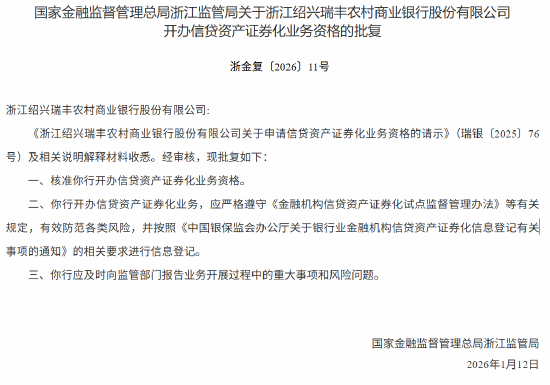
瑞丰农商行获批开办信贷资产证券化业务
Xin Lang Cai Jing· 2026-01-13 13:34
Core Viewpoint - The Zhejiang Regulatory Bureau of the National Financial Supervision Administration has approved the Zhejiang Shaoxing Ruifeng Rural Commercial Bank to engage in credit asset securitization business, emphasizing compliance with relevant regulations and risk management [1][2]. Summary by Categories Regulatory Approval - The Zhejiang Shaoxing Ruifeng Rural Commercial Bank has received approval to start credit asset securitization business [1][2]. Compliance Requirements - The bank must strictly adhere to the "Supervision Management Measures for Pilot Credit Asset Securitization by Financial Institutions" and other relevant regulations [1][2]. - The bank is required to register information according to the notice from the China Banking and Insurance Regulatory Commission regarding credit asset securitization [1][2]. Risk Management - The bank is mandated to effectively prevent various types of risks while conducting the securitization business [1][2]. - It must report significant events and risk issues to regulatory authorities during the business operation [1][2].

AIC再开闸,老树新枝更需苦练内功
第一财经· 2025-11-25 15:38
Core Viewpoint - The establishment of Asset Investment Companies (AICs) by banks like Industrial Bank, CITIC Bank, and China Merchants Bank indicates a significant expansion of comprehensive financial operations in China, following regulatory approvals aimed at enhancing the financial ecosystem and supporting troubled enterprises [2][3]. Summary by Sections AIC Establishment and Regulatory Background - The first AIC pilot programs began in 2017 with five major state-owned banks, primarily focusing on debt-to-equity swaps to assist viable but struggling companies in reducing leverage and managing risks [2]. - In 2020, the regulatory framework was expanded to allow AICs to engage in direct equity investments beyond debt-to-equity swaps, with further relaxations announced in 2024 [2]. Performance and Investment Data - As of June 2024, the total assets of the five major AICs reached 586.99 billion yuan, with 156 investment cases completed in 2024, amounting to 57.604 billion yuan [3]. Challenges and Risks - AICs face significant challenges, including limited external financing channels, high risk weights from parent banks, and insufficient research and personnel capabilities [4]. - The banking sector's traditional focus on collateralized loans and scale efficiency may hinder effective risk management in equity investments, raising concerns about the success rates of rapid debt-to-equity transitions [5]. Recommendations for Improvement - To enhance the effectiveness of AICs, it is crucial to develop a governance framework based on direct investment risk characteristics and to improve market transparency [5]. - The establishment of a credit transfer market and the promotion of credit asset securitization are essential for revitalizing credit resources and enabling market-driven pricing of credit assets [6].




2024年度信贷ABS产品到期与清算观察
Zhong Cheng Xin Guo Ji· 2025-05-22 05:56
Group 1: Product Expiration Overview - In 2024, a total of 260 credit ABS products will expire, with NPL and RMBS products accounting for 89 and 78 products respectively, together representing nearly two-thirds of all expiring products[4] - The top five initiating institutions for expiring products include China Construction Bank, Bank of China, Ping An Bank, China Merchants Bank, and Minsheng Bank, with a focus on RMBS and NPL products[5] Group 2: Product Duration Analysis - Among the 260 expiring products, 237 have had their subordinate securities redeemed, while 23 products, all NPLs, have not been redeemed[9] - RMBS products have an average duration of 5.47 years, with the longest at 9.10 years, while other products like Auto ABS and consumer loan ABS have durations mainly concentrated between 1-2 years[11] Group 3: Product Liquidation Methods - Out of the 260 products, 226 have been liquidated, leaving 34 products unliquidated, which includes 12 normal loan ABS and 22 NPL products[12] - The predominant liquidation methods are warehouse repurchase and original distribution, accounting for over 98% of liquidated products[12] Group 4: Subordinate Securities Placement and Yield Analysis - Of the 260 products, 127 had subordinate securities placed externally, representing nearly 50% of the total[14] - The average yield for subordinate securities in normal loan ABS is significantly lower, typically in the 6-7% range, while NPL products have an average yield of 24.65%[17]