储备管理购买(RMPs)

Search documents
市场担心沃什重启QT?但真正的工具可能是SOMA
Hua Er Jie Jian Wen· 2026-02-02 08:50
Core Viewpoint - The nomination of Kevin Warsh as the next Federal Reserve Chair raises concerns about balance sheet reduction, although Citigroup believes a full restart of Quantitative Tightening (QT) is unlikely [1] Group 1: Warsh's Hawkish Stance - Kevin Warsh has a strong stance on the Federal Reserve's balance sheet, advocating for significant reductions [2] - The market reacted to Warsh's views with a steepening bull market, leading to a negative swap spread for 30-year bonds [2] - There are slight rate hike expectations priced in for 2027/2028, despite Citigroup's view that Warsh's focus on inflation risks is less relevant in the current environment [2] Group 2: SOMA Adjustments - Citigroup predicts that a full restart of QT will face significant challenges, with more likely actions being a reduction in Reserve Management Purchases (RMPs) and adjustments to the weighted average maturity (WAM) of the SOMA portfolio [3] - The adjustment of the SOMA portfolio could release approximately $4.2 trillion in reinvestment space between late 2026 and 2027, with a shift towards short-term Treasury securities [3] - Citigroup suggests that the Federal Reserve may increase the proportion of short-term Treasuries in the SOMA holdings to 40%, which is technically easier to implement [3] Group 3: Concerns Over Term Premium - Citigroup notes that any rolling of SOMA securities will increase financing needs for the Treasury, but if the Treasury continues to favor short-term debt issuance, the yield curve may not steepen significantly [4] - There are concerns about a potential "buyer strike" in the Treasury market, driven by fears related to QT and future auction sizes [4] - Despite worries about foreign demand for U.S. debt declining, Citigroup's data shows that foreign participation in 10-year Treasury auctions has actually increased [4][5]
美联储RMP+美财政部美债发行管理≈ QE?
Hua Er Jie Jian Wen· 2025-12-15 06:40
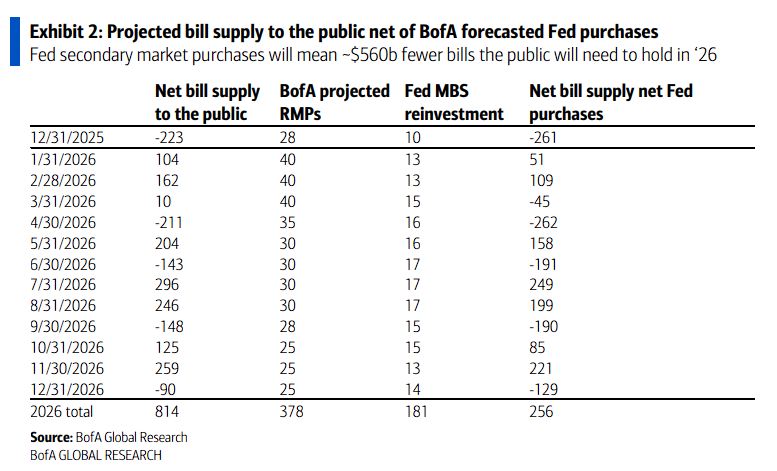
Core Viewpoint - The Federal Reserve's newly launched Reserve Management Purchases (RMPs) plan, in conjunction with the U.S. Treasury's bond issuance strategy adjustments, is creating a market effect similar to quantitative easing (QE) [1] Group 1: RMPs and Market Effects - The RMPs plan, while not traditional QE, allows the Treasury to increase short-term Treasury bill issuance and reduce the supply of medium- to long-term bonds [1][2] - Bank of America (BofA) projects that by 2026, the Federal Reserve will purchase a total of $560 billion in Treasury bills through RMPs and MBS reinvestments, while the Treasury plans to issue an additional $500 billion in short-term bills and reduce medium- to long-term bond issuance by $600 billion [1][2] Group 2: Treasury Issuance Adjustments - The Treasury is expected to issue $500 billion more in short-term bills in 2026 compared to 2025, while reducing medium- to long-term bond issuance by $600 billion [3][4] - This significant shift in supply structure aims to address the large amount of medium- to long-term bonds maturing in 2026 and the increased Treasury buyback operations [4] Group 3: Impact on Treasury Yields - The Treasury has indicated its intention to maintain stable long-term bond auction sizes in the coming quarters, focusing on increasing short-term Treasury bill issuance to meet financing needs [5] - BofA's scenario analysis suggests that a higher issuance of Treasury bills could lead to a net easing effect of 20-30 basis points on the 10-year Treasury yield [5][6] Group 4: Investment Opportunities - BofA recommends investors focus on three trading opportunities: 1. Going long on front-end swap spreads, currently at negative 18 basis points, with risks stemming from unexpected fiscal deficits [8] 2. Going long on 5-year real yields, currently at 103 basis points, supported by a historically accommodative financial environment [8] 3. Selling the volatility spread between 1-year and 10-year rates, currently at 2 basis points, with risks from rising uncertainty in Fed policy [8]