
中长期债券

Search documents
美财政部维持发债规模不变,未来数个季度内不提高中期及长期债券发行量
Sou Hu Cai Jing· 2026-02-04 14:28
Group 1 - The U.S. Treasury has decided to maintain the current issuance scale of medium- and long-term bonds, aligning with market expectations and dispelling speculation about potential adjustments to reduce long-term borrowing costs [1] - The Treasury plans to keep the auction amounts of coupon bonds and floating rate notes stable for "at least the next few quarters," continuing a forward guidance that has been in place for two years [1] - The total refinancing amount for this quarter is set at $125 billion, with specific issuance details provided [1] Group 2 - The Treasury is assessing the possibility of increasing the auction sizes of coupon bonds and floating rate notes, focusing on structural demand trends and the potential costs and risks of various issuance methods [2] - Analysts from Goldman Sachs expect that the Treasury will not take aggressive actions to adjust the issuance mix despite the government's focus on reducing financing costs [2] - The statement from the Treasury conveys a strong signal of stability regarding the auction sizes of coupon bonds and floating rate notes for the upcoming quarters [2] Group 3 - The Treasury plans to issue $58 billion in 3-year bonds on February 10, $42 billion in 10-year bonds on February 11, and $25 billion in 30-year bonds on February 12 [3]
美联储RMP+美财政部美债发行管理≈ QE?
Hua Er Jie Jian Wen· 2025-12-15 06:40
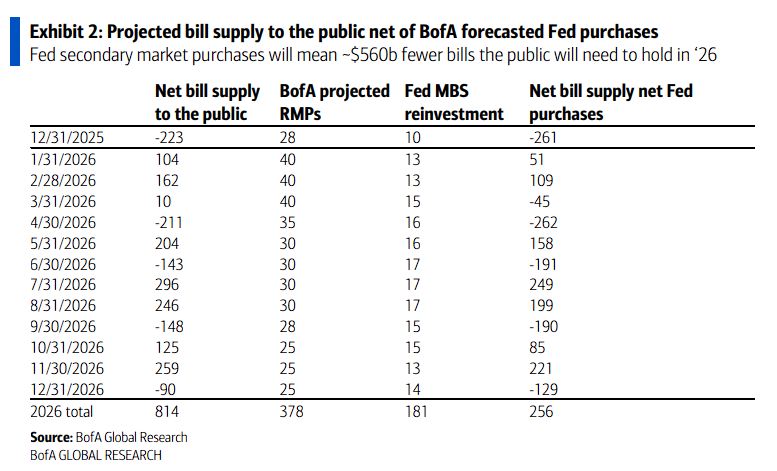
Core Viewpoint - The Federal Reserve's newly launched Reserve Management Purchases (RMPs) plan, in conjunction with the U.S. Treasury's bond issuance strategy adjustments, is creating a market effect similar to quantitative easing (QE) [1] Group 1: RMPs and Market Effects - The RMPs plan, while not traditional QE, allows the Treasury to increase short-term Treasury bill issuance and reduce the supply of medium- to long-term bonds [1][2] - Bank of America (BofA) projects that by 2026, the Federal Reserve will purchase a total of $560 billion in Treasury bills through RMPs and MBS reinvestments, while the Treasury plans to issue an additional $500 billion in short-term bills and reduce medium- to long-term bond issuance by $600 billion [1][2] Group 2: Treasury Issuance Adjustments - The Treasury is expected to issue $500 billion more in short-term bills in 2026 compared to 2025, while reducing medium- to long-term bond issuance by $600 billion [3][4] - This significant shift in supply structure aims to address the large amount of medium- to long-term bonds maturing in 2026 and the increased Treasury buyback operations [4] Group 3: Impact on Treasury Yields - The Treasury has indicated its intention to maintain stable long-term bond auction sizes in the coming quarters, focusing on increasing short-term Treasury bill issuance to meet financing needs [5] - BofA's scenario analysis suggests that a higher issuance of Treasury bills could lead to a net easing effect of 20-30 basis points on the 10-year Treasury yield [5][6] Group 4: Investment Opportunities - BofA recommends investors focus on three trading opportunities: 1. Going long on front-end swap spreads, currently at negative 18 basis points, with risks stemming from unexpected fiscal deficits [8] 2. Going long on 5-year real yields, currently at 103 basis points, supported by a historically accommodative financial environment [8] 3. Selling the volatility spread between 1-year and 10-year rates, currently at 2 basis points, with risks from rising uncertainty in Fed policy [8]


四季度券商发债潮持续但主题转移 从短期资金筹措转向长端成本优化
Xin Lang Cai Jing· 2025-11-28 10:00
Core Insights - The A-share market has been strong since July 2025, leading to a significant increase in bond issuance by securities firms, with a total domestic bond issuance exceeding 1.7 trillion yuan, a nearly 50% year-on-year increase [1] - The surge in bond issuance is attributed to increased operational settlement funds due to market conditions and the industry's proactive allocation towards heavy asset businesses [1] - Guotai Junan's bond issuance plan of 110 billion yuan has garnered attention as the largest single bond issuance in Chinese history, currently in the "submitted for registration" status [1] Group 1: Bond Issuance Trends - As of November 28, 2025, Guotai Junan's bond issuance reached 127.3 billion yuan, ranking second in the industry, just behind China Galaxy's 138.9 billion yuan [2] - The structure of Guotai Junan's new debt issuance includes 30% short-term financing bonds and 70% medium to long-term bonds, with three-year bonds making up 37% of the total issuance [2] - The issuance of short-term financing bonds peaked in the third quarter, with a 165% quarter-on-quarter increase, while medium to long-term bonds were primarily issued in May, September, and October [2][3] Group 2: Market Dynamics and Cost Reduction - The bond issuance wave began in July 2025, with a peak issuance of 165.9 billion yuan in that month, followed by high issuance in August and September [4] - In the fourth quarter, the focus of bond issuance shifted from short-term financing to medium to long-term bonds, as evidenced by Huatai Securities, which saw a significant decrease in short-term bond issuance [5] - The cost of new bond issuance has decreased compared to existing debt, with examples from CITIC Securities showing lower interest rates for newly issued bonds compared to those issued in previous high-rate periods [7]
货币政策如何化解财政难题?——联储独立性与货币宽松展望
2025-10-22 14:56
Summary of Key Points from the Conference Call Industry Overview - The discussion primarily revolves around the **U.S. fiscal policy** and its implications on **monetary policy** and **debt management**. The focus is on the challenges faced by the U.S. government regarding rising interest payments and their impact on fiscal health and economic sectors sensitive to interest rates. Core Insights and Arguments 1. **Fiscal Challenges**: The U.S. government is experiencing a significant imbalance between spending and revenue, with interest payments consuming a larger portion of the budget compared to Japan and the EU, approximately **13%-14%** of general fiscal spending [2][2][2]. 2. **Rising Interest Payments**: Since 2020, U.S. interest payments have escalated rapidly, projected to reach **twice** the 2020 levels by 2025, with an average debt interest rate of about **3.5%** [5][5][5]. 3. **Debt Management Strategies**: To alleviate fiscal pressure, the U.S. needs to reduce interest payments by **$180 billion** if no deficit growth occurs in FY 2026, or by **$80 billion** to return to 2024 levels [5][5][5]. 4. **Impact of Monetary Policy**: The potential for a **rate cut** after Powell's term in 2026 could lead to a decrease in short-term bond rates, while long-term rates may still rise, complicating the overall debt servicing costs [3][8][8]. 5. **Debt Structure**: The current debt structure shows a high proportion of short-term debt (under one year), which is sensitive to interest rate changes. This strategy was adopted to manage costs during rising interest rates [5][8][8]. 6. **Long-term Debt Sensitivity**: Historical data indicates that short-term bonds are more sensitive to interest rate cuts, while long-term bonds show less responsiveness, which could lead to increased overall costs for the government [9][9][9]. Additional Important Content 1. **Quantitative Analysis**: Two scenarios were presented indicating the necessity for significant reductions in interest payments to ease fiscal pressures [4][4][4]. 2. **Debt Refinancing**: The refinancing of maturing debt at lower rates could help reduce future interest costs, particularly for the portion of debt that is due for renewal [6][6][6]. 3. **Market Reactions**: The fiscal challenges have raised concerns in the market regarding the U.S. debt repayment capacity, leading to increased long-term bond yields, which adversely affects sectors like manufacturing and real estate [1][2][2]. This summary encapsulates the critical aspects of the conference call, focusing on the U.S. fiscal and monetary landscape, the implications of rising interest payments, and the strategies for managing debt effectively.
天风证券:2025两网公司中长期债券发行加速 看好补贴拖欠问题加速解决
智通财经网· 2025-09-17 00:05
Core Viewpoint - The overall balance of supply and demand in China's power system is expected in 2024, but challenges remain, including the mismatch in renewable energy generation and consumption areas, and delays in the construction of transmission lines and energy storage [1] Investment Outlook - Investment in grid enterprises is projected to remain high, with State Grid and Southern Grid's investment potentially exceeding 825 billion yuan in 2025, an increase of 220 billion yuan from 2024 [1] - The acceleration of capital expenditure in the grid sector is anticipated in 2025 due to the aforementioned challenges [1][7] Debt Issuance - The issuance of medium to long-term bonds by State Grid and Southern Grid is expected to significantly exceed historical levels, with State Grid projected to issue 1.46 trillion yuan in bonds during the 14th Five-Year Plan period [4] - In the first eight months of 2025, State Grid's bond issuance is expected to reach 439.5 billion yuan, a 56% increase compared to the entire year of 2024 [4] - Southern Grid's cumulative bond issuance from 2002 to August 2025 is projected to be 968.8 billion yuan, with 406.3 billion yuan issued during the 14th Five-Year Plan [4] Financial Metrics Comparison - As of the first half of 2025, State Grid's and Southern Grid's asset scales are expected to reach 5.96 trillion yuan and 1.39 trillion yuan, respectively, with asset-liability ratios of 54.2% and 60.6% [5] - In 2024, State Grid's operating revenue and net profit were 391.93 billion yuan and 77.3 billion yuan, significantly higher than Southern Grid's figures [5] Renewable Energy Subsidy Issues - The issue of renewable energy subsidy arrears is significant, with an estimated cumulative shortfall of about 400 billion yuan by the end of 2021 [6] - The establishment of settlement companies in Beijing and Guangzhou aims to address the renewable energy subsidy gap through market-based financing solutions [6] Recommended Stocks - Suggested stocks to focus on include renewable energy operators such as Longyuan Power, Datang Renewable, and Xintian Green Energy, as well as thermal power operators transitioning to renewable energy [2][8]
