储备资产多样化

Search documents
特朗普还未访华,中国突然曝出黄金库存,美国的霸权地位,还守得住吗
Sou Hu Cai Jing· 2025-12-08 20:13
Core Viewpoint - China's central bank has reported an increase in gold reserves, reaching 74.12 million ounces by the end of November, marking the 13th consecutive month of growth, amidst rising global discussions on the credibility of the US dollar [1][3][5] Group 1: Gold Reserves and Financial Strategy - The continuous increase in gold reserves indicates a rising proportion of gold in China's foreign exchange reserve structure, reflecting heightened vigilance against external financial risks [3][5] - The strategy of steadily increasing gold reserves is part of a long-term approach to enhance financial security and stability, rather than merely seeking maximum profit [5][11] - The increase in gold reserves is seen as a move to boost international confidence in the Chinese yuan, enhancing its stability and China's influence in the global financial arena [7][19] Group 2: Shift in Asset Allocation - Alongside increasing gold reserves, China has been reducing its holdings of US Treasury bonds, indicating a shift in asset allocation aimed at optimizing risk management [9][11] - This reduction in reliance on US debt, coupled with an increase in gold reserves, reflects a strategic adjustment to enhance the resilience of China's overall reserve system [11][23] - The diversification of reserves is a calculated response to the evolving global financial landscape, where the dominance of the US dollar is being reassessed [13][21] Group 3: Global Financial Implications - China's actions may serve as a model for other countries facing uncertainties related to dollar fluctuations, promoting a trend towards diversified reserve strategies [25][26] - The adjustments in China's reserve strategy not only address its own financial security but also contribute to a broader reconfiguration of the global financial system [26][28] - The ongoing increase in gold reserves and the strategic reduction of US debt holdings signify a gradual shift in China's position within the international financial framework [28]


多国央行表态,黄金作为储备资产的重要性正在增强
Huan Qiu Wang· 2025-11-27 01:23
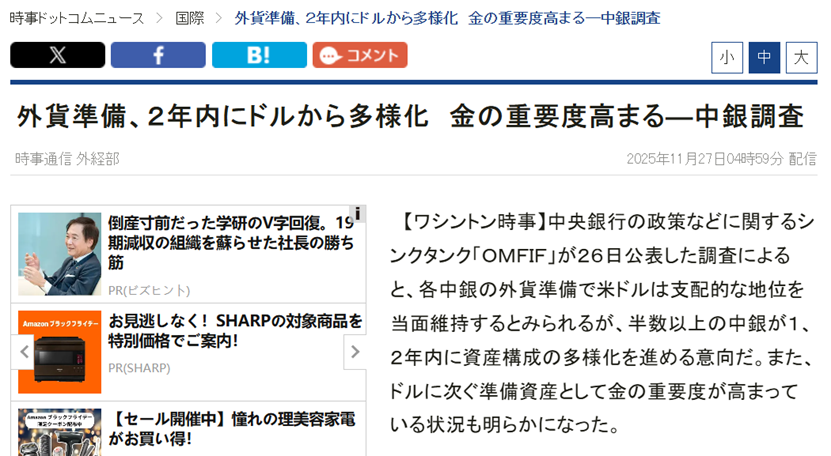
Group 1 - International precious metal futures saw a general increase, with COMEX gold futures rising by 0.45% to $4,196.10 per ounce and COMEX silver futures increasing by 4.13% to $53.76 per ounce [1] - The Federal Reserve's Beige Book indicates that U.S. economic activity remains largely unchanged, with a decline in consumer spending; however, initial jobless claims were lower than expected and durable goods orders improved, leading to an 85% market expectation for a rate cut in December [1] - A survey by OMFIF reveals that while the U.S. dollar will maintain its dominant position in central bank foreign exchange reserves, over half of the central banks intend to diversify their asset allocation in the next 1-2 years, highlighting the growing importance of gold as a reserve asset [1] Group 2 - The survey included banks from Europe, Asia, Africa, and Central and South America, indicating that while the dollar is expected to account for over 50% of global reserve assets in the next decade, 58% of central bank officials plan to diversify their reserve assets due to concerns over international political divisions and U.S. fiscal stability [4]
瑞银:多家央行认为到2029年黄金是表现最佳资产
news flash· 2025-07-09 08:39
Group 1 - Nearly half of the surveyed central banks believe that the United States may restructure its federal debt [1] - Over 70% of the surveyed central banks view the tariff policies of the Trump administration as the biggest risk [1] - Almost all surveyed central banks are pursuing diversification of reserve assets, with a strong preference for gold [1] Group 2 - 67% of the surveyed central banks believe that gold will be the best-performing asset from now until around 2029, a significant increase from 21% in the 2024 survey [1]

瑞银调查:近半数各国央行认为美债可能重组
Xin Hua Wang· 2025-07-08 13:58
Group 1 - Nearly half of central banks surveyed believe the U.S. may restructure its federal debt [1] - The survey conducted by UBS covered nearly 40 central banks and revealed that two-thirds are concerned about the independence of the Federal Reserve [3] - Concerns about the quality of U.S. economic data and the weakening of the rule of law were also highlighted by nearly half of the central banks [3] Group 2 - The primary risk identified by 74% of central banks is the trade and international alliance policies of the Trump administration [5] - There is an increasing pessimism regarding the global economic outlook, with many central banks now expecting stagflation [5] - Almost all surveyed central banks are pursuing diversification of reserve assets, with a strong preference for gold [7] Group 3 - 67% of central banks believe gold will be the best-performing asset from now until around 2029, a significant increase from 21% in the previous year's survey [7] - No central bank plans to reduce its gold holdings in the next 12 months, and over one-third have increased their gold positions in the past year [7] - While 13% of central banks think Bitcoin could be the best-performing asset in the next five years, only one is considering investing in it [7]