光伏产业反内卷

Search documents
硅料行业大事件!通威股份拟并购丽豪清能 业内人士:光伏产业“反内卷”的一个案例
Mei Ri Jing Ji Xin Wen· 2026-02-24 16:25
Core Viewpoint - The acquisition of Qinghai Lihua Qingneng Co., Ltd. by Tongwei Co., Ltd. is a significant move in the silicon material industry, aimed at optimizing the photovoltaic sector and addressing internal competition issues [2][6]. Group 1: Acquisition Details - Tongwei plans to acquire 100% of Lihua Qingneng through a combination of issuing shares and cash payments, with the stock expected to be suspended for up to 10 trading days starting February 25, 2026 [2]. - The acquisition will increase Tongwei's silicon material production capacity to over 1 million tons annually, combining its existing capacity of over 900,000 tons with Lihua Qingneng's planned capacity of 200,000 tons [3][6]. Group 2: Company Background - Lihua Qingneng specializes in the research, production, and sales of photovoltaic-grade high-purity crystalline silicon and electronic-grade polysilicon, with a total planned investment of 20 billion yuan for its production projects [3]. - The company is located in the Xining Economic and Technological Development Zone and has significant production projects planned, including a 200,000-ton photovoltaic-grade high-purity crystalline silicon project [3]. Group 3: Industry Implications - The merger is seen as a strategic move to combat the "involution" within the photovoltaic industry, enhancing Tongwei's leading position in the polysilicon sector during a current industry downturn [6]. - The integration is expected to facilitate management synergy and cultural alignment between the two companies, reducing acquisition risks and enhancing operational efficiency [5][6]. - The acquisition aligns with national policies encouraging industry consolidation, which is viewed positively by market participants [5].


中国光伏制造行业展望
Zhong Cheng Xin Guo Ji· 2026-02-06 09:36
Investment Rating - The report maintains a "stable weakening" rating for the Chinese photovoltaic manufacturing industry, with an expectation of overall credit quality weakening in the next 12 to 18 months, but still above a "negative" status level [6]. Core Insights - The report observes a slowdown in domestic photovoltaic installation demand in 2026, with a decline in export growth due to various factors including policy adjustments and geopolitical risks. The industry is expected to continue reducing production and controlling prices, leading to a gradual recovery in prices across the supply chain, although the overall supply-demand imbalance is unlikely to be fundamentally resolved in the short term [6][16]. - The long-term outlook suggests that as outdated capacities are eliminated, industry concentration will increase, and the development environment for the photovoltaic manufacturing industry is expected to improve [6]. Industry Fundamentals - The photovoltaic industry is supported by policy guidance focusing on "capacity control" and "price regulation," with efforts to eliminate "involution" competition. The industry is transitioning from administrative directives to a system of institutional constraints and market-based clearing [8]. - The domestic photovoltaic installation capacity saw a significant increase in the first half of 2025, driven by policy incentives, but is expected to decline in the latter half of the year due to market adjustments and reduced demand [10][11]. Financial Performance - The report indicates that the financial performance of the industry remains under pressure, with many companies facing liquidity challenges. However, leading firms are managing to maintain reasonable liquidity levels due to accumulated operational experience and bank credit support [6][16]. - The report highlights that the overall profitability of the industry is still low, with many companies experiencing losses, particularly in the component manufacturing segment [35][36]. Conclusion - The report concludes that while the photovoltaic manufacturing industry is facing significant challenges, including a complex international trade environment and domestic policy changes, there are opportunities for recovery through industry consolidation and improved operational efficiencies [6][16].
媒体报道丨光伏产业如何“反内卷”
国家能源局· 2026-01-13 13:59
Core Viewpoint - The Chinese photovoltaic industry is addressing its "growing pains" by focusing on breaking the cycle of "involution" competition and promoting a collaborative approach to industry standards and supply chain quality [2] Group 1: Industry Performance - As of November 2025, the total installed solar power capacity in China reached 1.16 billion kilowatts, representing a year-on-year growth of 41.9% [2] - The rapid expansion of the industry has led to issues such as supply-demand imbalances and chaotic price competition, highlighting the urgent need for transformation and upgrading [2] Group 2: Supply-Side Strategies - The industry should implement differentiated policies based on the characteristics of different segments of the supply chain, such as establishing a technology grading mechanism for the rapidly evolving battery segment [3] - For mature segments like silicon materials and wafers, the focus should be on energy consumption and environmental standards to phase out outdated production capacity [3] - Strict regulation is necessary to address the sale of products below cost in the component segment, ensuring that high-quality production is prioritized [3] Group 3: Demand-Side Strategies - The domestic market should encourage state-owned enterprises to take responsibility for major projects, stabilizing the development foundation [3] - A hard requirement that components must meet conversion efficiency standards to be connected to the grid will drive technological upgrades in the industry [3] - Optimizing bidding rules to reduce the weight of price and promote a "quality for price" approach is essential [3] Group 4: Policy Support - Recent guidelines from the National Development and Reform Commission and the National Energy Administration aim to create a collaborative framework for energy consumption and regulation [4] - The industry is moving towards high-quality development through technological innovation, rule restructuring, and ecological collaboration, aiming to enhance its competitive advantage in the global energy transition [4]

两部门:调整光伏等产品出口退税政策!光伏ETF(159857)标的指数强势涨近3%,冲击六连阳!
Sou Hu Cai Jing· 2026-01-12 04:33
Core Viewpoint - The cancellation of the VAT export tax rebate for photovoltaic products starting April 1, 2026, is expected to impact the industry significantly, particularly affecting the cost structure and competitive pricing of companies in the sector [2][3]. Group 1: Market Performance - As of January 12, 2026, the photovoltaic ETF (159857) saw a turnover of 9.74% with a transaction volume of 217 million yuan, while the tracked CSI Photovoltaic Industry Index (931151) surged nearly 3%, marking a six-day winning streak [1]. - Key component stocks such as Dongfang Risheng, Jiejia Weichuang, and Maiwei Co. experienced notable increases of 17.26%, 13.15%, and 11.36% respectively, with other companies like Trina Solar and Aotwei also showing upward trends [1]. Group 2: Policy Changes - The Ministry of Finance and the State Taxation Administration announced the cancellation of the VAT export tax rebate for photovoltaic products effective April 1, 2026, and a reduction of the VAT export tax rebate rate for battery products from 9% to 6% until the end of 2026, with a complete cancellation starting January 1, 2027 [2]. Group 3: Industry Impact - The cancellation of the export tax rebate is expected to increase direct costs for companies and reduce their price competitiveness, leading to a potential renegotiation of export prices by Chinese firms [3]. - Analysts predict that the removal of the rebate will accelerate the elimination of outdated production capacity in the domestic market, allowing leading and technologically advanced companies to gain market share [3]. - Zhongyin Securities noted that ongoing "anti-involution" policies in the photovoltaic industry are likely to stabilize upstream prices and enhance profit recovery expectations, particularly benefiting the silicon material segment [3].
光伏产业如何“反内卷”
Xin Lang Cai Jing· 2026-01-11 22:25
Core Insights - The Chinese photovoltaic industry is addressing its "growing pains" through initiatives aimed at breaking the cycle of "involution" competition and promoting a collaborative ecosystem for supply chain quality [1] - As of November 2025, China's solar power generation capacity is expected to reach 1.16 billion kilowatts, reflecting a year-on-year growth of 41.9%, showcasing the industry's global leadership in scale, technology, and application [1] - The industry faces challenges such as supply-demand imbalances and price wars, highlighting the urgent need for transformation and upgrading [1] Supply-Side Strategies - Emphasizing differentiated policies based on the characteristics of various segments, such as establishing a technology grading mechanism for rapidly evolving battery technologies and enforcing strict regulations to eliminate outdated capacities in mature segments like silicon materials and wafers [2] - The component sector requires strict regulation to curb sales below cost, ensuring that high-quality production is prioritized while phasing out inferior capacities [2] Demand-Side Strategies - The domestic market should see state-owned enterprises take responsibility for major projects, stabilizing the development foundation and pushing for technology upgrades through stringent requirements for component efficiency [2] - Optimizing bidding rules to reduce the emphasis on price and promote a "quality over price" approach is essential for fostering a healthier market environment [2] - In international markets, measures such as differentiated tax rebates should be implemented to prevent the export of low-quality products, while encouraging companies to explore emerging markets like the Middle East and Latin America [2] Policy Support - Recent guidelines from the National Development and Reform Commission and the National Energy Administration aim to create a collaborative framework that integrates source, network, and load, driven by market and innovation [3] - A comprehensive action is underway to transition from low-level "involution" to high-quality development, reinforcing China's competitive advantages in the global energy transition [3]
江松科技冲刺IPO:光伏“反内卷”中的设备突围
Cai Jing Wang· 2026-01-06 06:36
Core Viewpoint - The article highlights the competitive challenges in the global photovoltaic (PV) industry, particularly the phenomenon of "involution," characterized by price wars and homogenized products. Wuxi Jiangsong Technology Co., Ltd. (referred to as "Jiangsong Technology"), currently in the IPO stage, exemplifies a "counter-involution" trend through its innovative and differentiated approach in the PV battery automation equipment sector [1]. Group 1: Technological Innovation - The essence of the PV industry's involution is the homogenization of technology, leading to price wars as the primary competitive strategy. Jiangsong Technology focuses on technological innovation to break this deadlock by developing advanced automation equipment for PV battery production [2]. - The company has successfully developed automation equipment for various processes in PV battery manufacturing, including diffusion annealing, PECVD, etching, texturing, and alkali etching, making it one of the few domestic manufacturers capable of providing comprehensive production solutions [2]. - Jiangsong Technology's automation equipment features high operational efficiency, precision, low breakage rates, and customization capabilities, enabling smart production and data collection for clients' digital factories [2]. Group 2: Market Position and Growth - Jiangsong Technology's diffusion annealing automation equipment achieves a capacity of 13,500 wafers per hour with a breakage rate as low as 0.01%, outperforming both domestic and international competitors [3]. - The company's PECVD automation equipment has increased production capacity from 4,500-6,000 wafers per hour to 8,500 wafers per hour, significantly aiding in cost reduction and efficiency improvement in PV battery production [3]. - Jiangsong Technology ranks first among PV battery automation equipment manufacturers according to the China Photovoltaic Industry Association's 2022-2023 annual report, with a compound annual growth rate of 58.15% in revenue from 2022 to 2024, indicating strong market recognition [3]. Group 3: Industry Dynamics and Future Outlook - Equipment manufacturers play a crucial role in the PV industry's value chain, influencing production efficiency, quality, and costs. Jiangsong Technology's focus on N-type battery technology positions it well to meet new market demands and facilitate the transition to advanced technologies [4]. - The global PV industry continues to grow, with 2023 witnessing a record 390 GW of new installations, including 216.88 GW in China. This growth is expected to drive demand for equipment manufacturers like Jiangsong Technology [5]. - Jiangsong Technology's IPO funding aims to expand production capacity, enhance product offerings, and strengthen R&D capabilities, reflecting a strategic shift in the Chinese PV industry towards high-end equipment and innovative technologies [5].
光伏产业链价格企稳,“反内卷”成果显现
Ge Long Hui· 2025-12-28 03:48
Core Viewpoint - Since July, multiple departments have implemented policies to guide the photovoltaic industry towards a high-quality development phase focused on technological innovation, with initial signs of success in stabilizing and increasing prices in core segments like silicon materials [1] Group 1: Policy and Industry Response - The policies are aimed at controlling production capacity, prices, and improving standards within the photovoltaic sector [1] - Industry associations and enterprises are collaborating to advance these policies, indicating a coordinated effort to enhance the industry's overall quality [1] Group 2: Price Trends - Prices for core materials, particularly polysilicon, have shown a significant recovery, with the main contract for polysilicon doubling since the end of June [1] - As of December 26, the price of various models of monocrystalline silicon wafers ranged from 1.2 yuan to 1.52 yuan per piece, reflecting an increase of at least 40% compared to the price range of 0.86 yuan to 1.19 yuan per piece at the beginning of the third quarter [1] - The average price of N-type polysilicon rebounded to 53,900 yuan per ton, marking an increase of approximately 54% from the end of the second quarter [1]
午后拉升,光伏ETF华夏(515370)上涨1.67%,近二十日流入超10亿元
Mei Ri Jing Ji Xin Wen· 2025-12-24 07:39
Core Insights - The article highlights a significant increase in the solar photovoltaic (PV) sector, with the IEA predicting a 50% average annual growth in electricity generation in the Middle East and North Africa from 2023 to 2035, with solar PV expected to grow the fastest, increasing 15 times by 2035 compared to 2023 [1] Group 1: Market Performance - The solar ETF Huaxia (515370) experienced a rapid increase of 1.67% in the afternoon of December 24, with a capital inflow of 100 million yuan yesterday and over 1 billion yuan net inflow in the past twenty days [1] Group 2: Industry Trends - According to Guojin Securities, since July, there has been a significant release of "anti-involution" signals in the solar industry, with continuous improvement in policy specifications [1] - The price control aspect indicates that the price of polysilicon is gradually covering costs, and it is expected that the price center of the industry chain will progressively cover costs [1] - On the supply side, the advancement of storage dynamics and new energy consumption standards for polysilicon are expected to accelerate the elimination of outdated production capacity, leading to ongoing "anti-involution" efforts that will drive industry profit recovery [1] Group 3: ETF Overview - The solar ETF Huaxia (515370) tracks the CSI Solar Industry Index, which includes upstream, midstream, and downstream companies in the solar industry, such as silicon wafers, polysilicon, battery cells, cables, photovoltaic glass, battery modules, inverters, photovoltaic brackets, and solar power plants, providing a comprehensive reflection of the overall performance of the solar industry [1]
多家光伏硅料龙头成立合资公司
Zheng Quan Ri Bao· 2025-12-10 16:41
Core Viewpoint - The establishment of Beijing Guanghe Qiancheng Technology Co., Ltd. is seen as a significant step towards addressing the "involution" issue in the photovoltaic industry, aiming to optimize competition and stabilize pricing mechanisms [1][5][7]. Company Overview - Beijing Guanghe Qiancheng Technology Co., Ltd. was registered on December 9, 2025, with a registered capital of 3 billion yuan [1]. - The company is located at Room B6221, 6th Floor, Building 36, Huagong East Lane 3, Chaoyang District, Beijing, but has not yet commenced operations [2]. - The legal representative of Guanghe Qiancheng is Hou Yicong, and its business scope includes technology services, development, consulting, and management [1]. Shareholder Composition - Guanghe Qiancheng has 10 shareholders, with 9 being silicon material production companies [3]. - Major shareholders include Tongwei Co., Ltd. (30.35% stake), GCL-Poly Energy Holdings Limited (16.79%), Xinjiang Daqo New Energy Co., Ltd. (11.31%), and Xinte Energy Co., Ltd. (10.12%) [3][4]. Industry Context - The photovoltaic industry has been facing challenges due to unfair competition practices, prompting regulatory bodies to take action to restore order and promote high-quality development [5]. - The Ministry of Industry and Information Technology has initiated energy-saving inspections for 41 silicon material companies to eliminate high-energy-consuming outdated capacities [6]. - The price of polysilicon, a core raw material for photovoltaic cells, has shown significant fluctuations, with the price of N-type polysilicon rising from 37 yuan/kg at the beginning of the year to 53 yuan/kg currently, marking an increase of approximately 43% [6]. Market Implications - The establishment of Guanghe Qiancheng is expected to enhance the competitive landscape of the industry, concentrating market share among leading firms and stabilizing prices to ensure profitability [7]. - The market's positive reaction to Guanghe Qiancheng's registration reflects a strong demand for addressing the "involution" issue within the photovoltaic sector [6][7].
中国光伏行业协会执行秘书长表示“不要低估政策决心”,光伏ETF基金(516180)涨超2.0%
Xin Lang Cai Jing· 2025-11-13 03:31
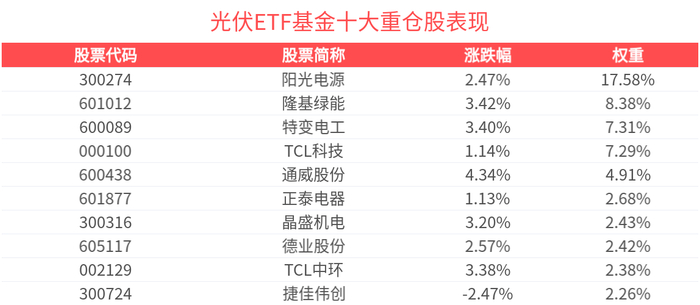
Group 1 - The core viewpoint emphasizes the determination of policies in the photovoltaic industry, indicating that the industry will not cease its efforts until it overcomes vicious competition [1] - As of November 13, 2025, the CSI Photovoltaic Industry Index (931151) rose by 2.84%, with notable increases in constituent stocks such as Shangneng Electric (300827) up by 20.00%, Lianhong Xinke (003022) up by 10.00%, and Jinlang Technology (300763) up by 8.17% [1] - The Photovoltaic ETF Fund (516180) increased by 2.34%, closing at 0.88 yuan, and has seen a cumulative rise of 2.89% over the past two weeks, ranking 2nd out of 11 comparable funds [1] Group 2 - As of October 31, 2025, the top ten weighted stocks in the CSI Photovoltaic Industry Index include Yangguang Electric (300274), Longi Green Energy (601012), and TBEA (600089), collectively accounting for 60.74% of the index [2] - The weight and performance of the top stocks are as follows: Yangguang Electric (17.58%, up 2.47%), Longi Green Energy (8.38%, up 3.42%), and TBEA (7.31%, up 3.40%) [4]