光伏行业深度调整

Search documents
工信部定调!光伏还在深度调整期 “反内卷”是重中之重
2 1 Shi Ji Jing Ji Bao Dao· 2026-02-05 13:55
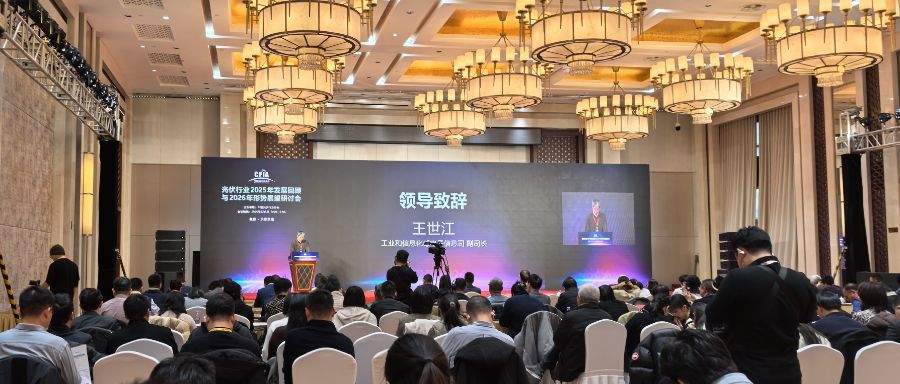
Core Viewpoint - The Chinese photovoltaic industry is currently undergoing a deep adjustment period, with 2026 identified as a critical year for governance and addressing internal competition within the industry [1][3]. Industry Overview - The photovoltaic industry has achieved significant milestones during the 14th Five-Year Plan, including an annual output value exceeding 10 trillion yuan, total exports surpassing 180 billion USD, and cumulative installed capacity exceeding 1200 GW [2]. - The cumulative new installed capacity during the 14th Five-Year Plan is 4.5 times that of the 13th Five-Year Plan, and the cumulative new power generation is 3.6 times higher [2]. Challenges and Adjustments - The industry is facing a mismatch in supply and demand, leading to significant challenges for enterprises [3]. - The cancellation of the value-added tax export rebate for photovoltaic products starting April 1, 2026, may lead to a major reshuffle in the industry in the second half of the year [2]. Governance and Regulation - The Ministry of Industry and Information Technology emphasizes the need to combat internal competition as a primary issue for industry governance in 2026 [3]. - Key strategies include enhancing departmental collaboration, regulating capacity, and promoting quality standards to achieve dynamic balance in supply and demand [3][4]. Innovation and International Cooperation - The industry is encouraged to focus on innovation-driven development, particularly in advanced photovoltaic technologies such as perovskite tandem cells [4]. - There is a push for deepening international cooperation to navigate global energy transitions and trade protectionism, supporting enterprises in overseas expansion [4]. Future Directions - The industry is expected to shift from competition based on scale and price to value competition, with a focus on creating a healthy development environment and promoting industrial upgrades [6]. - The manufacturing sector should advance towards intelligent, green, and integrated development, enhancing smart manufacturing and green energy use [6].

光伏巨头通威、隆基预亏近百亿,行业深度调整未见拐点
Hua Er Jie Jian Wen· 2026-01-18 09:31
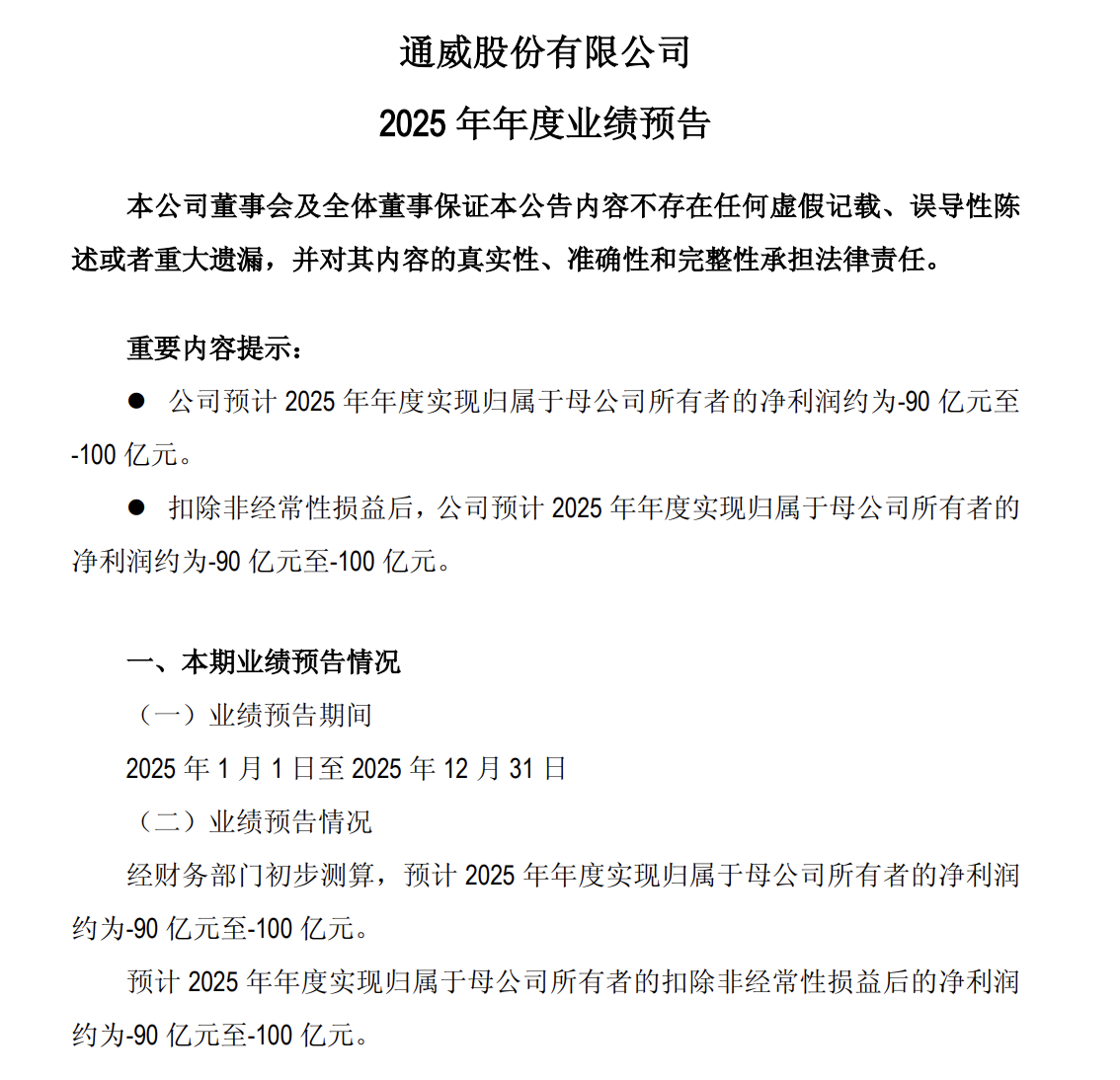
Core Viewpoint - The leading companies in the photovoltaic industry are expected to face significant losses in 2025, indicating a continued deep adjustment phase in the industry due to overcapacity, intense price competition, and increasing trade barriers [1] Group 1: Company Performance - Tongwei Co. and Longi Green Energy have projected net losses of 90-100 billion yuan and 60-65 billion yuan respectively for 2025, reflecting ongoing challenges in the photovoltaic sector [1] - Tongwei Co. reported that its industrial silicon business faced a net profit loss of approximately 9 billion yuan due to low product prices and production ramp-up issues, while its battery and module sales also declined, contributing to an additional loss of about 12 billion yuan [2] - Longi Green Energy highlighted that the persistent low prices and cost pressures in the photovoltaic industry have resulted in continued operational losses [6] Group 2: Industry Challenges - The photovoltaic industry is experiencing a dual weakness in supply and demand, with demand stabilizing after significant releases in previous years, and uncertainty surrounding future overseas market demand [10] - The recent regulatory changes by the State Administration for Market Regulation have dismantled the previously established self-regulatory measures in the silicon material industry, leading to a return to free competition [1] - The rising prices of silver have significantly increased production costs for battery and module segments, while the acceptance of these cost increases by end-users remains uncertain [10]


阿特斯三季度排产环比下调!光伏需求增速放缓,行业进入深度调整期
Sou Hu Cai Jing· 2025-08-03 18:52
Core Viewpoint - The photovoltaic industry is undergoing a deep adjustment period, with significant changes in market demand growth trends. Companies like Canadian Solar (阿特斯) are adjusting their production strategies in response to these industry-wide developments [1][4]. Industry Summary - The growth rate of photovoltaic demand is slowing, becoming a consensus within the industry. The domestic photovoltaic installation market has shown a pattern of high growth followed by a decline. In the first half of the year, the newly installed capacity reached 212 GW, setting a historical record. The China Photovoltaic Industry Association has raised its forecast for new installations this year to a range of 270 GW to 300 GW. However, after the surge in installations in the first half, the pace is expected to slow down in the second half [3]. - The overseas market exhibits different development characteristics. Changes in U.S. policies have a relatively limited short-term impact on demand, while emerging markets continue to show stable growth. Rapid development in regions such as the Indo-Pacific and Middle East-Africa is providing significant support for global photovoltaic demand, with these areas gradually releasing market potential and becoming new drivers for industry growth [3]. Company Summary - In response to profound market changes, Canadian Solar has adopted a flexible production adjustment strategy. The company's third-quarter production was dynamically adjusted based on market demand, showing a decrease compared to the second quarter. This adjustment reflects the company's accurate judgment of market conditions and its ability to respond quickly [4]. - The company has stated that its component business will not solely pursue shipment scale but will prioritize profit stability. By balancing supply and demand, the company aims to ensure stable profitability. This strategic shift indicates a transition in photovoltaic manufacturing enterprises from scale expansion to high-quality development [4]. - Starting in the first half of 2024, Canadian Solar has established a "balance of quantity and profit" development strategy. The company is proactively optimizing its shipment structure and focusing on high-value markets to regulate production capacity. This forward-looking strategy is proving valuable in the current market environment, laying a foundation for maintaining competitive advantages during the industry adjustment period [4].