
全球资产价格重估

Search documents
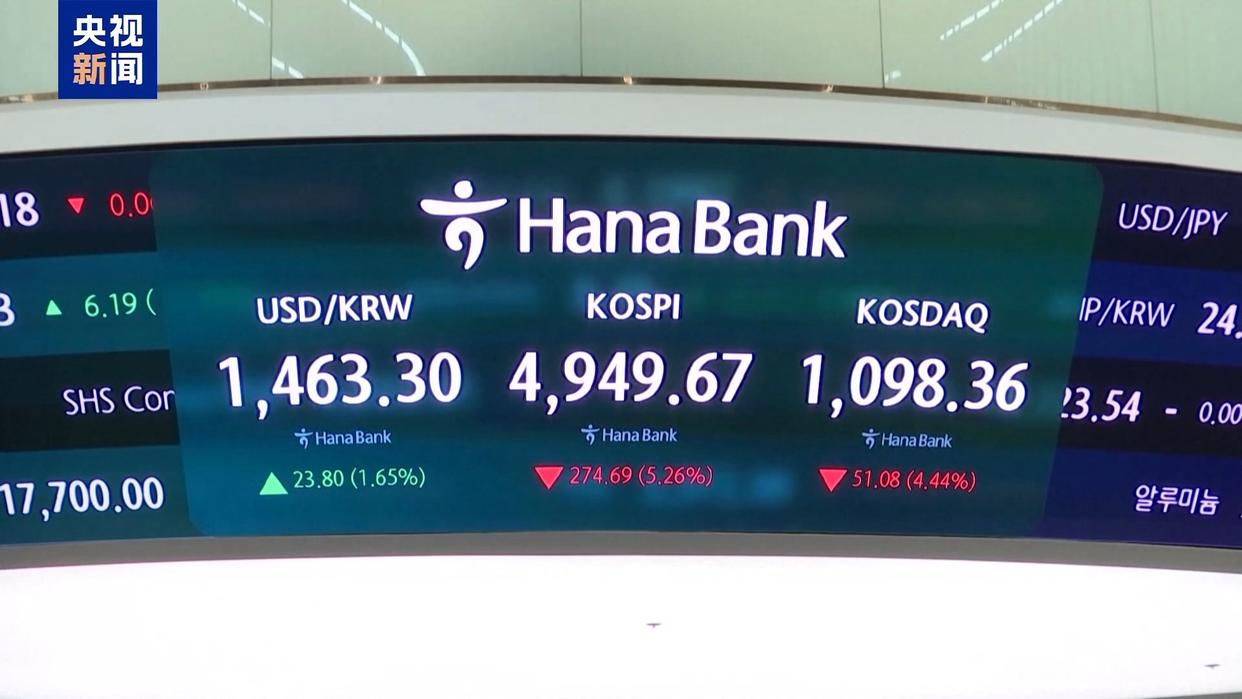
韩股大跌后触发熔断机制 专家:与美联储政策转向有关
Yang Shi Xin Wen· 2026-02-02 21:24
Group 1 - The Korean stock market experienced a significant drop, with the KOSPI index falling over 5%, triggering a trading halt for 5 minutes due to panic selling [1] - The nomination of Kevin Warsh as the next Federal Reserve Chairman by President Trump has led to a shift in market expectations, interpreted as a move towards a hawkish policy stance [1][12] - The strong dollar resulting from this nomination has decreased the attractiveness of emerging market assets, leading to capital outflows, particularly affecting the Korean market which heavily relies on foreign investment [1][12] Group 2 - The Korean stock market has structural vulnerabilities, being highly concentrated in a few industries like semiconductors, making it more susceptible to market fluctuations [4] - There is a risk of valuation bubbles in the market, causing heightened sensitivity to negative news, compounded by weak economic fundamentals and declining export growth [6] - Algorithmic trading has exacerbated market volatility, creating a vicious cycle of selling during downturns, which contributed to the recent market crash [6] Group 3 - The turbulence in the U.S. capital markets has led to a global reassessment of asset prices, with significant declines in precious metals and a divergence in stock market performance [8][9] - The shift in liquidity expectations and the reconstruction of policy credibility have increased uncertainty regarding future Federal Reserve policies, prompting a global capital reallocation [12] - The recent events in the Korean stock market reflect broader structural adjustments in the global financial system in response to the changing stance of the Federal Reserve [13]

今晚降多少?
Sou Hu Cai Jing· 2025-09-17 13:56
Group 1 - The core viewpoint is that the Federal Reserve is expected to lower interest rates in its upcoming meeting, with a 96% probability of a 25 basis point cut and a 4% chance of a 50 basis point cut [1][2] - The labor market data shows a significant slowdown, with only 22,000 jobs added in August 2025, far below the expected 75,000, and the unemployment rate rising to 4.3%, the highest in nearly four years [2][4] - The Federal Reserve's interest rate adjustments are seen as a tool for global economic influence, rather than solely responding to domestic inflation and employment metrics [6][7] Group 2 - The anticipated interest rate cut is viewed as a necessary measure to alleviate market pressures and is expected to impact various sectors, including housing and exports [13][10] - A potential 50 basis point cut could indicate the Fed's awareness of undisclosed systemic risks in the economy [12] - The global economic landscape is under significant stress, with emerging markets and Europe showing reduced resilience, suggesting that the Fed's actions will have far-reaching implications for global asset prices [9][10][14]
鲍威尔暗示降息引爆市场 道指创新高释放什么信号
Sou Hu Cai Jing· 2025-08-23 06:18
Group 1 - The core message of the articles revolves around the potential for a new round of interest rate cuts by the Federal Reserve, as indicated by Chairman Powell's dovish signals at the Jackson Hole conference [1][2] - Powell's shift in language from "robust" to "significantly slowing labor market" is seen as a critical indicator of a policy shift [1] - The mention of "decreasing high tariff cost pressures" provides a new perspective on declining inflation [1] - Powell's statement of being "open to rate cuts" has sparked significant market enthusiasm, suggesting a possible turning point in Federal Reserve monetary policy [1] Group 2 - The market reaction has been notably intense, with the Dow Jones surging 800 points to reach a historical high, and Tesla's market value increasing by $460 billion [1] - The Nasdaq Golden Dragon Index, which tracks Chinese stocks, rose by 2.74% in a single day, indicating that Chinese assets may be among the biggest beneficiaries of this potential easing [1] - Historical data shows that a shift in Federal Reserve policy often leads to significant cross-border capital migration, with current trends indicating a potential influx of international capital into Asian emerging markets [2] - The decline in U.S. Treasury yields, particularly the 30-year yield dropping below 4.9%, may accelerate this capital movement [2]