
公司治理水平

Search documents
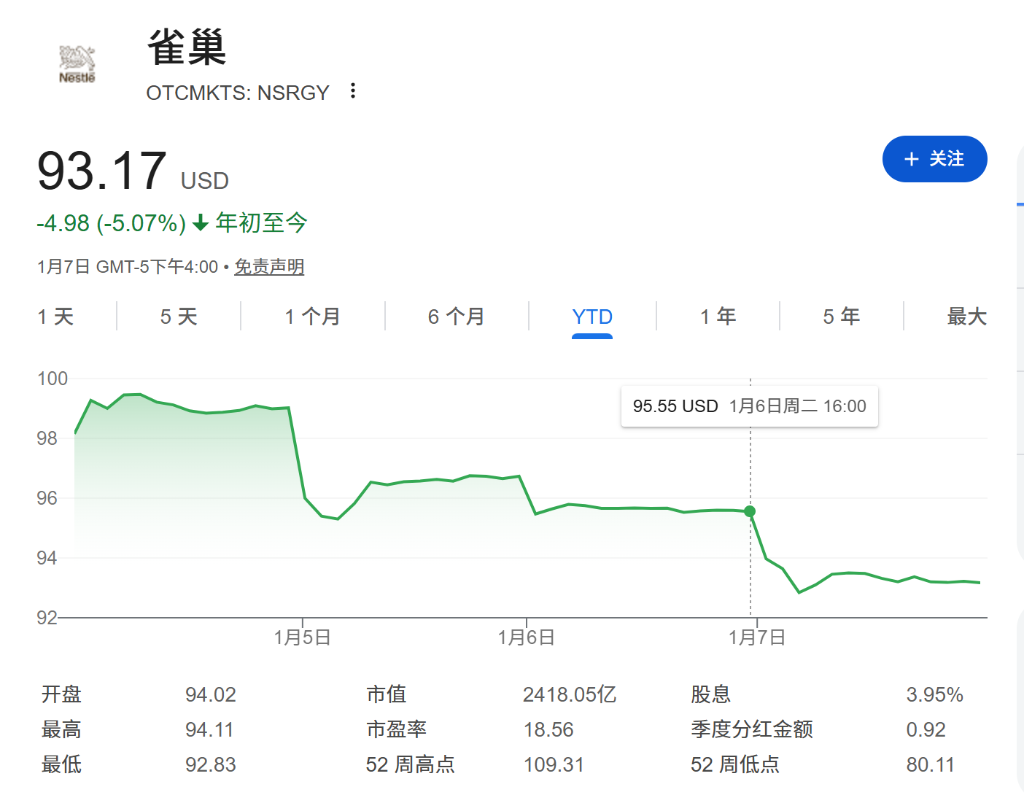
涉及46国!雀巢宣布全球大范围召回婴儿奶粉,或面临12亿瑞郎销售损失
Hua Er Jie Jian Wen· 2026-01-08 13:32
Core Insights - Nestlé is facing a significant trust crisis and financial challenge due to a large-scale recall of infant formula products across 46 countries, potentially leading to sales losses of up to 1.2 billion Swiss francs (approximately 1.35 billion USD) [1][2] - The recall was initiated due to concerns over possible contamination by Bacillus cereus toxins, which can cause nausea and vomiting, and has rapidly expanded from Europe to Asia, Latin America, the Middle East, and Africa [1] - The company's new CEO, Philipp Navratil, is under pressure to restore investor confidence and manage operational issues, with this recall exacerbating concerns about the company's internal controls and execution capabilities [5][6] Financial Impact - Analysts estimate that the recall could impact approximately 1.3% of Nestlé's group sales, with risk exposure reaching up to 1.2 billion Swiss francs [2] - Barclays analyst Warren Ackerman predicts total risk could account for 0.8% to 1.5% of group sales, while Nestlé claims the recalled products represent "far less than 0.5%" of annual sales [2] Brand Reputation - Market analysts express greater concern over the long-term damage to Nestlé's brand reputation than the immediate financial impact, highlighting disappointment in the company's execution and communication abilities [6] - Previous compliance and operational issues have already put pressure on Nestlé's reputation, including investigations by French authorities and recalls in the U.S. due to contamination concerns [6] Contamination Source - The contamination was traced back to a quality issue with arachidonic acid oil, affecting well-known brands such as NAN, BEBA, Guigoz, SMA, and Alfamino [7] Market Recovery Outlook - Analysts predict varying consumer responses in different countries, with potential risks highlighted in the Chinese market, referencing a past incident involving Danone that resulted in significant sales losses [8] - In contrast, the U.S. market has shown stronger recovery capabilities, as evidenced by Abbott's quick rebound after a similar recall [8]


2024年度A股CFO数据报告|百龙创园CFO李莉薪酬逆势大涨111%,公司股价跌幅超40%引关注
Xin Lang Cai Jing· 2025-08-04 11:37
Group 1 - The total compensation for CFOs in A-share listed companies reached 4.27 billion yuan in 2024, with an average annual salary of 814,800 yuan [2] - CFO of Bailong Chuangyuan, Li Li, saw her salary increase to 306,400 yuan in 2024, a 111.60% rise from 144,800 yuan in 2023, despite the company's stock price dropping by 40.47% [2][3] - Bailong Chuangyuan's total market value fell to 5.46 billion yuan by the end of 2024, highlighting a significant disconnect between executive compensation and company performance [2][3] Group 2 - Bailong Chuangyuan reported a revenue of 1.15 billion yuan in 2024, a year-on-year increase of 32.64%, and a net profit attributable to shareholders of 246 million yuan, up 27.26% [3] - The increase in CFO compensation amidst a declining stock price raises concerns about corporate governance and the alignment of executive pay with shareholder returns [3]

科技股投资前景如何评估?
Sou Hu Cai Jing· 2025-07-15 23:00
Group 1 - The investment outlook for technology stocks is influenced by various factors, including macroeconomic conditions, monetary policy, and industry-specific dynamics [1][2] - During economic expansion, demand for technology products and services increases, leading to potential price rises for technology stocks, while economic contraction can pressure revenues and stock performance [1] - Loose monetary policy enhances market liquidity and reduces financing costs, benefiting technology companies' ability to invest in R&D and acquisitions, whereas tight monetary policy can hinder financing and increase operational costs [1] Group 2 - The rapid development and transformation within the technology sector, driven by emerging technologies like artificial intelligence and quantum computing, are critical for assessing investment potential [2] - Competitive dynamics in the technology industry are intense, with companies possessing core technologies, strong R&D teams, and good brand reputation having a better chance of success and profitability [2] - Financial health indicators such as stable cash flow, reasonable debt structure, and strong profitability are essential for a technology company's sustained growth and attractiveness in the market [2] - Effective corporate governance is vital for long-term development, ensuring sound decision-making and risk management, which positively influences the investment outlook for technology stocks [2]