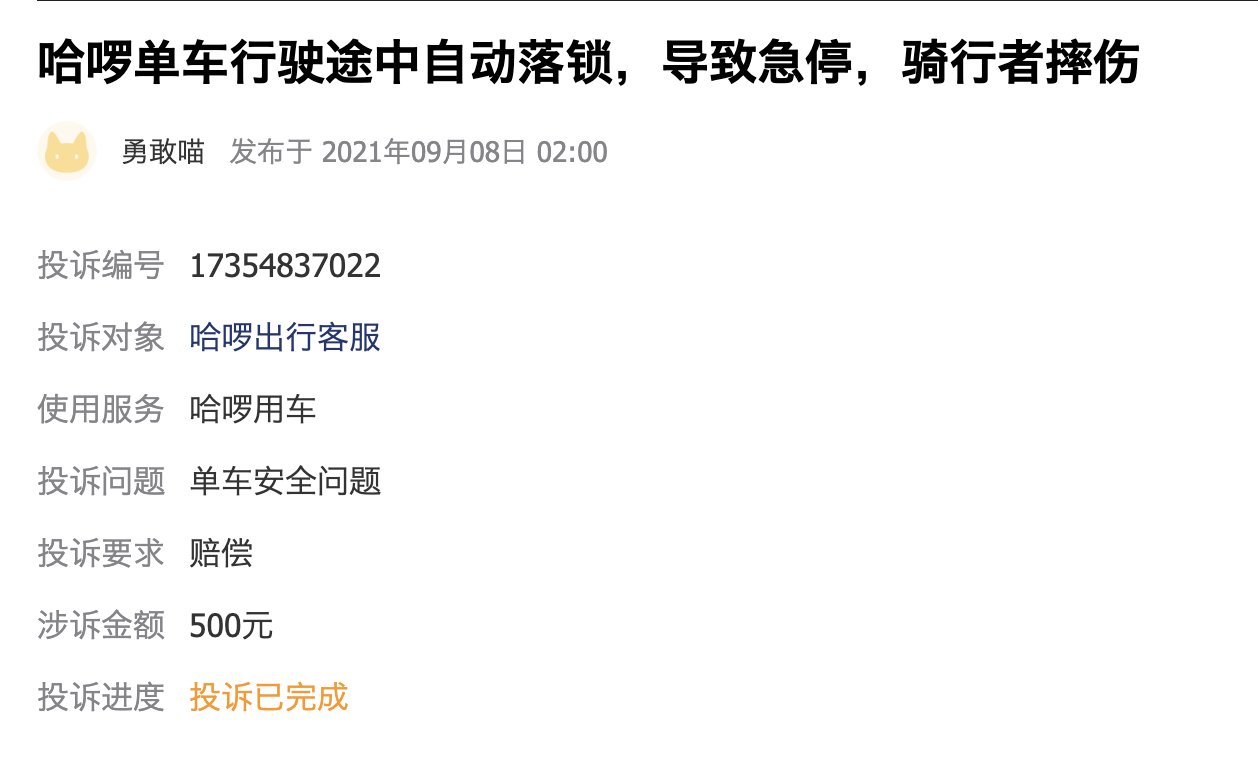
共享单车安全问题

Search documents
共享单车骑行中自动落锁致摔伤?品牌方:未发现技术缺陷,梳理后发现有三种可能
Yang Zi Wan Bao Wang· 2025-09-12 14:35
Core Viewpoint - A recent incident involving a woman who suffered a broken right foot due to a sudden locking of a Didi Qingju shared bicycle has raised significant safety concerns regarding shared bicycles in China [1] Group 1: Incident Details - The incident occurred when a woman was riding a Didi Qingju bicycle, which reportedly locked unexpectedly, leading to her injury [1] - The woman was diagnosed with three fractures in her right foot, and the platform indicated there was no record of an automatic lock in the backend, suggesting a possible chain malfunction [1] - Similar incidents have been reported by users of various brands, including Hello Bike and Meituan, indicating a broader issue within the shared bicycle industry [1][7] Group 2: Industry Statistics - As of December 2023, there are over 6 billion users of internet rental (electric) bicycles in China, with more than 12 million bicycles deployed across over 410 cities [1] - The number of internet rental bicycles exceeds 8 million across more than 700 cities, highlighting the extensive reach and popularity of shared bicycles [1] Group 3: Company Responses - Didi Qingju stated that bicycles should not automatically lock during use and that regular maintenance checks are conducted to ensure safety [1][12] - Hello Bike's response indicated that their technical team found no evidence of a technical defect causing automatic locking, suggesting user error or external factors may be involved [12][13] - Both companies are actively investigating user feedback and have implemented measures to improve safety and user experience [12][13]

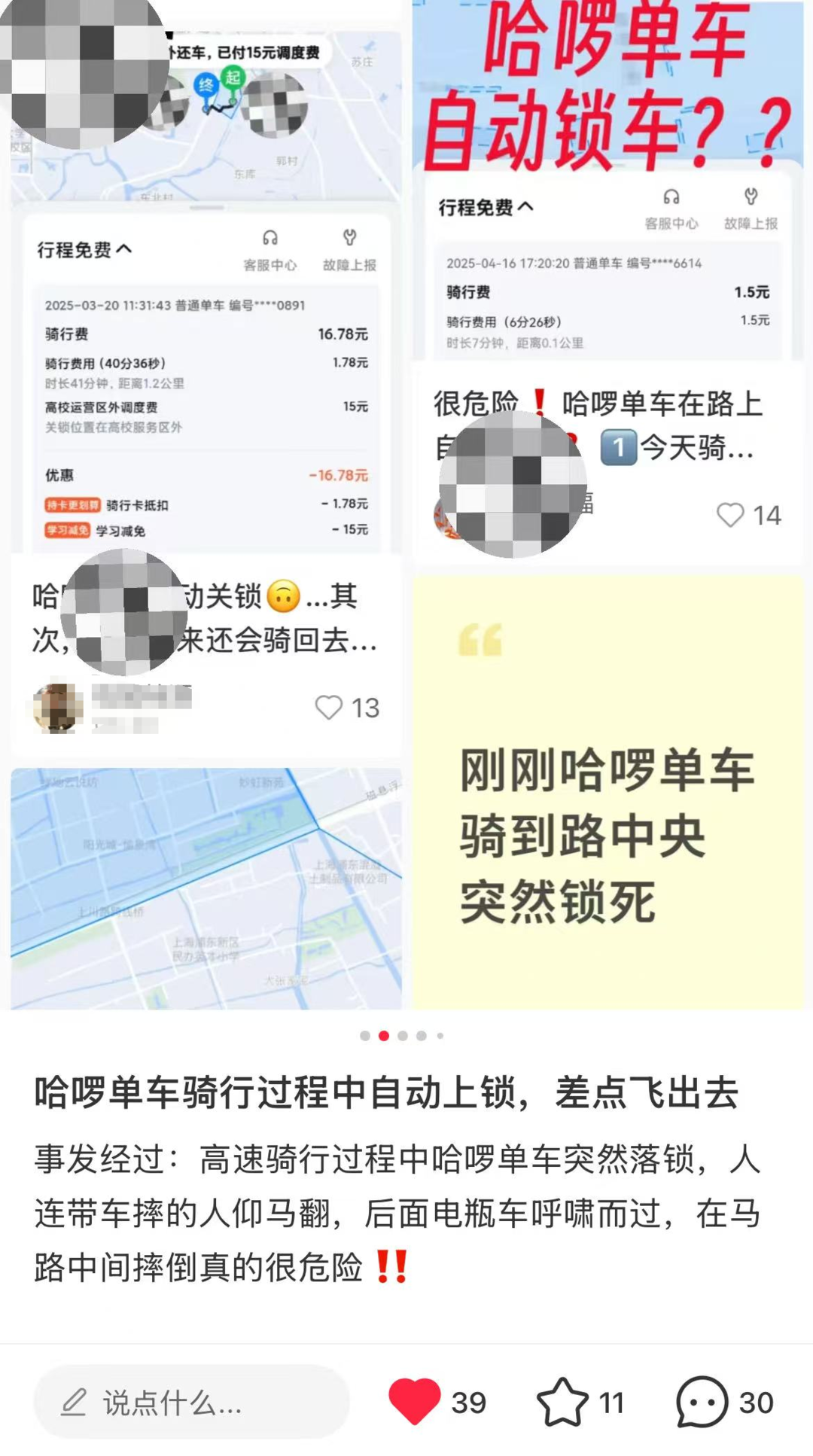
刚扫的单车,没骑几分钟就“车轮抱死”,人被摔骨折!青桔、哈啰回应
凤凰网财经· 2025-09-12 12:50
Core Viewpoint - The article highlights the safety concerns surrounding shared bicycles, particularly incidents of automatic locking that have led to user injuries, prompting calls for improved accountability and safety measures within the industry [2][3]. Group 1: Company Responses - Both major companies, Qingju and Hello Bike, have denied that technical defects caused the automatic locking incidents, attributing issues to potential hardware problems such as loose chains [5][6]. - Qingju has expressed regret for the negative riding experience and is actively managing user claims and insurance processes following reported accidents [5]. - Hello Bike has outlined three scenarios that could lead to automatic locking, emphasizing that their locking mechanism is designed to prevent locking while the bike is in motion [6]. Group 2: User Concerns and Industry Analysis - Users have expressed skepticism regarding the companies' self-assessments, suggesting that independent third-party evaluations are necessary to ensure vehicle safety [7]. - Industry analysts argue that the responsibility for safety should be reinforced through technological improvements and better product design to minimize risks [8]. - The article notes that the shared bicycle user base is expected to exceed 600 million by 2024, with a significant increase in riding frequency, highlighting the need for improved safety and claims mechanisms [9][11]. Group 3: Recommendations for Improvement - Analysts recommend that the shared bicycle industry adopt a more mature insurance framework similar to that of ride-hailing services, clarifying accident liability and compensation processes [11]. - It is suggested that leading companies establish a consumer protection fund to cover damages not addressed by traditional insurance [11]. - Regulatory bodies are encouraged to focus on enforcing existing responsibilities rather than introducing new regulations, promoting a more effective problem-solving framework [12]. Group 4: Future Directions - The shared bicycle industry is transitioning from rapid growth to refined operations, with a focus on enhancing user trust through transparency, improved insurance mechanisms, and corporate social responsibility [13]. - Achieving a state where users feel secure while riding and have clear compensation pathways is essential for the sustainable integration of shared bicycles into urban transportation systems [14].

共享单车自动落锁造成安全隐患 哈啰单车官方回应
Xi Niu Cai Jing· 2025-09-12 07:58
Core Viewpoint - The response from Hello Bike regarding incidents of automatic locking during rides indicates that there are no technical defects in the bike lock system, and the company has identified potential user-related causes for the incidents [1] Group 1: Technical Analysis - Hello Bike's technical team conducted a thorough investigation using user data and found no evidence of technical defects causing the automatic locking issue [1] - The bike lock design includes a specific logic that prevents locking when the speed is above 0.5 m/s, only allowing the lock to engage when the bike is at a very low speed [1] Group 2: User Behavior Insights - Two potential scenarios were identified for the automatic locking incidents: 1. Users may accidentally trigger the "return" button while riding due to friction or other reasons, leading to the bike locking [1] 2. If a previous user fails to lock the bike before leaving, the next user may inadvertently cause the bike to lock when stopping, as the previous user can still lock the bike remotely [1] Group 3: Market Implications - The safety issues related to Hello Bike's service will require ongoing market attention and scrutiny to ensure user safety and trust in the service [1]
刚扫的单车没骑几分钟就“车轮抱死”,人被摔骨折,青桔、哈啰回应
Mei Ri Jing Ji Xin Wen· 2025-09-11 23:24
Core Viewpoint - The frequent incidents of automatic locking of shared bicycles have raised significant safety concerns among users, prompting major companies like Qingju and Hello to respond to allegations of technical defects while denying any responsibility for the accidents [1][3][4]. Group 1: Incident Reports - There have been at least 41 reported incidents of shared bicycles automatically locking during rides over the past two years, affecting multiple platforms [1]. - A specific case involved a user, Ms. Ma, who suffered three fractures and soft tissue injuries after an unexpected brake while riding a Qingju bicycle [3]. Group 2: Company Responses - Qingju stated that the incidents may be due to a loose chain causing riding difficulties, and they have initiated a hardware and software check on the involved bicycles [3]. - Hello also denied any technical defects, asserting that their system did not detect any anomalies related to automatic locking and emphasized that all bicycles undergo strict testing before use [4]. Group 3: User Concerns and Industry Analysis - Users have expressed skepticism regarding the companies' self-assessments, suggesting that third-party evaluations of vehicle safety should be introduced to enhance public trust [4]. - Industry analysts highlight the need for shared bicycle companies to improve product design and safety measures to mitigate risks and clarify liability in case of accidents [5][9]. Group 4: Insurance and Liability - The current insurance mechanisms for shared bicycles are seen as inadequate, particularly regarding accidents caused by vehicle defects, and there is a call to adopt a more structured insurance system similar to that of ride-hailing services [9][10]. - Recommendations include establishing a consumer protection fund by leading companies to cover damages not addressed by traditional insurance [9][10]. Group 5: Regulatory Perspective - Regulatory bodies have been monitoring the shared bicycle industry, focusing on issues like price hikes, but there is a suggestion to enhance enforcement of corporate responsibility rather than imposing new regulations [10]. - The industry is transitioning from rapid growth to refined operations, emphasizing the importance of transparency, improved insurance mechanisms, and corporate social responsibility to foster a safer riding environment [10].
共享单车岂能半道使绊
Xin Lang Cai Jing· 2025-09-11 09:22
Core Points - The sudden locking of shared bicycles poses significant safety risks to users, with at least 41 reported incidents since July, particularly in Shanghai [1][2] - The platforms involved deny responsibility, attributing incidents to mechanical failures or user behavior, leading to user frustration and safety concerns [1] - The user base of shared bicycles has surpassed 600 million, indicating that even minor risks can escalate into major safety issues [1] Group 1 - The need for companies to investigate the causes of sudden locking incidents and identify potential safety hazards in their bicycles [2] - Regulatory bodies should intervene to clarify the circumstances surrounding these locking incidents to ensure user safety [2] - Transparency in addressing the root causes of locking incidents is essential for restoring user confidence in shared bicycle services [2]
共享单车自动落锁致摔伤?他们各执一词→
第一财经· 2025-09-11 01:56
Core Viewpoint - The safety issues surrounding shared bicycles have come to the forefront following incidents of automatic locking leading to user injuries, raising concerns about the reliability of the safety mechanisms in place [3][9]. Summary by Sections Incident Reports - A recent incident involved a woman who suffered multiple fractures after a shared bicycle suddenly locked while in use, with the platform denying any automatic locking records [3][4]. - Similar incidents have been reported on social media, indicating a pattern of automatic locking issues across various brands, including Hello and Meituan [4][6]. Company Responses - Both Didi Qingju and Hello Bike have stated that their investigations found no software or technical faults, attributing incidents to potential mechanical issues like chain malfunctions or user errors [6][9]. - Hello Bike outlined three possible scenarios for the automatic locking incidents, including user error and previous users not properly locking the bike [6][8]. Safety Mechanisms - Hello Bike emphasized that their locking mechanism is designed to prevent automatic locking while the bike is in motion, with a speed threshold of 0.5 m/s [8]. - The company also clarified that some reported incidents were misattributed to automatic locking, citing other mechanical failures as the cause [8]. Industry Concerns - The widespread use of shared bicycles, with over 600 million users and more than 12 million vehicles deployed across 410 cities, highlights the importance of reliable safety mechanisms [9]. - There is a call for third-party testing and government oversight to address public concerns and resolve the discrepancies between user reports and company claims [9].
共享单车自动落锁致摔伤?用户、企业各执一词
Di Yi Cai Jing· 2025-09-11 01:43
Core Viewpoint - The safety issues surrounding shared bicycles, particularly the automatic locking feature, have come under scrutiny following incidents of users being injured due to sudden lock-ups while riding [1][5]. Group 1: Incident Reports - A recent incident involved a woman who suffered multiple fractures after a shared bicycle suddenly locked while in motion, with the platform indicating no automatic lock records were found [2][5]. - Similar incidents have been reported on social media, with users from various brands, including Hello and Meituan, sharing experiences of unexpected lock-ups leading to injuries [3][5]. - Historical complaints date back to 2021, indicating that the issue of automatic locking has been a persistent concern among users [3][5]. Group 2: Company Responses - Both Didi Qingju and Hello have stated that their investigations found no software or technical faults, attributing incidents to potential chain malfunctions or user errors [1][5]. - Hello's system is designed to prevent locking when the bicycle is moving above 0.5 m/s, and they assert that the locking mechanism is not triggered during normal riding conditions [6][5]. - The companies emphasize that user feedback and data analysis have not revealed any technical defects leading to automatic locking incidents [5][6]. Group 3: Industry Concerns - The automatic locking feature is intended to prevent users from forgetting to lock the bicycles after use, but there is inconsistency in how long a bicycle remains unlocked before it automatically locks [7]. - The safety of shared bicycles is a significant public concern, with over 600 million users reported in China, and the need for reliable safety mechanisms is critical [7]. - There are calls for the introduction of third-party testing and government oversight to address public concerns and resolve the discrepancies between user reports and company claims [7].