
养老机构预收费监管

Search documents
两部门联合出台措施 规范养老机构预收费监管
Jing Ji Ri Bao· 2025-12-21 00:14
Core Viewpoint - The Ministry of Civil Affairs and the Financial Regulatory Bureau have issued the "Guidelines for the Management of Prepaid Fees in Elderly Care Institutions," aiming to strengthen and standardize the supervision of prepaid fees, enhance deposit management rules, and protect the legal rights of the elderly [1] Group 1: Regulatory Framework - The new guidelines are part of a broader effort to establish a comprehensive regulatory policy for prepaid fees in elderly care institutions, which includes measures to prevent illegal fundraising and ensure the safety of elderly individuals' funds [1][2] - Since 2022, the Ministry of Civil Affairs has intensified its regulatory efforts, resulting in a decrease in the number of illegal fundraising cases, participants, and amounts involved [1] Group 2: Special Account Usage - A key highlight of the guidelines is the requirement for elderly care institutions to deposit collected fees into dedicated accounts, effectively isolating these funds from operational risks [2] - The guidelines stipulate that any changes or cancellations of these accounts must be reported, preventing potential misuse of funds [2] Group 3: Monitoring and Risk Management - The guidelines define four categories of abnormal fund flows, including large transactions and suspicious activities, which trigger a need for banks to halt expenditures and alert the Ministry of Civil Affairs [3] - A mechanism for sharing information about illegal fundraising issues has been established between the Ministry of Civil Affairs and financial regulatory departments to facilitate early detection and response [2][3] Group 4: Challenges and Recommendations - Despite clear policies, challenges remain in fully resolving disputes related to prepaid fees, including compliance costs for smaller institutions and a lack of awareness among the elderly regarding the new regulations [3] - Experts suggest that collaboration among regulatory bodies, the industry, and institutions is essential to enhance the safety and security of elderly individuals' funds [3]
规范养老机构预收费监管
Jing Ji Ri Bao· 2025-12-20 01:15
Core Viewpoint - The Ministry of Civil Affairs and the Financial Regulatory Bureau have issued guidelines to strengthen and standardize the prepayment supervision of elderly care institutions, ensuring the protection of the legal rights of the elderly [1] Group 1: Regulatory Framework - The new guidelines aim to enhance the regulatory framework for prepayments in elderly care institutions, addressing issues such as insufficient occupancy rates and operational inefficiencies that can lead to financial instability [1] - Since 2022, the Ministry of Civil Affairs has intensified its efforts to prevent and address illegal fundraising in elderly care institutions, resulting in a decrease in the number of illegal fundraising cases, participants, and amounts involved [1] Group 2: Special Account Usage - A key highlight of the guidelines is the requirement for elderly care institutions to deposit collected deposits and membership fees into dedicated accounts, effectively isolating these funds from operational risks [2] - The guidelines define the rights and obligations of both the elderly care institutions and the custodial banks, emphasizing that custodial banks are not responsible for marketing or dispute resolution [2] Group 3: Monitoring and Risk Management - The guidelines specify four categories of abnormal fund flows, including large transactions and suspicious activities, which trigger a need for custodial banks to halt expenditures and alert the Ministry of Civil Affairs [3] - A shared mechanism for reporting illegal fundraising issues has been established between the Ministry of Civil Affairs and financial regulatory departments to facilitate early detection and response [2][3] Group 4: Challenges and Recommendations - Despite clear policies, challenges remain in resolving prepayment disputes, including the potential for smaller institutions to evade compliance and the lack of awareness among the elderly regarding the new regulations [3] - Experts suggest that collaboration among regulatory bodies, the industry, and institutions is essential to enhance the safety and security of elderly care services, including linking compliance with institutional ratings and subsidies [3]
两部门联合出台措施——规范养老机构预收费监管
Jing Ji Ri Bao· 2025-12-19 22:35
Core Viewpoint - The Ministry of Civil Affairs and the Financial Regulatory Bureau have issued the "Guidelines for the Management of Prepaid Fees in Elderly Care Institutions," aiming to strengthen and standardize the supervision of prepaid fees, enhance deposit management rules, and protect the legal rights of the elderly [1] Group 1: Regulatory Framework - The new guidelines are part of a broader effort since 2022 to combat illegal fundraising in elderly care institutions, resulting in a decrease in the number of illegal fundraising cases, participants, and amounts involved [1] - The guidelines aim to establish a comprehensive regulatory policy system for prepaid fees, ensuring the safety of elderly individuals' funds [1] Group 2: Special Account Management - A key highlight of the guidelines is the requirement for elderly care institutions to deposit collected fees into dedicated accounts, effectively isolating these funds from operational risks [2] - The guidelines define the rights and responsibilities of both the elderly care institutions and the banks managing these accounts, prohibiting institutions from using banks for marketing purposes [2] Group 3: Monitoring and Risk Management - The guidelines specify four categories of abnormal fund flows, including large transactions and suspicious activities, which trigger a need for banks to halt expenditures and alert the Ministry of Civil Affairs [3] - A multi-departmental risk interception network is established to address issues related to illegal fundraising and money laundering [3] Group 4: Challenges and Recommendations - Despite clear policies, challenges remain in fully resolving disputes related to prepaid fees, including the potential for smaller institutions to evade compliance and elderly individuals being misled by attractive offers [3] - Experts suggest that collaboration among regulatory bodies, the industry, and institutions is essential to enhance the awareness of risks among the elderly and promote short-term payment options to reduce reliance on prepaid fees [3]
银行介入,能解决养老机构爆雷吗?
Feng Huang Wang· 2025-11-28 13:21
Core Viewpoint - The article discusses the increasing risks associated with prepaid services in the elderly care sector, highlighting the need for regulatory measures to prevent fraud and protect the elderly's financial interests [1][2]. Group 1: Regulatory Measures - On November 19, the Ministry of Civil Affairs and the Financial Regulatory Bureau jointly issued guidelines for the management of prepaid funds in elderly care institutions to strengthen supervision and establish a third-party custody system with commercial banks [1][11]. - By July 2024, a cross-departmental regulatory mechanism for prepaid funds in elderly care institutions is expected to be established, as outlined in the guiding opinions released by multiple government departments [1][2]. Group 2: Prepaid Model and Risks - The prepaid model, while beneficial for cash flow and customer retention, has led to significant risks, including the potential for institutions to mismanage funds and fail to deliver promised services [4][5]. - Many elderly care institutions have adopted the prepaid model to alleviate funding shortages, but this has resulted in non-compliance with contractual obligations and financial mismanagement [4][5]. Group 3: Fraudulent Practices - The elderly care sector has seen a rise in fraudulent schemes, with scammers targeting the elderly by promising high returns on prepaid services, often leading to significant financial losses [5][8]. - Cases of fraud have been particularly severe in developed regions, with instances of institutions collecting large sums from elderly clients and subsequently disappearing [5][9]. Group 4: Vulnerability of the Elderly - The elderly are particularly susceptible to scams due to a combination of factors, including a lack of financial literacy, social isolation, and a tendency to make large upfront payments for services [10][12]. - The article emphasizes the need for increased awareness and communication between elderly individuals and their families to prevent financial exploitation [10][12]. Group 5: Role of Banks - Banks are encouraged to play a significant role in managing prepaid funds, ensuring that funds are used appropriately and monitoring for suspicious transactions [11][12]. - The guidelines stipulate that banks must verify the identity of institutions and ensure that funds are used for their intended purposes, although they are not liable for the actions of the institutions [11].


多维度监管养老预收费
Jing Ji Ri Bao· 2025-11-25 00:02
Core Viewpoint - The Ministry of Civil Affairs and the Financial Regulatory Bureau have jointly issued guidelines to strengthen the supervision of prepayment in elderly care institutions, aiming to enhance the third-party custody system in commercial banks [1] Group 1: Regulatory Framework - The guidelines specify requirements for the establishment, modification, and cancellation of dedicated deposit accounts for elderly care institutions [1] - There is a need for a multi-dimensional collaborative effort to ensure the effective implementation of the new regulations [1] Group 2: Monitoring and Compliance - Relevant departments are required to establish a dynamic regulatory mechanism to monitor the flow of funds through data sharing [1] - Commercial banks must improve their custody systems and set thresholds for abnormal fund flows to enable early detection and intervention of risks [1] Group 3: Transparency and Accountability - Elderly care institutions are required to establish a financial information disclosure system to regularly inform residents and their families about the use of funds [1] - Elderly individuals and their families can refer to the list of compliant institutions and custody information published by the Ministry of Civil Affairs when selecting care facilities [1]
民政部、金融监管总局联合发文!
Jin Rong Shi Bao· 2025-11-21 04:48
Core Viewpoint - The Ministry of Civil Affairs and the Financial Regulatory Bureau have jointly developed the "Guidelines for the Management of Prepaid Fees in Elderly Care Institutions" to enhance the supervision of prepaid fees and protect the legal rights of the elderly [1][3]. Summary by Sections Regulatory Framework - In recent years, some elderly care institutions have adopted prepaid service fees, deposits, and membership fees, which have led to issues such as non-compliance with contracts and financial mismanagement [3]. - A joint directive from seven departments, including the Ministry of Civil Affairs and the People's Bank of China, aims to strengthen the regulation of prepaid fees in elderly care institutions by establishing a cross-departmental regulatory mechanism by 2025 [3]. Prepaid Fee Management - The "Guidelines" stipulate that elderly care institutions must select a bank from a list published by civil affairs departments to open a dedicated prepaid deposit account for managing prepaid fees [3][4]. - The guidelines outline the processes for opening, changing, and closing these dedicated accounts, emphasizing that funds collected must be deposited into the account promptly [4]. Fund Usage and Refunds - Elderly care institutions are required to submit expenditure requests to the managing bank, detailing the purpose and providing supporting documents [4]. - Refunds must be processed by the bank within one day of receiving a valid refund request from the institution, ensuring timely returns to clients [4]. Risk Management - The guidelines mandate that banks must report any suspicious or abnormal transactions to the relevant civil affairs department and other regulatory bodies [4]. - Specific reporting requirements are in place for large transactions, suspicious activities, and potential illegal fundraising [4]. Rights and Responsibilities - The guidelines clarify the rights and responsibilities of both elderly care institutions and managing banks, including the obligation of institutions to provide accurate documentation and the banks' responsibility to manage funds without charging additional fees [5]. - Banks are not liable for disputes arising from the services provided by elderly care institutions or insufficient account balances [5].
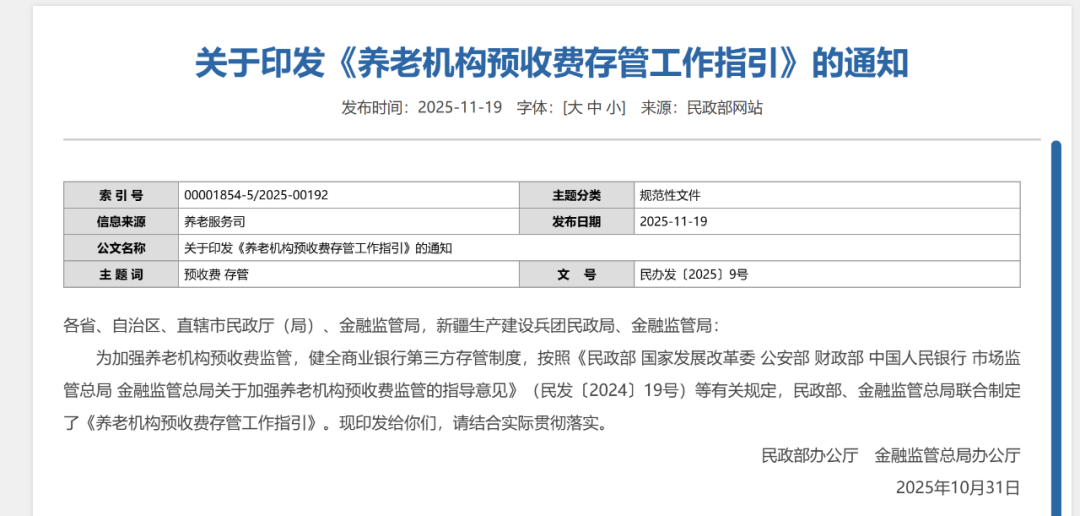
进一步加强养老机构预收费监管
Ren Min Ri Bao· 2025-11-20 22:21
Core Viewpoint - The Ministry of Civil Affairs and the Financial Regulatory Administration have issued guidelines to enhance the supervision of prepayment collection by elderly care institutions, ensuring the protection of the legal rights of the elderly [1][2]. Summary by Relevant Sections - **Prepayment Special Deposit Accounts**: The guidelines define a special deposit account as one opened by elderly care institutions at commercial banks for managing deposits, membership fees, and required risk guarantee funds collected from the elderly. Institutions must report to the regulatory civil affairs department before closing such accounts and cannot collect further deposits or fees from the elderly after reporting [1]. - **Collection and Management of Fees**: Elderly care institutions are required to collect deposits and membership fees primarily through the deposit bank. If collected through other payment institutions or in cash, the funds must be transferred to the special deposit account by the end of the following day. Funds can be used for emergency medical expenses for the elderly, with the bank allowed to process these requests without prior documentation, provided that supporting materials are submitted within seven working days post-treatment [1]. - **Monitoring of Transactions**: The guidelines stipulate that if there are large, suspicious, high-risk, or non-designated purpose transactions in the special deposit accounts, the deposit bank must not process expenditures other than refunds and must alert the regulatory civil affairs department about the risks [2].
民政部、金融监管总局印发工作指引 进一步加强养老机构预收费监管
Ren Min Ri Bao· 2025-11-20 21:46
Core Viewpoint - The Ministry of Civil Affairs and the Financial Regulatory Administration have issued guidelines to enhance the supervision of prepayment collection by elderly care institutions, establishing a third-party deposit system with commercial banks to protect the legal rights of the elderly [1] Group 1: Guidelines on Prepayment Collection - The guidelines specify that a dedicated deposit account must be opened by elderly care institutions at commercial banks to manage prepayments such as deposits and membership fees from the elderly [1] - If an elderly care institution intends to close the dedicated deposit account, it must report the disposal plan of the deposited funds to the regulatory civil affairs department in advance [1] - Institutions are required to collect deposits and membership fees primarily through the deposit bank; any other payment methods must transfer funds to the dedicated account by the end of the following day [1] Group 2: Fund Management and Refund Procedures - Funds in the dedicated account can be used for emergency medical expenses for the elderly, with the bank allowed to process these transactions without prior documentation, provided that supporting materials are submitted within seven working days after the medical event [1] - Refund requests must be submitted promptly by the elderly care institution to the deposit bank, which is required to process the refund on the same day or the next day after verifying the information [1] Group 3: Monitoring and Risk Management - The guidelines mandate that the deposit bank must not process expenditures for the elderly care institution if there are large transactions, suspicious activities, high-risk transactions, or funds used for non-designated purposes, and must alert the regulatory civil affairs department of any risks [1]
两部门发文健全存管规则 加强养老机构预收费监管
Zhong Guo Qing Nian Bao· 2025-11-19 23:18
Core Viewpoint - The Ministry of Civil Affairs and the Financial Regulatory Administration have issued guidelines to strengthen and standardize the supervision of prepayment deposits in elderly care institutions, ensuring the protection of the legal rights of the elderly [1][2]. Group 1: Guidelines for Elderly Care Institutions - Elderly care institutions must select a bank from a list provided by the Ministry of Civil Affairs to open a dedicated prepayment deposit account and sign a custody agreement [1]. - Institutions are required to report to the regulatory authority before closing the dedicated account and cannot collect deposits or membership fees thereafter [1]. - Deposits and membership fees should primarily be collected through the custody bank, and any other collection methods must transfer funds to the dedicated account by the next day [1]. Group 2: Fund Management and Usage - Institutions must submit expenditure requests to the custody bank, detailing the purpose and providing supporting documents [1][3]. - In emergencies, funds can be used for medical expenses, but supporting documents must be submitted within seven working days after the event [1]. Group 3: Refund Procedures - Institutions must promptly submit refund requests to the custody bank for fees that are due for refund, which should be processed within one day [2]. - The custody bank is prohibited from processing expenditures for accounts with suspicious or abnormal transactions and must report such cases to the relevant regulatory authorities [2]. Group 4: Responsibilities of Custody Banks - Custody banks are responsible for managing the deposited funds and cannot charge additional service fees [3]. - Banks must develop a management system for tracking the funds and ensure data integration with the Ministry of Civil Affairs [3]. - All transactions must be conducted through designated platforms, and banks must alert institutions if their balance falls below the required risk guarantee amount [3].
两部门印发通知 进一步加强和规范养老机构预收费监管
Yang Shi Wang· 2025-11-19 08:32
Core Viewpoint - The Ministry of Civil Affairs and the Financial Regulatory Administration have issued guidelines for the management of prepaid fees in elderly care institutions, aiming to enhance regulation and protect the legal rights of the elderly [1][3]. Group 1: Establishment and Management of Special Deposit Accounts - Elderly care institutions must open a special deposit account at a commercial bank to manage prepaid deposits and membership fees, selecting from banks listed by the Ministry of Civil Affairs [4]. - Institutions are required to provide necessary documentation for account opening, and any changes or closures must be reported to the regulatory authority within seven working days [5]. Group 2: Use of Managed Funds - Funds collected must be deposited into the special account on the same day or the next day, and any expenditures must be approved by the deposit bank with supporting documentation [6]. - In emergencies, funds can be used for elderly medical expenses, but documentation must be provided within seven working days post-expenditure [6]. Group 3: Refund of Managed Funds - Refund requests must be submitted to the deposit bank, which is obligated to process refunds within one day upon verification of the request [7]. - If the special deposit account is closed and there are remaining funds, the bank can transfer the balance to the institution's basic account upon request [7]. Group 4: Abnormal Fund Flows - The deposit bank must report any large, suspicious, or high-risk transactions to the regulatory authority and take necessary actions to prevent unauthorized expenditures [8][9]. - Definitions for large and suspicious transactions are to be further detailed by local regulatory authorities based on specific criteria [9]. Group 5: Rights and Obligations of Parties - Elderly care institutions must provide accurate and timely information to the deposit bank and are responsible for any risks arising from misinformation [10]. - The deposit bank is responsible for managing the funds according to regulations and must not charge additional fees, while also ensuring data integration with regulatory authorities [11].