养老金入市

Search documents
多元“长钱”构建A股资金新生态
Zheng Quan Ri Bao· 2026-01-12 17:19
Core Viewpoint - In 2026, China's capital market is experiencing a significant influx of diverse funds, driven by three main engines: public funds, insurance capital, and foreign investment [1][2][3] Group 1: Public Funds - The public fund market has shown a notable recovery, with over 6.3 billion yuan raised from stock ETFs since January 12, 2026, and 14 equity funds established with a total issuance of 0.961 billion yuan [1] - The shift in market funding structure indicates a growing risk appetite among residents, with low-fee, high-transparency ETF products becoming a key entry point for individual investors [1] Group 2: Insurance Capital - Insurance funds are steadily increasing their market presence, with a total investment in stocks and securities funds reaching 5.59 trillion yuan by the end of Q3 2025, accounting for 14.92% of the total assets under management, a new high since 2022 [2] - Regulatory support, such as the reduction of risk factors for stock investments, is encouraging insurance companies to enhance their equity investment [2] Group 3: Foreign Investment - There is a confirmed trend of continuous foreign capital inflow, with 50.6 billion USD entering the Chinese stock market in the first ten months of 2025, significantly surpassing the total of 11.4 billion USD for the entire year of 2024 [3] - Major foreign institutions express optimism about China's economy and capital market, indicating that foreign capital is likely to continue flowing into the market due to attractive valuations and structural growth opportunities [3] Group 4: Channels for Fund Inflow - The acceleration of household savings conversion into investments is expected to bring an additional 5.4 trillion to 12 trillion yuan to the A-share market by 2030 [3] - The long-term layout of the pension system is establishing a core channel for "long money" to enter the market, enhancing the appeal of long-term capital [3] - Improved return capabilities of listed companies are fundamentally increasing the market's attractiveness for long-term funds [3] Group 5: Future Outlook - A new funding ecosystem in the A-share market is emerging, characterized by more long-term capital, longer investment horizons, and better returns [4] - Increased participation of long-term capital is expected to stabilize irrational market fluctuations and enhance resource allocation efficiency [4] - The shift towards long-term investment logic will support technological innovation and industrial upgrades, benefiting the market, enterprises, and investors [4]
特朗普的资本重构:一场万亿美元级别的资金流向大转移
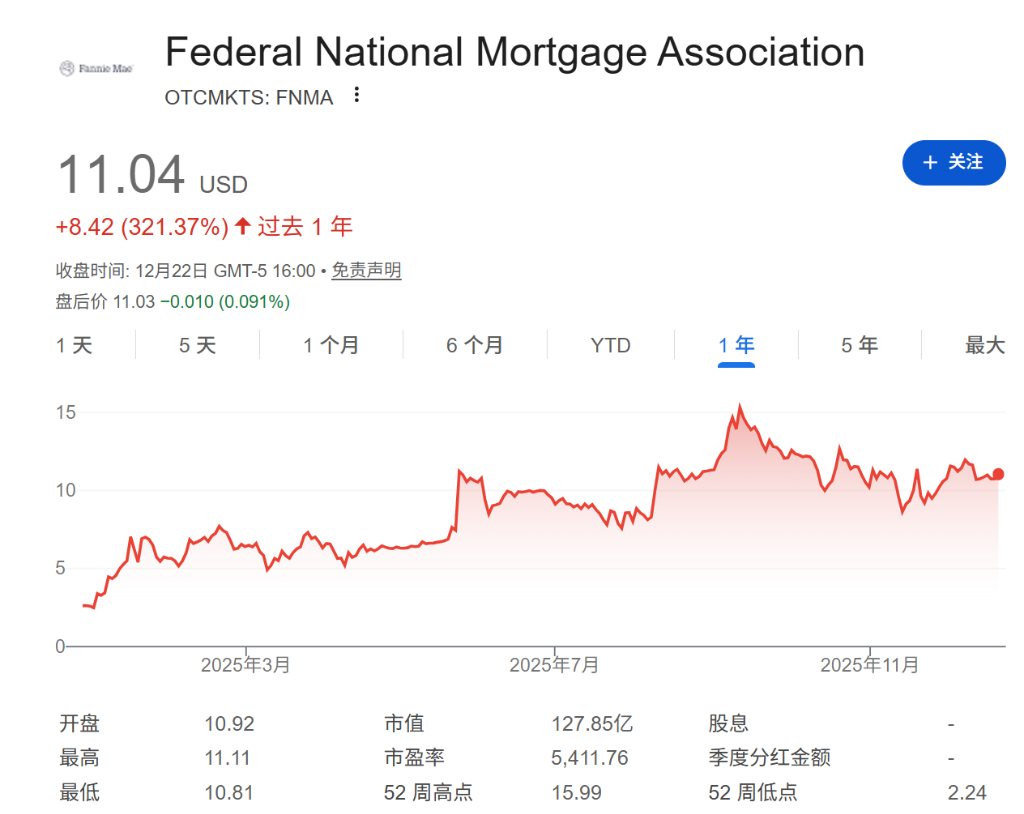
美股IPO· 2025-12-24 00:07
Group 1: Policy Changes and Economic Impact - Trump's administration is reshaping the flow of capital in the U.S. economy through aggressive policy changes, including deregulation of banks and a shift in funding from renewable energy to traditional sectors [1][3] - The "Big Beautiful" bill and subsequent regulatory adjustments signal a redirection of funds away from renewable energy projects towards pipelines, cryptocurrencies, and traditional finance [3] - The relaxation of capital rules for banks is expected to release up to $219 billion in capital for major banks, allowing them to invest more in government-backed assets [4] Group 2: Housing Market and Privatization - A controversial proposal aims to end government control over Fannie Mae and Freddie Mac, leading to significant stock price increases for these entities [6] - The privatization discussions are complicated by the Treasury's $360 billion preferred equity stake in these companies, raising concerns about potential increases in borrowing costs for consumers [8] Group 3: Cryptocurrency and Digital Assets - The Trump administration's new stance on digital assets includes the signing of the GENIUS Act, which provides a legal framework for stablecoins, potentially expanding the market from $310 billion to $4 trillion by 2030 [9] - Major banks, including JPMorgan, are actively entering the stablecoin market, while concerns arise about the potential outflow of deposits from small banks to stablecoins [9] Group 4: Energy Sector Changes - The "Big Beautiful" bill has led to the cancellation or postponement of $29.3 billion worth of clean energy projects, as the administration shifts focus towards fossil fuels and nuclear energy [10] - Companies in the clean energy sector are facing significant challenges, including layoffs and project cancellations, as federal support for renewable energy diminishes [10] Group 5: Retirement Savings and Alternative Investments - A new executive order aims to unlock $13 trillion in retirement savings by encouraging investment in alternative assets, which could significantly benefit the private equity sector [11] - This shift may lead to increased access for ordinary investors to financial products previously limited to seasoned investors, despite warnings about potential risks [11]


特朗普的资本重构:一场万亿美元级别的资金流向大转移
Hua Er Jie Jian Wen· 2025-12-23 10:30
Group 1: Economic Policy Changes - The Trump administration is rapidly altering the flow of capital in the U.S. economy, signaling a shift away from renewable energy projects towards pipeline projects, cryptocurrencies, and traditional finance [1] - A series of regulatory changes, including the relaxation of bank leverage limits and the privatization of mortgage giants, are reshaping the incentive structures within the financial system [1][2] - The administration aims to restore the U.S. as a leading economy by reducing regulatory burdens that stifle economic creativity [1] Group 2: Bank Regulation and Liquidity - Federal banking regulators are relaxing key capital rules, lowering the "enhanced supplementary leverage ratio" (eSLR) from 5% to between 3.5% and 4.25%, effective in early 2026 [2] - This change could release up to $219 billion in capital for major banks like JPMorgan Chase & Co. and Citigroup Inc., leading to increased stock buybacks and dividend payments [2] - Critics warn that these policies may weaken the banking system and increase industry concentration [2] Group 3: Mortgage Market Privatization - A controversial proposal aims to end government control over Fannie Mae and Freddie Mac, leading to significant stock price increases for these entities [3][6] - The Treasury holds $360 billion in preferred equity, making the handling of this asset a central issue in privatization discussions [6] - Potential reforms could raise borrowing costs for consumers, with mortgage rates possibly increasing by 0.2 to 0.8 percentage points [6] Group 4: Cryptocurrency Regulation - The Trump administration is embracing digital assets, having signed the GENIUS Act to provide a legal framework for stablecoins, which could lead to a market growth from $310 billion to $4 trillion by 2030 [7] - Major banks, including JPMorgan, are actively entering the stablecoin market, while Tether seeks a $500 billion valuation [7] - The new regulations require stablecoin issuers to maintain reserves at a 1:1 ratio, potentially increasing demand for U.S. Treasury securities [7] Group 5: Energy Sector Shifts - The administration's policies have led to a significant reversal in energy investment, ending tax credits for electric vehicles and renewable energy projects, resulting in the cancellation or delay of $29.3 billion in clean energy projects [8] - Major companies in the clean energy sector are facing layoffs and project cancellations, while the government is refocusing on fossil fuels and nuclear energy [8] Group 6: Retirement Savings Market - The Trump administration is attempting to tap into the $13 trillion retirement savings market by requiring a reassessment of investment guidelines for retirement plans [9] - This move is seen as a boon for the private equity industry, potentially releasing billions in new capital as funds shift from traditional assets to alternative investments [9] - Critics express concerns about the risks and costs associated with exposing ordinary investors to high-risk financial products [9]
富达基金孙晨:养老金入市应发挥主导作用,应加大其权益资产配比
Xin Lang Cai Jing· 2025-12-22 08:34
Core Viewpoint - The 22nd China International Financial Forum highlighted the opportunities for long-term capital investment in Chinese assets due to significant underallocation by overseas investors [1][5]. Group 1: Market Changes - The Chinese market is evolving from a single-driven model to a more diversified one, resembling a configuration market [3][7]. - The structure of investors is changing, with the institutionalization of the retail market being a critical factor [4][7]. Group 2: Role of Pensions - Pensions should play a leading role in the market, with an emphasis on increasing equity asset allocation across national, corporate, and personal pensions [4][7]. - The interaction between pension market entry and a slow bull market is mutually reinforcing [4]. Group 3: Corporate Evolution - Chinese multinational companies are emerging, which is crucial for attracting international capital [4][8]. - The share of overseas income for these companies is expected to rise from the current low percentage to over 40% [8]. Group 4: Future Actions - Potential increases in MSCI weight and the revaluation of the Chinese capital market are seen as dual drivers for the Chinese stock market [8]. - The importance of QDII and QDLP in the construction of a two-way open cross-border capital market system is emphasized [8].

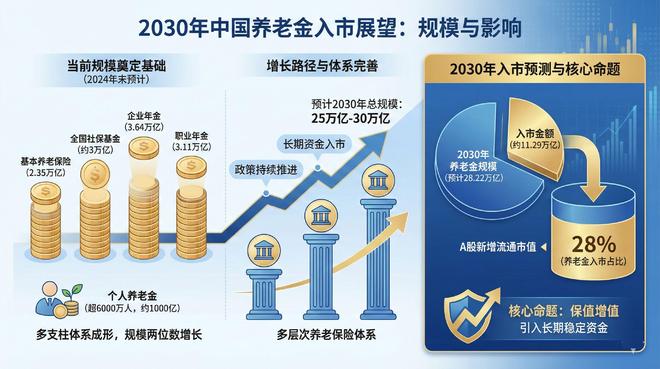
预计2030年中国养老金入市规模占A股新增流通市值28%
Zhong Guo Jing Ying Bao· 2025-12-16 08:15
Core Insights - The "China Pension Development Report 2025" predicts that by 2030, China's pension scale will reach 28.22 trillion yuan, with an estimated market entry amount of approximately 11.29 trillion yuan, accounting for 28% of the new circulating market value in A-shares [2][3] Group 1: Current Scale and Market Entry Foundation - As of the end of 2024, the investment scale of China's basic pension insurance fund, national social security fund, enterprise annuities, and occupational annuities is expected to reach 2.35 trillion yuan, 3 trillion yuan, 3.64 trillion yuan, and 3.11 trillion yuan respectively, all achieving double-digit growth [3] - Over 60 million people have opened personal pension accounts, with a contribution scale expected to reach 100 billion yuan, providing significant support for pension market entry [3] - The multi-pillar pension security system in China is taking shape, with enterprise annuities covering 30.44 million employees in 2023, and the third pillar personal pension system set to be fully implemented nationwide by the end of 2024 [3] Group 2: Global Comparison and Investment Trends - Among the top twenty global pension funds, only China's national social security fund is included, while international pension funds typically have equity asset investment ratios exceeding 40% [4] - The combined scale of the second and third pillars of pensions in the U.S. has reached 38.4 trillion USD, primarily invested in stocks or equity mutual funds [4] - The report suggests that as the three-pillar pension system improves and policies promoting long-term capital market entry continue, the scale and depth of pension investments in China are expected to gradually increase [4] Group 3: Wealth Management and Asset Allocation - The proportion of asset-based pensions in China's multi-tiered pension system is continuously increasing, with the total pension asset scale expected to exceed 20 trillion yuan this year [5][6] - The central government's emphasis on the "preservation and appreciation" goal for social security funds reflects a heightened focus on the long-term value of pensions, necessitating diversified asset allocation and investment strategies for sustainable growth [6] - Pension market entry will not only help achieve capital preservation and appreciation but also enhance the professional service capabilities of financial institutions, promoting a shift from traditional credit-led finance to comprehensive financial services [6]
李大霄的投资智慧:远离“妖股” 坐稳“好轿子” 静待牛市腾飞
Xin Lang Zheng Quan· 2025-08-18 03:06
Core Viewpoint - The article emphasizes the importance of prudent investment strategies, particularly in the current market environment, where investors are cautioned against chasing high-priced stocks and should focus on quality investments instead [1][2][3]. Investment Strategy - Investors should avoid blindly chasing stocks above 3700 points and refrain from using leverage for such pursuits [2]. - It is advised to steer clear of poorly rated stocks and those that are overvalued, as these pose significant risks [2][3]. - The recommended approach is to buy quality stocks at market lows and hold them patiently for appreciation, rather than engaging in high-risk trading behaviors [3]. Institutional Investment - Attention should be given to stocks favored by foreign investors, as institutional funds such as insurance, social security, and pension funds are actively entering the market, providing essential support [2]. - The article highlights that these institutional investments are the "good vehicles" for investors to consider, contrasting them with less favorable opportunities [2]. Cautionary Advice - Investors are reminded to maintain a rational and value-oriented investment philosophy, using idle funds for investments to ensure long-term success [2]. - The article suggests that those unfamiliar with stock investments might start with mutual funds or ETFs focused on quality assets before moving to individual stocks [3].
营收降31%、净利降42%!信达澳亚基金混合型基金规模缩水超155亿元,寄望“固收+”破局
Xin Lang Ji Jin· 2025-03-31 03:42
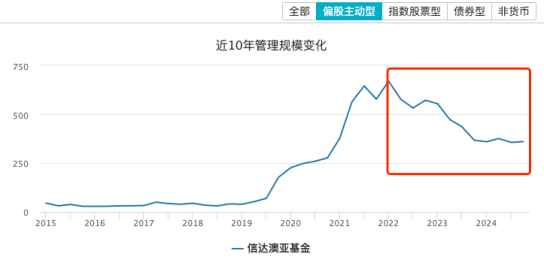
Group 1 - The core viewpoint of the article highlights the declining performance of Xinda Australia Fund, with a significant drop in revenue and net profit compared to 2023 [1] - Xinda Australia Fund reported a revenue of 644 million yuan in 2024, a year-on-year decrease of 31.24%, and a net profit of 101 million yuan, down 41.92% [1] - The fund's business structure, primarily focused on actively managed equity funds, has faced multiple pressures, leading to a continuous decline in revenue and net profit for two consecutive years [1] Group 2 - The current product landscape shows that mixed funds have the highest number at 52, with a total scale of 27.243 billion yuan, followed by bond funds at 20 with a scale of 43.957 billion yuan, and equity funds at 4 with a scale of 9.009 billion yuan [2] - The scale of actively managed equity funds has significantly shrunk, from 21.887 billion yuan at the end of 2021 to only 9.009 billion yuan by the end of 2024, nearly halving [3] - Mixed funds also saw a notable decline, from 42.805 billion yuan at the end of 2021 to 27.243 billion yuan by March 18, 2025, a reduction of over 15.5 billion yuan [3] Group 3 - In contrast, Xinda Australia Fund has been focusing on bond and money market funds, achieving substantial growth in these areas, with bond fund scale increasing by 36.399 billion yuan and money market fund scale growing by 46.038 billion yuan compared to the end of 2021 [4] - Despite a significant recovery in the A-share market in the second half of 2024, Xinda Australia Fund's performance growth was only 4.52%, lagging behind the CSI 300 index [7] - Over the past two years, Xinda Australia Fund's overall performance has consistently underperformed compared to the CSI 300 index, with a net value decline of 14.22% in 2023 [7] Group 4 - Investors, having experienced years of bear markets, are primarily focused on recovering their investments, leading to a situation where actively managed equity funds are seeing more redemptions despite net value recovery [8] - The public fund industry is undergoing a transformation phase, with leading institutions evolving from "scale kings" to "all-round players," while smaller institutions must pursue differentiation to survive [8] - The deepening of the comprehensive registration system and the acceleration of pension fund entry into the market will favor institutions with strong research capabilities, product innovation, and customer service [11]
A股“财报效应”明显?3月25日,昨晚的三大重要消息冲击来袭!
Sou Hu Cai Jing· 2025-03-25 06:19
Group 1 - The Chinese government is considering increasing pensions and providing childcare subsidies to boost domestic consumption and enhance consumer capacity [1] - The correlation between Hong Kong and A-share markets is significant, with Hong Kong stocks leading the fluctuations in A-shares [1] - Standard Chartered suggests that global stock markets may experience turbulence until early April, recommending investment in Chinese stocks, particularly in Hang Seng Tech Index components and high-yield non-bank H-shares [3] Group 2 - The A-share market is experiencing a significant downturn, with the micro-cap stock index dropping nearly 6% and over 4,700 stocks declining [5] - The upcoming annual report season in April is expected to have a pronounced "earnings report effect," making micro-cap stocks vulnerable to poor performance [5] - Major indices showed slight recoveries, with the Shanghai Composite Index up 0.15%, indicating that a stable index is crucial for attracting external capital [7]