内需攻坚

Search documents
沈建光︱2026年经济展望:分化中显韧性,攻坚中现机遇︱马年大咖谈
Di Yi Cai Jing· 2026-02-21 00:25
Group 1: Global Economic Overview - The global economy is projected to grow at a rate of 3.3% in 2026, consistent with 2025 and 2024, despite ongoing trade tensions and high debt levels impacting recovery [2] - The International Monetary Fund (IMF) highlights that asset price bubbles, particularly in AI, and high debt levels in developed countries are significant uncertainties for 2026 [2][3] Group 2: China's Economic Transition - China's economy is expected to enter a new phase characterized by a balance of quality and efficiency, shifting from export-driven growth to a focus on domestic demand [1][5] - In 2025, China achieved a growth target of 5%, but the growth rate showed a declining trend throughout the year, with net exports contributing 32.7% to economic growth [5][6] Group 3: Key Drivers of China's Economic Growth - Infrastructure investment is set to accelerate, supported by a significant increase in funding, with approximately 295 billion yuan allocated for major projects [6] - Manufacturing investment is anticipated to recover, driven by advancements in technology and the rise of new economic sectors such as semiconductors and AI [6] - Despite external pressures, China's export competitiveness is expected to remain strong, with a projected growth rate of around 5% in 2026 [6] Group 4: Domestic Demand Challenges - 2026 is defined as a year of "domestic demand challenges," with weak domestic demand and insufficient internal momentum being the primary concerns [7] - Consumer spending is expected to face constraints due to high base effects, pressure on income growth, and a significant decline in real estate wealth, with retail sales growth projected to slow to around 3% [8] Group 5: Policy Adjustments - Macro policy in 2026 will focus on releasing potential and enhancing efficiency rather than merely increasing stimulus, with a fiscal deficit rate expected to remain around 4% [9] - Monetary policy will shift to include promoting reasonable price recovery, indicating a proactive approach to low inflation environments [9] - Real estate policies will emphasize controlling new supply, reducing inventory, and optimizing supply to stabilize the market [10]
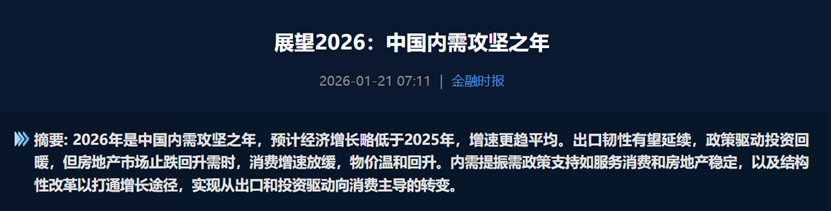
江苏优化实施消费品以旧换新,2026将是中国内需攻坚之年
Huan Qiu Wang· 2026-01-28 00:57
Group 1 - The core viewpoint of the articles highlights Jiangsu Province's initiative to promote large-scale equipment updates and optimize the implementation of the "old for new" consumption policy by 2026, including subsidies for various consumer goods [1][3] - The central economic work conference in December 2025 emphasized the importance of releasing potential and improving efficiency rather than increasing stimulus measures, indicating a cautious approach to economic growth in 2026 [1] - The retail sales of social consumer goods are projected to grow by 3% in 2026, lower than the 3.7% growth in 2025, due to high base effects, reduced subsidy scales, and pressures on income growth [3] Group 2 - The "old for new" policy is expected to significantly influence retail sales, with a doubling of subsidy scale compared to the previous year, although the actual impact may not meet expectations [3] - Service retail sales showed a positive trend with a year-on-year growth of 5.5%, indicating a recovery in this sector, while goods consumption faces challenges [3] - Recommendations include increasing counter-cyclical policies, particularly fiscal measures to support service consumption and stabilize the real estate market, aiming to shift the economic development model from export and investment-driven to consumption-led growth [3]