内需驱动经济

Search documents
新永安国际证券晨会纪要-20260121
Xin Yong An Guo Ji Zheng Quan· 2026-01-21 03:29
Core Insights - The report highlights the significant fluctuations in the Japanese bond market, with calls from the Japanese Finance Minister for investors to remain calm amid a sell-off that has affected U.S. bonds as well [8][12] - China has introduced a series of policy measures aimed at boosting investment and consumption, including a special guarantee plan worth 500 billion RMB (approximately 72 billion USD) to encourage private enterprises to borrow and expand their businesses [8][12] Market Performance - The Shanghai Composite Index closed at 4113.65 points, down 0.01%, while the Shenzhen Component fell by 0.97% and the ChiNext Index dropped by 1.79% [1][5] - The Hang Seng Index ended at 26487.51 points, down 0.29%, with the Hang Seng Technology Index declining by 1.16% and the Hang Seng China Enterprises Index falling by 0.43% [1][5] - U.S. markets also experienced declines, with the Dow Jones Industrial Average down 1.76% at 48488.59 points, the S&P 500 down 2.06% at 6796.86 points, and the Nasdaq down 2.39% [1][5] Company Developments - China’s leading PCB equipment manufacturer, Dazhu CNC, reported a 144% year-on-year increase in net profit for the first ten months of the previous year, with revenues rising by 64.4% [10] - Junlebao Dairy, a comprehensive dairy company in China, submitted its listing application to the Hong Kong Stock Exchange, reporting a nearly 30% increase in net profit for the first nine months of the previous year [10] - Muyuan Foods, a major pig farming and pork production company in China, is reportedly planning to raise up to 11.7 billion HKD (approximately 1.5 billion USD) through a Hong Kong IPO [10] - Shanghai Shangmi Technology is expected to launch an IPO in February, aiming to raise around 12 billion HKD (approximately 1.5 billion USD) [10] Economic Indicators - China's GDP growth for the fourth quarter was reported at 4.5%, with a year-to-date growth of 5.0% [16] - The retail sales of consumer goods in China for December showed a year-on-year increase of 0.9%, while industrial value-added output rose by 5.2% [16]
A股晚间热点 | 高层发声!让内需成为经济发展的主动力
智通财经网· 2026-01-20 15:22
Group 1 - Xi Jinping emphasized the need for domestic demand to become the main driving force of economic development, advocating for a focus on domestic circulation and the integration of consumption and investment [1] - The Ministry of Finance announced that the overall fiscal expenditure in 2026 will maintain necessary levels, ensuring that spending will "only increase and not decrease" [2] - Global markets faced significant downturns due to concerns over Japan's fiscal deterioration and geopolitical tensions stemming from Trump's actions, leading to a sharp decline in European and American stock markets [3] Group 2 - Goldman Sachs maintained its prediction of a "slow bull" market for A-shares, forecasting over 3 trillion yuan in new domestic capital inflows into the stock market by 2026 [4] - The Chinese government reiterated its commitment to stable development in Sino-U.S. relations, highlighting mutual benefits and the importance of maintaining sovereignty and development interests [5] - Six departments, including the Ministry of Finance, announced the continuation of tax and fee incentives for community family services, including elderly care and childcare [6] Group 3 - The Shanghai Futures Exchange adjusted margin ratios and price limits for copper, gold, and silver futures contracts, indicating a regulatory response to market conditions [7] - Shanghai released an action plan to enhance the global pricing influence of non-ferrous metal commodities, aiming to improve resource allocation capabilities [8] - Recent trends showed a continued net redemption of large-cap ETFs, with significant declines in the share sizes of several major funds [9] Group 4 - The National Space Administration reported rapid development in China's commercial space sector, with plans for 50 launches in 2025, including breakthroughs in reusable rocket technology [12] - The satellite industry is experiencing adjustments, but the trend towards acceleration in commercial space development remains unchanged, with several significant milestones expected in the near future [13] - Various sectors, including real estate and artificial intelligence, are also highlighted for potential investment opportunities, with specific projects and models being developed [16][17]


【市场聚焦】宏观:政策的矛与盾
Xin Lang Cai Jing· 2025-12-11 10:16
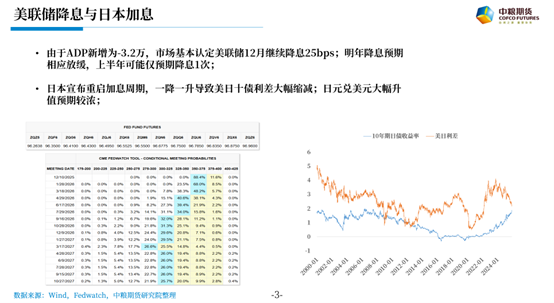
Group 1 - The Federal Reserve's interest rate cuts and Japan's interest rate hikes create a liquidity game between the US and Japan by 2026, with the importance of liquidity potentially surpassing the impact of Fed rate cuts due to accelerated AI spending [1][5][24] - China is likely to set a positive tone for the "15th Five-Year Plan" in the coming year, maintaining an active fiscal and monetary policy, while current tax reforms and debt management diverge from expectations [1][9][26] - The support and pace of fiscal policies for consumption will be the foundational policy basis for whether domestic commodities can reverse their current trends [1][12][34] Group 2 - The significant decline in the US-Japan interest rate differential due to monetary misalignment will naturally shift liquidity towards Japan, creating a sharp contradiction with the capital demands of AI expansion [4][21] - The current spending levels in the high-tech sector, when combining hardware and software investments, are higher than those in 2000, indicating a shift in investment focus [4][21] - The tightening liquidity in the US market suggests that capital will have higher demands for AI development, amplifying the probability of underperformance [5][24] Group 3 - The recent political bureau meeting emphasized the integration of existing and incremental policies, indicating a more responsive approach to fiscal policy based on external pressures and domestic recovery trends [9][26] - There is a notable divergence between sustained fiscal efforts and corporate expansion, with long-term loan growth continuing to decline, reflecting a fundamental shift from historical patterns [12][29] - The fixed investment growth is under pressure, and outside of advanced technology sectors, the contribution of broad investment to the economy remains low due to limited fiscal resources [15][32]