A股慢牛

Search documents
股指周报:地缘冲突的扰动强度超出市场预期-20260323
Zhong Yuan Qi Huo· 2026-03-23 08:58
1. Report Industry Investment Rating - No specific industry investment rating is provided in the report. 2. Core Viewpoints of the Report - The A-share market has been impacted by external conflicts and rising international energy prices, showing a volatile adjustment. However, the economic stabilization at the beginning of the year and the management's stance on the "stability" of the capital market during the Two Sessions have laid a foundation for "stability" expectations in the capital market. Short-term market over - adjustment may provide a good window period for medium - term allocation [2]. - The market is currently under pressure from multiple factors such as the escalation of the Middle East geopolitical conflict and rising inflation expectations. Investor risk - aversion is high, and global technology and growth stocks' valuations are being dragged down. The market is gradually lowering its expectations for interest rate cuts. The high yield of 30 - year treasury bonds challenges the expectation of loose market liquidity, which affects the core logic of the A - share slow - bull market [2]. - For the March market, maintain a defensive view. In the current market situation, position management may be a relatively effective risk - control measure. Controlling positions, observing more and acting less may be a relatively prudent choice [2]. 3. Summary by Directory 3.1 Market Review - **Weekly Market Performance**: Before the holiday, the four major indices were mainly in a volatile adjustment. The CSI 300 fell 2.19% weekly, the SSE 50 fell 2.47% weekly, the CSI 500 fell 5.82% weekly, and the CSI 1000 fell 5.25% weekly. The average daily trading volume of the four major indices decreased significantly compared with the previous week [2]. - **Domestic Data**: The valuation levels of the four major indices are presented in the charts. The basis and volatility of the four major stock index options have risen significantly. The European and American indices have declined, and the volatility has increased [10][14][20]. 3.2 Macroeconomic Analysis - **Domestic Macroeconomy**: Multiple economic indicators are presented, including GDP growth, industrial enterprise profits, social consumption, industrial added value, fixed - asset investment, real estate investment, manufacturing PMI, price indices, and import - export data. Some indicators show a trend of softening, while others are stabilizing and rebounding [26][28][30]. - **Domestic High - Frequency Data**: High - frequency data such as blast furnace operation, excavator sales, steel inventory, and real - estate - related data are provided, reflecting the short - term operation of the domestic economy [44][47][50]. - **Foreign Macroeconomy**: Key data of the US and the Eurozone, including employment, inflation, unemployment rate, and PMI, are presented, showing the economic situation of these regions [57][59][61]. 3.3 Market Sentiment - **Funding Aspect**: The funding cost remains stable in both the short and long term. The net currency injection in the open market is shown in the chart. The domestic capital's buying enthusiasm has slightly declined, as reflected in the financing balance, trading volume, and public fund data [67][71]. - **Important Market Information This Week**: The intensity of the US - Iran conflict's disturbance exceeds market expectations, and high oil prices may last longer. There are both positive and negative impacts on China's exports. A series of important events this week include geopolitical events, corporate earnings releases, product launches, and industry conferences [76].
预见金马|国泰基金李昇:坚守科创主线!
券商中国· 2026-02-16 15:18
Core Viewpoint - The A-share market is expected to maintain a slow bull trend in 2026, with potential for new highs after the digestion of crowded positions in the market [5][6]. Group 1: Market Outlook - The year 2025 marked the beginning of the "14th Five-Year Plan" and was crucial for the high-quality development of public funds, with a strong market performance driven by the technology innovation sector [6]. - The resilience and vitality of the market improved alongside the quality of development throughout 2025 [6]. Group 2: Company and Industry Insights - The total number of followers on the券商中国 WeChat platform has surpassed 6 million, indicating strong engagement and trust from readers [2].


写在2026丙午马年前:四分之一转弯处的大众理财
Sou Hu Cai Jing· 2026-02-11 10:29
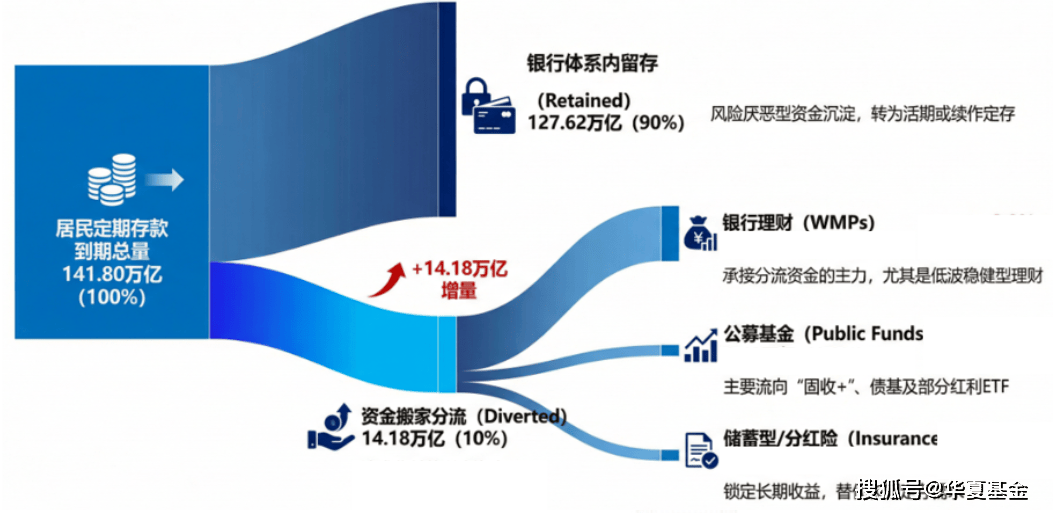
Core Insights - The article discusses the evolving landscape of personal finance in China, highlighting key trends and investment strategies as the Chinese New Year approaches [1][2]. Group 1: Investment Trends - The five most popular investment keywords for this year are identified as "gold awakening," "new three golds," "deposit migration," "A-share slow bull," and "AI narrative finance" [1]. - The concept of "new three golds" refers to a combination of money market funds, bond funds, and gold funds, which have gained popularity among investors [15]. - The A-share market is experiencing a slow bull phase, with the index surpassing 4000 points for the first time in ten years, indicating a potential recovery in investor confidence [8][12]. Group 2: Market Dynamics - A significant amount of over 50 trillion yuan in 2-5 year fixed deposits is expected to mature by 2026, leading to a potential influx of capital back into savings accounts [3][20]. - The decline in risk-free interest rates has resulted in lower returns from money market funds, which have dropped from over 6% in early 2014 to around 1% currently [3]. - The public fund industry is adapting to these changes, with products like low-volatility fixed income and multi-asset funds becoming more prominent as alternatives to traditional savings [6][8]. Group 3: Gold Investment - Gold has emerged as a key asset for investors seeking to hedge against uncertainty and inflation, with its appeal growing among younger demographics [15][20]. - The price of gold has seen significant volatility, with rapid increases in value over short periods, indicating a shift in market sentiment towards gold as a safe haven asset [16][18]. - The article emphasizes the importance of understanding the dual nature of gold as both a speculative asset and a hedge against market instability [16][18]. Group 4: ETF Popularity - The use of ETFs has surged, with 20.95 million A-share investors reportedly achieving higher returns through ETFs compared to traditional stock trading [12]. - The total scale of ETFs has increased from 4 trillion yuan to 6 trillion yuan, reflecting a growing acceptance of low-cost investment tools among the public [12]. - The article suggests that ETFs are becoming a preferred investment vehicle for ordinary investors, providing a more equitable opportunity for wealth generation [12]. Group 5: Future Outlook - The article anticipates a more diversified investment landscape in 2026, with a focus on asset allocation and the recognition of the value of various financial tools [20][21]. - The potential for three interest rate cuts by the Federal Reserve in 2026 could impact gold prices and investor strategies, prompting a reevaluation of gold holdings [18]. - Overall, the article highlights a collective shift in how individuals approach wealth management and investment in the current economic climate [20].
沪指近十年春节后上涨概率达70%!有股民用年终奖补仓
Xin Lang Cai Jing· 2026-02-11 06:24
Core Viewpoint - The A-share market exhibits a significant "calendar effect" around the Spring Festival, with a high probability of rising in the days following the holiday [1] Market Trends - Historical data indicates that the Shanghai Composite Index has a 70% probability of increasing in the first 5 and 10 trading days after the Spring Festival over the past decade [1] - Investors are optimistic about the post-holiday market, with some using year-end bonuses to increase their stock holdings [1] Investment Strategies - Analysts recommend maintaining a certain level of stock holdings during the holiday, emphasizing the importance of assessing the medium to long-term market trends [1] - For investors with a strong risk tolerance and an investment horizon of over three months, it is advised to maintain over 70% of their portfolio in stocks to capitalize on growth opportunities post-holiday [1] Focus Areas for Investment - Two main sectors are highlighted for potential investment: 1. Technology growth sectors, including AI applications, semiconductors, and humanoid robots [1] 2. High-growth segments in renewable energy, such as HJT batteries and energy storage [1]
中金研究 | 本周精选:宏观、策略、风光公用环保
中金点睛· 2026-02-07 01:06
Strategy - The price of gold exceeding $5,500 per ounce marks a significant milestone, indicating that the total value of existing gold is now comparable to the total amount of U.S. Treasury bonds, a first since the 1980s, suggesting potential shifts in the global financial system established post-Bretton Woods [3] - The A-share market has shown strong performance, driven by positive feedback from stock market performance and capital inflows, with sectors like non-ferrous metals, oil and petrochemicals, AI applications, and commercial aerospace being particularly active [4][5] - The current market environment supports a slow bull market, with growth style stocks favored, while low-position rebound opportunities are emerging [5] Macroeconomy - The nomination of Kevin Warsh as the next Federal Reserve Chairman has raised concerns about potential tightening of monetary policy, but the current liquidity dynamics and fiscal trends suggest that the expansion of the Fed's balance sheet is unlikely to change significantly [5] - The increasing U.S. fiscal financing needs and the stability of the financial system are heavily reliant on the Fed's provision of ample liquidity, especially with midterm elections approaching [5] Industry - The commercial aerospace sector is experiencing rapid growth, with space photovoltaics emerging as a key area for power system upgrades, driven by the deployment of low Earth orbit constellations and advancements in satellite technology [9]

技术看市:反弹如期而至,A股有点美股味道,对单日大阴线免疫力增强,长时间牛市形成信心壁垒
Jin Rong Jie· 2026-02-03 10:47
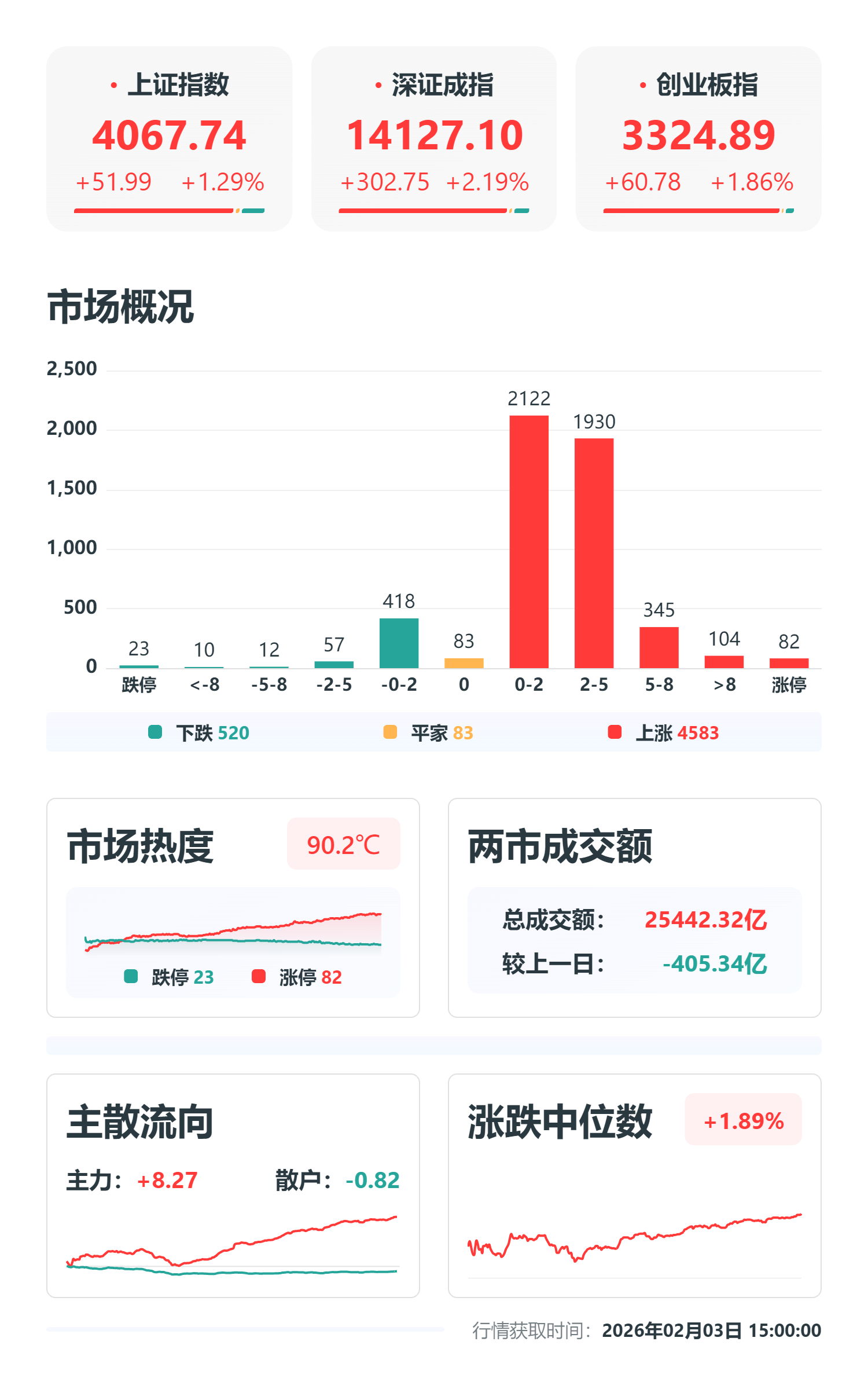
Group 1 - The A-share market experienced a technical rebound on February 3, with major indices rising across the board. The Shanghai Composite Index increased by 1.29% to 4067.74 points, the Shenzhen Component rose by 2.19%, the ChiNext Index gained 1.86%, the CSI 300 climbed 1.18%, and the STAR 50 was up by 1.39% [1] - A total of 4583 stocks rose while 514 declined, with 89 stocks remaining unchanged. The total trading volume in the Shanghai and Shenzhen markets was 2.54 trillion yuan, a decrease of approximately 405.33 billion yuan compared to the previous trading day, with a net inflow of 14.4 billion yuan in major funds [1] Group 2 - In terms of capital flow, sectors such as communication equipment, internet services, photovoltaic equipment, aerospace, and electric grid equipment saw significant net inflows, while sectors like non-ferrous metals, precious metals, securities, semiconductors, and banking experienced net outflows [7] - Market analyst Xu Xiaoming noted that the market opened high and absorbed some of the previous day's losses, with a dip in the morning followed by a steady rise, closing at a high and recovering more than half of the previous day's decline. This behavior is reminiscent of the resilience seen in U.S. stocks during downturns, where significant buying occurs after large declines, often leading to consecutive gains [7] - Xu Xiaoming expressed hope for a slow bull market in A-shares, aiming for 2026 to be the year of a slow bull market. He emphasized the importance of defensive strategies when trends break down, suggesting that waiting for risk to subside before increasing positions is a prudent approach [7][8]
每日看盘|流动性预期改善,A股或将重返“慢牛”轨道
Sou Hu Cai Jing· 2026-02-03 09:46
Group 1 - The A-share market experienced a strong rebound on Tuesday, with the Shanghai Composite Index showing signs of recovery after initial resistance, driven by active sectors such as space photovoltaic and commercial aerospace [1] - The narrative around "balance sheet reduction" has weakened, as the confirmation of the new Federal Reserve chair nominee has led to a reassessment of global market liquidity, impacting asset prices and causing fluctuations in the dollar index [2][3] - Major Asian stock indices, including the KOSPI and Nikkei 225, saw significant gains of 6.84% and 3.92% respectively, positively influencing the A-share and Hong Kong markets [3] Group 2 - The "balance sheet reduction" narrative is viewed as a trading noise that may alter short-term A-share movements but is unlikely to change the long-term trend of liquidity easing [4] - Despite some noise from discussions regarding VAT in the financial and internet sectors, the overall trend in A-shares remains strong, supported by robust domestic liquidity and a strong appreciation of the RMB [4] - The emergence of new industry catalysts, such as the commercial aerospace and space photovoltaic sectors, provides momentum for trading activities, indicating a potential return to a "slow bull" market trajectory [5]
中金研究 | 本周精选:宏观、策略、大宗商品
中金点睛· 2026-01-24 01:08
Group 1: Strategy - The formation of a "slow bull market" in A-shares is influenced by multiple factors, including fundamental, institutional, and capital market changes, with a shift in the macro paradigm and ongoing capital market reforms creating a conducive environment for this slow bull market [4] - The article emphasizes that the current conditions are more favorable for a "slow bull market" than in the past, which could significantly support the construction of a financial strong nation, boost consumption, and upgrade industries [4] - The realization of this slow bull market relies on China's commitment to economic transformation and deepening capital market reforms to enhance the market's medium to long-term attractiveness [4] Group 2: Strategy - The article discusses the three main drivers for a currency to achieve international reserve status: market forces, policy support, and historical inertia, with market forces being the most fundamental [7] - It identifies two main obstacles to the internationalization and reserve status of the RMB: the low proportion of trade settlement compared to trade volume and insufficient development and openness of the financial market [7] - The article proposes a "three-pronged" approach to enhance the RMB's internationalization and reserve status, focusing on cross-border trade settlement, financial market development, and regional initiatives [7] Group 3: Strategy - There are notable differences in AI investment between China and the US, despite similar overall investment scales, with variations in infrastructure, chip development, and model application [9] - The funding sources for AI investments differ significantly, with the US being predominantly driven by the private sector, while China sees a dual drive from both government and private sectors [9] - These funding sources influence investment characteristics, such as return expectations and investment timelines, leading to different focuses in investment areas [9] Group 4: Macroeconomy - The article highlights the recent volatility in US and Japanese bonds due to geopolitical risks and fiscal discipline issues, suggesting that this could lead to systemic risks in overseas markets [12] - It anticipates that debt monetization and Yield Curve Control (YCC) may become necessary to suppress long-term interest rates, potentially resulting in a trend of increased dollar liquidity and a continued weak dollar [12] - This environment is expected to favor commodities like gold, silver, and copper, as well as emerging markets, particularly the Chinese stock market, which remains underweighted by global funds [12] Group 5: Commodities - Extreme weather is identified as a key variable affecting commodity markets, leading to synchronized supply and demand adjustments across energy, metals, and agricultural sectors [16] - The article notes that different commodities respond to weather changes in distinct ways, with energy prices driven by temperature and metal prices influenced by precipitation [16] - Specific forecasts include a tightening of the US natural gas market and a downward trend in European gas prices due to low inventory levels, while aluminum costs may rise due to reduced hydropower generation from decreased rainfall [16] Group 6: Macroeconomy - The 2026 US midterm elections are highlighted as a critical juncture, with potential implications for government policy and market dynamics, particularly concerning high inflation and living costs [18] - The article suggests that the focus of the elections may shift from stimulating economic growth to alleviating cost-of-living pressures, impacting investment strategies [18] - Key insights for investors include limited expansion potential for index valuations, increased volatility, and heightened policy risks for monopolistic sectors, while cost-benefit industries may become more favorable for capital allocation [18]

A股晚间热点 | 高层发声!让内需成为经济发展的主动力
智通财经网· 2026-01-20 15:22
Group 1 - Xi Jinping emphasized the need for domestic demand to become the main driving force of economic development, advocating for a focus on domestic circulation and the integration of consumption and investment [1] - The Ministry of Finance announced that the overall fiscal expenditure in 2026 will maintain necessary levels, ensuring that spending will "only increase and not decrease" [2] - Global markets faced significant downturns due to concerns over Japan's fiscal deterioration and geopolitical tensions stemming from Trump's actions, leading to a sharp decline in European and American stock markets [3] Group 2 - Goldman Sachs maintained its prediction of a "slow bull" market for A-shares, forecasting over 3 trillion yuan in new domestic capital inflows into the stock market by 2026 [4] - The Chinese government reiterated its commitment to stable development in Sino-U.S. relations, highlighting mutual benefits and the importance of maintaining sovereignty and development interests [5] - Six departments, including the Ministry of Finance, announced the continuation of tax and fee incentives for community family services, including elderly care and childcare [6] Group 3 - The Shanghai Futures Exchange adjusted margin ratios and price limits for copper, gold, and silver futures contracts, indicating a regulatory response to market conditions [7] - Shanghai released an action plan to enhance the global pricing influence of non-ferrous metal commodities, aiming to improve resource allocation capabilities [8] - Recent trends showed a continued net redemption of large-cap ETFs, with significant declines in the share sizes of several major funds [9] Group 4 - The National Space Administration reported rapid development in China's commercial space sector, with plans for 50 launches in 2025, including breakthroughs in reusable rocket technology [12] - The satellite industry is experiencing adjustments, but the trend towards acceleration in commercial space development remains unchanged, with several significant milestones expected in the near future [13] - Various sectors, including real estate and artificial intelligence, are also highlighted for potential investment opportunities, with specific projects and models being developed [16][17]

A股重磅!宽基ETF连续出现净赎回,有“巨无霸”份额回落至“924”行情之前,多只科创、创业板系ETF份额缩水,发生了啥?
Jin Rong Jie· 2026-01-20 08:57
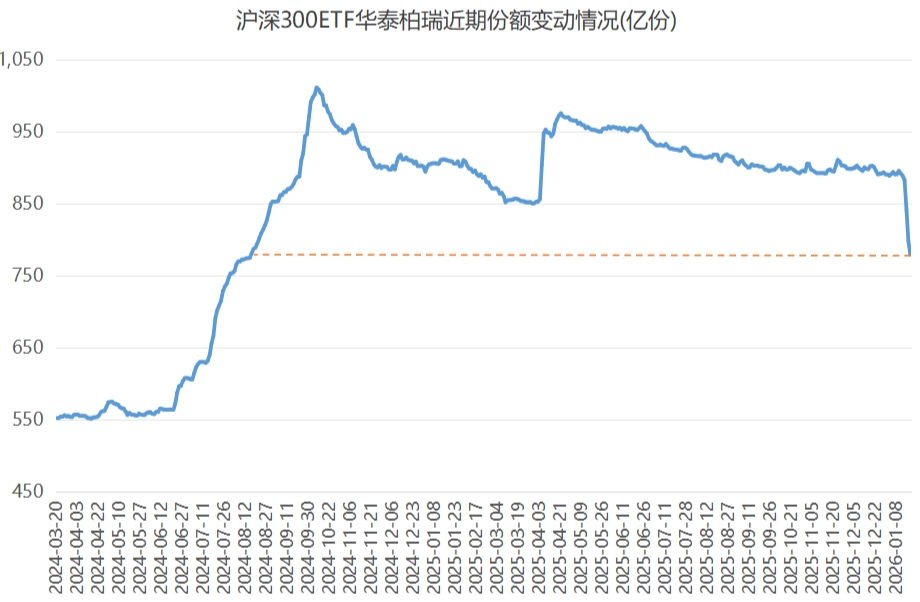
Group 1 - Recent net redemptions in A-share broad-based ETFs have drawn market attention, with significant outflows recorded on January 15 and 16, totaling 687 billion and 863 billion respectively, marking the highest single-day outflows in history [1] - As of January 19, four out of six major broad-based ETFs saw their shares decline by over 10% in the last three trading days, with the largest, Huatai-PB CSI 300 ETF, dropping to 778.63 billion shares, a scale of approximately 369.2 billion, the lowest since August 2024 [1] - The ChiNext and STAR Market ETFs also experienced significant declines, with the E Fund STAR 50 ETF and E Fund ChiNext ETF seeing share reductions of 34.55% and 20.22% respectively [3] Group 2 - In contrast to the outflows from broad-based ETFs, certain commodity, cross-border, and narrow-based ETFs attracted significant inflows, with the Southern Nonferrous ETF being the only product to receive over 10 billion in net inflows, totaling 100.87 billion, driven by rising base metal prices [3] - Other ETFs such as Yongying Satellite ETF, Harvest Software ETF, and GF Media ETF also received net inflows exceeding 6 billion [3] - According to CITIC Securities, the impact of ETF redemptions on individual stocks was significant, with main board, ChiNext, and STAR Market stocks experiencing sell-offs of 946 billion, 334 billion, and 265 billion respectively during the peak outflow days [3] Group 3 - Regulatory measures have been implemented to cool down the market following rapid price increases and overheated sentiment, including raising the minimum margin requirement for margin trading from 80% to 100% [5][6] - The China Securities Regulatory Commission emphasized the need for comprehensive market monitoring and timely counter-cyclical adjustments to maintain market stability and prevent excessive volatility [6] - There are differing views on the long-term outlook for A-shares, with some analysts suggesting the potential for a slow bull market due to reforms, while others remain skeptical about escaping historical volatility patterns [7]