流动性博弈

Search documents
2026年的第一周 全球风险资产齐涨 投资者“情绪高涨”
智通财经网· 2026-01-10 23:36
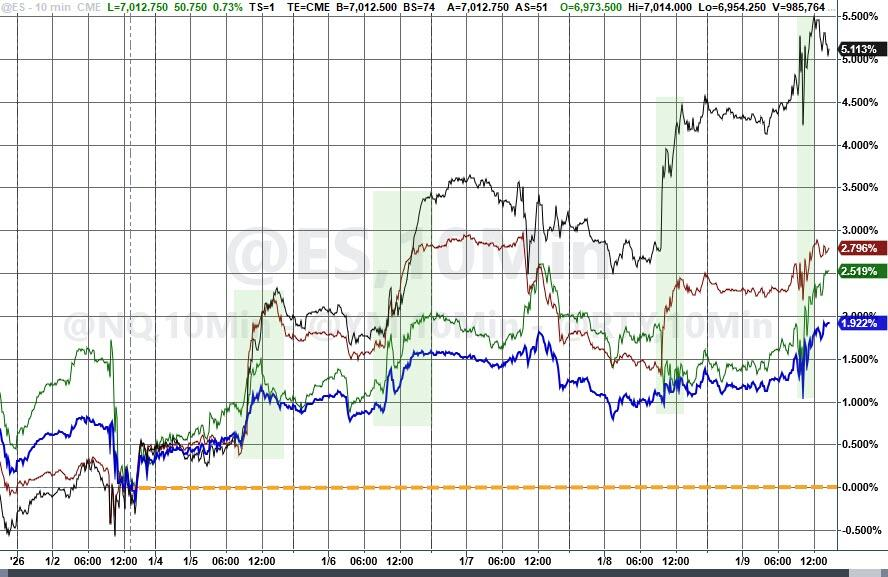
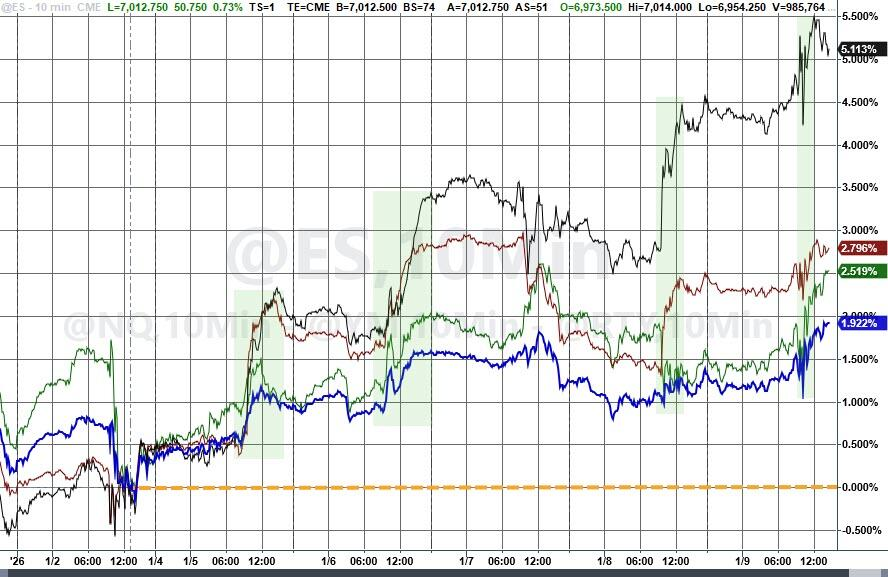
Group 1: Market Overview - Global financial markets exhibit strong risk appetite, with major stock indices reaching historical highs as investors shift from defensive assets to cyclical sectors and high-risk assets [1][4] - The S&P 500 index increased by 1.6%, while the Russell 2000 index surged by 4.6%, indicating broad market participation [1] - The A-share market in Asia also saw significant gains, with the Shanghai Composite Index breaking the 4100-point mark and achieving a remarkable "16 consecutive days of gains" [2][10] Group 2: Commodity Market Performance - The commodity market performed well, driven by geopolitical factors and inflation expectations, with oil prices experiencing the largest single-day increase since October of the previous year [4][13] - Silver prices rose by 10% over the week, while gold approached historical highs, reflecting strong demand despite a strengthening dollar [4][14] Group 3: Credit Market Dynamics - The credit market joined the bullish trend, with junk bond spreads narrowing by 10 basis points, encouraging new corporate borrowing [8] - The U.S. administration's policies, including support for the real estate market, contributed to the upward momentum in the markets [8][9] Group 4: Economic Indicators - Despite a slight miss in U.S. non-farm payroll data, service sector activity expanded at its fastest pace in over a year, and productivity increased significantly [10][12] - The anticipated liquidity influx of $600 billion in the first quarter is expected to return basic liquidity to comfortable levels [6] Group 5: Investor Sentiment and Risks - Investor sentiment is high, with significant capital flowing into high-beta assets, as evidenced by the Vanguard S&P 500 ETF attracting $10 billion in just a few days [6] - However, there are concerns regarding the sustainability of this optimism, with some analysts questioning the market's speculative nature and potential risks associated with high valuations [19]

2026年的第一周,全球风险资产齐涨,投资者“情绪高涨”
Hua Er Jie Jian Wen· 2026-01-10 02:21
Market Overview - The global financial markets have shown strong risk appetite in the first trading week of 2026, with major stock indices reaching historical highs as investors shift from defensive assets to cyclical sectors and high-risk assets [1][5] - The S&P 500 index rose by 1.6%, while the Russell 2000 index surged by 4.6%, indicating an expanding market breadth [1] Asian Market Performance - The A-share market in China witnessed significant activity, with the Shanghai Composite Index breaking the 4100-point mark and achieving a remarkable "16 consecutive days of gains," with daily trading volume exceeding 3.15 trillion yuan [2][12] Commodity Market Dynamics - The commodity market performed strongly, driven by geopolitical factors and inflation expectations, with oil prices experiencing the largest single-day increase since October of the previous year, silver rising by 10% over the week, and gold nearing historical highs [3][14][15] Credit Market Activity - The credit market also joined the upward trend, with junk bond spreads narrowing by 10 basis points, stimulating new corporate borrowing [8] - The U.S. government's supportive policies, including new measures for the real estate market, have contributed to the market's rally [8] Investor Sentiment and Trends - Investors are increasingly favoring high-beta assets, with significant capital flowing into riskier segments of the market, as evidenced by the Vanguard S&P 500 ETF attracting $10 billion in just a few days [6] - Speculative assets have also seen active trading, with a "Meme stock" ETF soaring nearly 15% and heavily shorted stocks rising by 7%, marking the best start since at least 2008 [6] Economic Indicators - Despite a slight miss in U.S. non-farm payroll data, with only 50,000 jobs added in December against an expectation of 70,000, positive indicators such as service sector expansion and productivity gains have helped maintain investor optimism [11] - The U.S. monetary policy and strong fiscal support are expected to provide a favorable backdrop for economic activity in the second quarter of 2026 and beyond [11] Geopolitical Influences - Geopolitical risks have significantly impacted commodity prices, with oil and precious metals experiencing notable increases [14][16] - The volatility in stocks and bonds has decreased amid rising geopolitical tensions [17] Market Caution - Despite the bullish market sentiment, some analysts express caution, suggesting that the current speculative fervor may be unwarranted after a nearly doubling of the S&P 500 index over three years [19] - The upcoming decision on the successor to the Federal Reserve Chair Jerome Powell is also a focal point for market participants [19]
【市场聚焦】宏观:政策的矛与盾
Xin Lang Cai Jing· 2025-12-11 10:16
Group 1 - The Federal Reserve's interest rate cuts and Japan's interest rate hikes create a liquidity game between the US and Japan by 2026, with the importance of liquidity potentially surpassing the impact of Fed rate cuts due to accelerated AI spending [1][5][24] - China is likely to set a positive tone for the "15th Five-Year Plan" in the coming year, maintaining an active fiscal and monetary policy, while current tax reforms and debt management diverge from expectations [1][9][26] - The support and pace of fiscal policies for consumption will be the foundational policy basis for whether domestic commodities can reverse their current trends [1][12][34] Group 2 - The significant decline in the US-Japan interest rate differential due to monetary misalignment will naturally shift liquidity towards Japan, creating a sharp contradiction with the capital demands of AI expansion [4][21] - The current spending levels in the high-tech sector, when combining hardware and software investments, are higher than those in 2000, indicating a shift in investment focus [4][21] - The tightening liquidity in the US market suggests that capital will have higher demands for AI development, amplifying the probability of underperformance [5][24] Group 3 - The recent political bureau meeting emphasized the integration of existing and incremental policies, indicating a more responsive approach to fiscal policy based on external pressures and domestic recovery trends [9][26] - There is a notable divergence between sustained fiscal efforts and corporate expansion, with long-term loan growth continuing to decline, reflecting a fundamental shift from historical patterns [12][29] - The fixed investment growth is under pressure, and outside of advanced technology sectors, the contribution of broad investment to the economy remains low due to limited fiscal resources [15][32]