
农业节水

Search documents
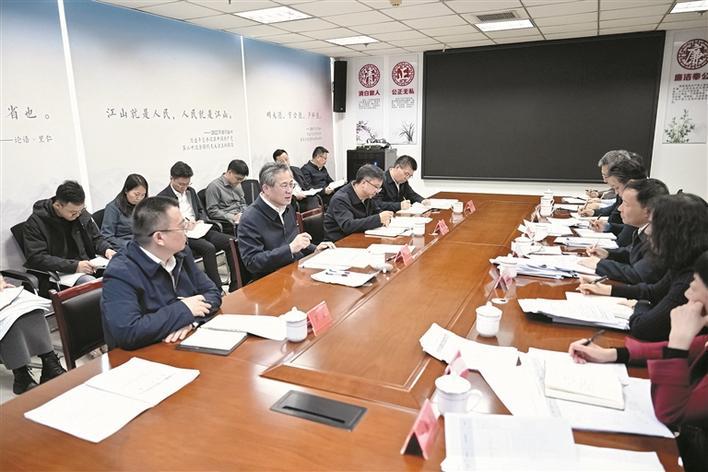
收心鼓劲启新程实干担当开新局 为兵团经济社会高质量发展再立新功
Xin Lang Cai Jing· 2026-02-24 18:20
Group 1 - The core message emphasizes the importance of implementing the spirit of the 20th Central Committee's Fourth Plenary Session and addressing feedback from the central inspection to enhance the economic and social development of the Xinjiang Production and Construction Corps (XPCC) [2] - The focus is on revitalizing idle state-owned assets, improving management, and ensuring effective governance to enhance the financial capabilities of the XPCC [3] - The need for a "big finance" concept is highlighted, aiming to improve the precision and effectiveness of financial resource allocation while adhering to strict fiscal discipline [3] Group 2 - Agriculture is identified as a foundational and advantageous industry for the XPCC, with a call for modernization and effective land management to optimize resource utilization [4] - The establishment of a demonstration area for water-saving agriculture is prioritized, emphasizing technological support and market awareness to enhance agricultural productivity and quality [4] - The XPCC aims to strengthen its position as a key supplier of high-quality agricultural and livestock products, focusing on production capacity and ecological sustainability [4] Group 3 - The importance of strengthening party leadership and addressing inspection feedback is stressed, with a focus on achieving tangible results in governance and performance [5] - The need for comprehensive and targeted rectification of issues identified in inspections is emphasized, alongside the promotion of a correct view of performance [5] - The commitment to strict party governance and the implementation of anti-corruption measures is reiterated, aiming to create a positive political environment for development [5]

履职为民解“水”困
Xin Lang Cai Jing· 2026-01-31 19:28
Core Insights - The article highlights the importance of water conservation in the agricultural sector of Erdos City, particularly in the Etuoke Qianqi region, which faces significant water scarcity issues [1][2] - A representative from the local community has been actively advocating for agricultural water-saving technologies, leading to the implementation of a drip irrigation demonstration project that aims to enhance agricultural productivity while conserving water [1] Group 1: Water Conservation Initiatives - The local government plans to implement a water-saving action plan by 2025, allocating special funds for the demonstration of small-flow drip irrigation technology across 30,000 acres of farmland [1] - The new irrigation method is projected to save over 30% of water compared to traditional irrigation methods, significantly reducing irrigation time and costs for farmers [1] Group 2: Community Engagement and Development - The representative has established a cooperative for goat farming, which has successfully brought together 48 local farmers to improve the sheep industry through scientific practices and sustainable grazing methods [1] - The cooperative's initiatives not only protect the local grassland ecology but also enhance the economic well-being of the community members [1]
全国耕地灌溉面积已超10.9亿亩 较2020年底增加5300万亩以上
Jing Ji Ri Bao· 2025-12-25 22:03
Core Insights - The total irrigated area of arable land in China has exceeded 10.9 million acres, an increase of over 5.3 million acres since the end of 2020 [1] - By 2025, the irrigated area is expected to contribute to 80.76% of the national grain output, up from 80.35% last year, indicating a 0.41 percentage point increase [1] - Large and medium-sized irrigation areas account for 38.89% of the national grain sowing area and 50.9% of the total grain output [1] Summary by Sections Irrigation Area Expansion - The Ministry of Water Resources has strengthened the modernization and renovation of large and medium-sized irrigation areas, with plans to start construction on 7 large irrigation areas by 2025, covering over 5.6 million acres [1] - Ongoing construction of 15 large irrigation areas is expected to cover 11.3 million acres, along with 157 modernization projects for large and medium-sized irrigation areas, which will add nearly 20 million acres of restored and improved irrigation area upon completion [1] Water Efficiency Policies - The Ministry of Water Resources, along with four other departments, has issued opinions on establishing a comprehensive water-saving policy framework to enhance agricultural water efficiency and effectiveness [1] - By the end of 2025, the effective utilization coefficient of irrigation water in farmland is projected to increase to 0.583 [1]
生态环境法典草案三次审议稿回应各界关切:固体废物跨省转移要报“出入”双方
Xin Lang Cai Jing· 2025-12-25 17:24
Group 1 - The ecological environment code draft is China's second law named as a "code," focusing on judicial guarantees for ecological environment protection [1][2] - The draft emphasizes the responsibilities of the People's Court and People's Procuratorate in ecological environment protection, enhancing the compensation and public interest litigation systems [2] - The draft introduces a credit repair mechanism for enterprises correcting their dishonest behavior, allowing them to apply for credit restoration [2] Group 2 - The pollution prevention section has been improved to regulate the burning of straw and leaves, and to strengthen the supervision of solid waste transfer across provinces [3] - The draft includes provisions for controlled nuclear fusion radioactive pollution prevention, establishing a management system for fusion fuel and facilities [3][4] - In emergency situations causing damage to wildlife, the draft states that no legal responsibility will be incurred [4] Group 3 - The draft includes new regulations to promote agricultural water conservation and improve irrigation efficiency [5] - It emphasizes the importance of the "Three North" project for ecological protection and restoration [5] Group 4 - The draft aims to enhance the development and utilization of renewable energy, supporting both centralized and distributed energy sources [6][7] - It outlines the establishment of a green and low-carbon policy framework, promoting a circular economy and resource recycling [6] Group 5 - The draft adjusts legal responsibilities to ensure consistency across similar violations, enhancing penalties for radioactive pollution [9][10] - It proposes modifications to the ecological environment damage compensation litigation system, allowing only the People's Procuratorate to initiate lawsuits if the government fails to act [10]
陕西2项农业节水科技成果获全国大奖
Shan Xi Ri Bao· 2025-11-19 23:03
Core Viewpoint - The 2024-2025 Agricultural Water-Saving Technology Award results have been announced, highlighting significant achievements in agricultural water-saving technologies in Shaanxi province [1] Group 1: Award Achievements - Two technological achievements from Shaanxi received awards: the first prize for "Key Technologies and Applications of Green Smart Rainwater Harvesting and Supplementary Irrigation in the Loess Plateau" and the second prize for "Key Technologies and Applications for Quality Improvement and Efficiency Enhancement of Tomato Drip Irrigation in Northwest Arid Areas" [1] - The first prize-winning technology was developed by Northwest A&F University and Shaanxi Chongren Water Conservancy Engineering Co., Ltd., while the second prize was a collaboration between Northwest A&F University and Yan'an University [1] Group 2: Award Background - The Agricultural Water-Saving Technology Award is the only national award in the field of agricultural water-saving and rural water supply, established on November 25, 2009, with approval from the Ministry of Science and Technology and the National Office for Science and Technology Awards [1] Group 3: Future Developments - The general manager of Shaanxi Chongren Water Conservancy Engineering Co., Ltd., Ren Liyu, stated that there will be further optimization of rainwater harvesting and supplementary irrigation technologies using big data analysis and artificial intelligence to enhance water resource management and improve water use efficiency [1]
新华社:高质量完成“十四五”规划|近5年我国新增恢复和改善灌溉面积超2亿亩
Shui Li Bu Wang Zhan· 2025-09-30 15:16
Group 1 - The core viewpoint emphasizes the importance of water management in ensuring food security, highlighting the modernization of irrigation systems and the increase in irrigated land area [1] - Over the past five years, 1,959 large and medium-sized irrigation areas have been modernized, resulting in the addition of over 200 million mu of restored and improved irrigation area [1] - By the end of 2024, the irrigated area of arable land is expected to increase by 49 million mu compared to the end of the 13th Five-Year Plan, with over 80% of grain production coming from this irrigated area [1] Group 2 - The Ministry of Water Resources is focused on enhancing agricultural water efficiency, establishing a comprehensive policy system for water-saving irrigation, including scientific irrigation systems and water pricing policies [1] - By the end of 2024, the area of water-saving irrigation projects is projected to reach 638 million mu, a 12.5% increase from the end of the 13th Five-Year Plan, with a 4% reduction in average water usage per mu of irrigated land [1] - The efficiency of water supply has improved, with the proportion of rural population served by large-scale water supply projects increasing by 15 percentage points compared to the end of the 13th Five-Year Plan [2] Group 3 - China has established the world's largest rural centralized water supply system, significantly improving drinking water conditions for rural populations [2] - By the end of the 14th Five-Year Plan, the national tap water coverage rate in rural areas is expected to reach 96% [2]
科学用水保障粮食丰产
Jing Ji Ri Bao· 2025-07-15 23:12
Core Viewpoint - The National Bureau of Statistics reported that the total summer grain production in China is expected to reach 299.48 billion jin in 2025, indicating stable production and harvest [1] Irrigation and Water Management - Water is crucial for agriculture, and irrigation support is essential for achieving high yields. In response to drought conditions in regions like Shaanxi and Henan, water departments have implemented measures, providing a total of 57 billion cubic meters of irrigation water across 43 million acres [1] - The Jiaokou Abstract Wei Irrigation District has undergone modernization, featuring 30 pumping stations and 344 kilometers of irrigation channels, significantly improving irrigation efficiency and drought resilience [2] - The average yield in large and medium-sized irrigation districts is 1.5 to 2 times the national average, highlighting their importance in ensuring food security [3] Technological Advancements in Irrigation - The introduction of digital tools in irrigation management, such as real-time monitoring of water conditions, has improved the efficiency of water resource allocation. For instance, the Anhui Province has developed a digital twin irrigation system to optimize water usage across 10.6 million acres [4] - The use of advanced irrigation techniques, such as drip and spray irrigation, has led to significant water savings, with one acre requiring only 90 cubic meters of water compared to 120 cubic meters in traditional methods [6] Water Resource Allocation - In the Huai River Basin, 16 large reservoirs have provided 1.2 billion cubic meters of water for irrigation, while in the Yellow River Basin, key reservoirs have entered drought management modes to ensure water supply during critical periods [5] - The Ministry of Water Resources is focusing on precise irrigation strategies to meet the water needs of crops, ensuring the safety of urban and rural water supply in drought-prone areas [5] Water Conservation Efforts - By the end of 2024, the area of water-saving irrigation projects in China is expected to reach 63.8 million acres, with over 40 million acres utilizing high-efficiency irrigation methods. The effective utilization coefficient of irrigation water has improved from 0.530 in 2014 to 0.580 [7] - The Ministry of Water Resources plans to establish a comprehensive water-saving policy framework to enhance agricultural water efficiency and ensure water security [7]