出口景气度

Search documents
宏观经济周度高频前瞻报告:经济周周看:未来高度关注出口景气度-20260322
ZHESHANG SECURITIES· 2026-03-22 14:06
Economic Indicators - The latest GDP weekly high-frequency prosperity index as of March 21 is 5.3%, a slight increase from the previous value of 5.2%[9] - The industrial prosperity index is at 8.2%, up from 8.1%, while the service sector index rose to 3.2% from 3.0%[10] Production Sector - The service sector shows stable progress, with real estate transactions improving significantly, while metro passenger volume in 11 cities has decreased compared to last year[2] - The automotive steel tire operating rate continues to rise, nearing levels from the past two years, indicating a stable industrial sector[11] Demand Insights - Domestic consumption growth is projected at 3.5%, slightly up from 3.4%, influenced by fluctuations in oil prices[22] - The construction sector is recovering slowly post-holiday, with a funding availability rate of 50.7%, up 7.9 percentage points from the previous week[32] Real Estate Market - New housing sales in 30 major cities reached 166.49 million square meters, a 0.47% increase week-on-week, but a 17% decrease year-on-year[45] - Land transaction volume decreased by 342 million square meters compared to the previous week, reflecting a 5.11% year-on-year decline[45] Export Performance - Container throughput increased to 659,800 TEUs, up from 603,800 TEUs the previous week, with a year-to-date growth of 10.97%[51] - Global energy pressures are expected to positively impact China's export share, with ongoing strong external demand[2]
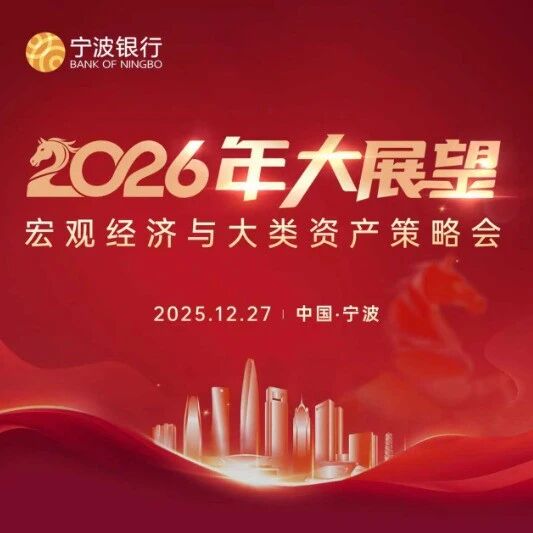
年度之约!宁波银行2026年大展望带您抓住新年新机遇
和讯· 2025-12-25 10:08
Core Viewpoint - The article discusses the upcoming "2026 Year Outlook" event hosted by Ningbo Bank, focusing on macroeconomic trends and investment strategies for the new year, addressing key questions regarding monetary policy, fiscal policy, currency trends, export performance, and market conditions for A-shares and Hong Kong stocks [1]. Group 1: Event Overview - The "2026 Year Outlook" event will take place on December 27, featuring discussions on macroeconomic conditions and asset strategies for 2026 [1]. - The event will include insights from four senior experts at Ningbo Bank, including the Vice President and heads of various departments [1]. Group 2: Agenda Highlights - The event will feature a series of presentations, including: - Macroeconomic and capital market outlook for 2026 by Zhou Yanchang, Chief Strategy Analyst [4]. - Bond market outlook for 2026 by Chai Feibin, General Manager of the Investment Banking Department [4]. - RMB exchange rate outlook for 2026 by Wang Dandan, Vice President [4]. - Outlook for commodities and precious metals market for 2026 by Qiu Difan, General Manager of the Research Department [4]. Group 3: Live Broadcast Information - The event will be live-streamed on Ningbo Bank's corporate finance video account and wealth management Douyin account, with coverage from multiple mainstream media outlets [6].


郭磊:9月PMI的七个信号|宏观经济
清华金融评论· 2025-10-07 08:38
Core Viewpoint - The September economic data indicates a seasonal improvement, aligning with other soft indicators like EPMI and BCI, suggesting a positive trend in the economy during the autumn peak season [4][5]. Group 1: Economic Indicators - The September EPMI rose by 4.6 points to 52.4, reflecting seasonal characteristics of the autumn peak, with the increase aligning with seasonal averages [5]. - The BCI index rebounded from 46.9 to 51.1 in September, exceeding expectations after a slowdown in the previous months [5]. - The PMI for September was reported at 49.8, slightly above the previous value of 49.4, indicating a stabilization in economic activity [5]. Group 2: Production and Demand - Production outpaced demand, with the production index at 51.9 and new orders at 49.7, resulting in a production-new orders differential of 2.2 points, the highest since January 2024 [8]. - The export index remained stable, with new export orders at 47.8, indicating resilience in external demand despite global economic challenges [8]. Group 3: Business Size Impact - Large enterprises showed higher PMI at 51.0, while small enterprises improved significantly by 1.6 points, contrasting with a decline in medium-sized enterprises [9]. - The disparity suggests that large firms benefit from more substantial projects, while small firms gain from exports and emerging sectors [9]. Group 4: Price Trends - Price indices showed fluctuations, with the purchasing price index at 53.2 and the factory price index at 48.2, indicating ongoing price pressures despite some initial improvements [10]. - The short-term price trends need reinforcement, as production levels exceed demand, affecting pricing stability [10]. Group 5: Business Expectations - The production and business activity expectation index rose to 54.1, reflecting improved business sentiment due to factors like debt clearance and market activity [10]. - The equipment manufacturing sector showed the highest PMI at 51.9, while consumer goods manufacturing also improved, driven by seasonal factors [10]. Group 6: Construction Sector - The construction sector's PMI was at 49.3, indicating a low level of activity historically for September, with investment in real estate and infrastructure showing signs of weakness [11]. - The need for policy measures to stimulate investment in construction is highlighted to prevent further economic slowdown [13].