出口红利

Search documents
邻二甲苯2025年利润“前高后低”
Zhong Guo Hua Gong Bao· 2025-12-24 03:55
Core Viewpoint - The paraxylene industry is expected to experience a fundamental recovery and restructuring in profitability in 2025, with profits showing a distinct "high-low" trend throughout the year, moving away from consecutive losses. Average profits are projected to rise from a meager 89 yuan per ton in 2024 to 296 yuan in 2025, driven by upstream cost advantages, export demand, and capacity growth [1] Group 1 - In early 2025, the paraxylene industry struggled at the breakeven point, with profits fluctuating around the loss threshold due to rising raw material prices, particularly isomer xylene, which pressured profit margins [1][2] - A turning point occurred in the second quarter, with profits peaking between late April and early May, reaching a historical high of over 1190 yuan, supported by a combination of supply tightness from domestic maintenance and strong export performance, especially to India [2] Group 2 - However, the high-profit scenario is not sustainable, as profits began to decline after mid-year due to the fading cost advantages and a reversal in supply-demand fundamentals. New capacities from companies like Yulong Petrochemical and Tianjin Petrochemical increased domestic supply, leading to a market shift from tight balance to surplus [3] - The paraxylene industry faced renewed losses by November and December, with losses exceeding 300 yuan at times, as the oversupply effect became evident and downstream demand remained weak, exacerbating the profit erosion [3] Group 3 - The profit recovery in 2025 is characterized as a temporary outcome driven by "cost collapse" and "export benefits," reflecting the industry's return to the harsh reality of self-sustaining supply-demand pricing amid a cycle of capacity expansion [4] - The export market played a crucial buffering role, delaying the oversupply phenomenon, but did not alter the long-term trend of a loosening domestic supply-demand structure. Future profitability will depend on companies' ability to enhance competitiveness through technological upgrades, cost control, and deep global market engagement [4]
PS:出口增量趋势或稳定 但结构差异仍存
Sou Hu Cai Jing· 2025-06-12 06:50
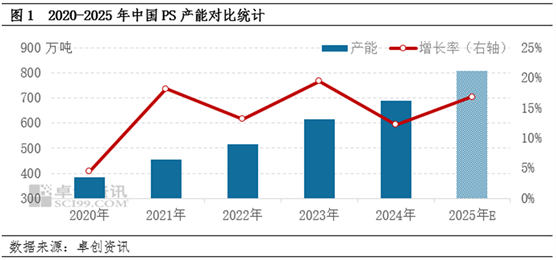
Core Insights - The Chinese PS industry has experienced a compound annual growth rate (CAGR) of over 13% since 2019, driven by profit motives, downstream demand growth, and integrated project extensions, but is now facing an oversupply situation due to demand growth lagging behind supply growth [1][3][5] - The industry is expected to continue expanding, with total PS capacity projected to exceed 8 million tons by the end of 2025 [1] Production Capacity and Utilization - From 2020 to 2024, domestic PS capacity is steadily increasing, with a CAGR of 13.36% since 2019, although the pace of new project launches is slowing down due to mismatched supply and demand growth [1][3] - The annual capacity utilization rate for the PS industry is projected to decline to 63.87% in 2024 and below 60% by the end of 2025 [5] Profitability Trends - The profitability of the PS industry has fluctuated, with a peak in 2020 due to export benefits, where GPPS and HIPS gross profit margins reached 1722 CNY/ton and 3200 CNY/ton respectively [3] - Since 2021, the industry has faced declining profitability, with average losses for GPPS and HIPS due to supply-demand imbalances, although a slight recovery is expected in 2024-2025 [3][5] Import and Export Dynamics - The import dependency of the Chinese PS market has decreased, with the import volume declining to a low of 10.65% as domestic production has increased [7] - The export volume of Chinese PS has seen a compound growth rate of 40.52% since 2019, with exports expected to reach 215,900 tons in 2024, nearly six times the volume in 2020 [7][9] Regional Export Insights - Southeast Asia remains the primary export market for Chinese PS, with Vietnam consistently accounting for 21-28% of exports from 2020 to 2025 [9] - The share of exports to Europe has increased from 4% in 2021 to 22% in 2024, driven by high costs in Europe and a demand gap [10] Future Outlook - The competition in the PS market is expected to intensify, leading to further price advantages and a stable increase in export proportions, particularly for ordinary grades of PS [12][14] - The supply of high-end PS resources remains limited, with the majority of future demand likely to be met domestically rather than through exports [14]