
创新药产业转型

Search documents
港股收评:恒指跌0.94,科网股全天弱势,创新药、铝业股齐涨
Ge Long Hui A P P· 2026-01-07 08:40
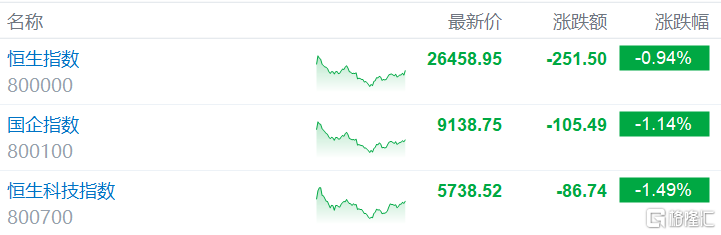
Market Overview - The Hong Kong stock market indices showed weakness, with the Hang Seng Index down 0.94% to 26,458.95, the Hang Seng Tech Index down 1.49% to 5,738.52, and the Hang Seng China Enterprises Index down 1.14% to 9,138.75 [1][2] Sector Performance - Major technology stocks collectively declined, with Alibaba down over 3%, and Netease and Kuaishou down over 2% [4][5] - The automotive sector faced significant losses, with BYD, NIO, and Xpeng all dropping over 3% [7] - Oil stocks also fell, with Kunlun Energy and China National Offshore Oil Corporation down over 3% [8][9] - Real estate stocks performed poorly, with Sunac China down 8.27% and several other major developers declining [10] - Chinese brokerage stocks were under pressure, with GF Securities down over 4% [11] Notable Gainers - The paper industry saw gains, with Nine Dragons Paper up 8.97% and Lee & Man Paper up 6.92% [14] - The innovative drug sector was active, with Ascentage Pharma-B and Tonghua Dongbao Pharmaceutical-B both rising over 8% [16] - Aluminum stocks rose, with Nanshan Aluminum International up over 10% [18] - Coal stocks strengthened, with Feishang Non-Ferrous Coal up over 34% [19] - The restaurant sector saw increases, with Ronghui Holdings up over 13% [21] - Solar energy stocks had some upward movement, with GCL-Poly Energy up over 24% [22] Investment Outlook - According to Galaxy Securities, the Hong Kong stock market is expected to see increased trading activity and a potential upward trend, with a focus on technology and consumer sectors due to supportive policies and low valuations [24]




千亿美元出海“秀肌肉”、“首创”瓶颈“卡脖子”:中国创新药直面“仿创”转型考
Xin Hua Cai Jing· 2025-12-12 12:46
Group 1 - The core viewpoint of the articles highlights that by 2025, China's innovative drug exports are expected to exceed $100 billion, with the number of new drugs in development ranking second globally [1][2] - The Chinese innovative drug industry is transitioning from a "follower" to a "leader" through various strategies, including the application of healthcare data, strengthening collaboration between industry and academia, and exploring differentiated international pathways [1][4] - The release of the "2025 China Pharmaceutical Innovation Index" provides a systematic assessment of the comprehensive innovation capabilities of local pharmaceutical companies, making the industry more assessable and guideable [2][3] Group 2 - The Chinese government is accelerating the establishment of a supportive policy framework for innovative drugs, with various regions implementing policies to promote high-quality development in the sector [2][3] - The integration of healthcare data into research and development is expected to guide companies in determining research directions based on clinical needs, enhancing efficiency [3][4] - Despite the rapid development of innovative drugs, there are concerns regarding the lack of original innovations, with many products being classified as "follow-on" rather than "first-in-class" [4][5] Group 3 - The potential for AI to empower new drug development is seen as a breakthrough opportunity for domestic companies to lead globally [5] - Companies are encouraged to adopt differentiated strategies and explore deep internationalization models to accumulate global experience [5] - The industry is at a critical juncture, with the need to balance the urgency of innovation with the execution capabilities to elevate from a "scale highland" to a "quality peak" in the global pharmaceutical innovation landscape [5]
医疗ETF(159828)涨超2.0%,政策明朗化助力创新药产业转型
Sou Hu Cai Jing· 2025-07-23 02:55
Group 1 - The core viewpoint of the article highlights that the clarification of national medical insurance policies is expected to boost the innovative drug industry, marking the beginning of a policy dividend period for innovative drugs [1] - The National Medical Insurance Administration has established the principle of "new drugs not subject to centralized procurement, and centralized procurement applies to non-new drugs," which alleviates market concerns regarding the inclusion of innovative drugs in centralized procurement [1] - This policy clarity allows companies to more accurately formulate research and development plans and increase investment in core therapeutic areas, enhancing the predictability of returns on innovative drug R&D [1] Group 2 - The medical device industry is entering a dual-driven period of policy and technology, with domestic substitution and technology going abroad becoming core trends [1] - The dynamic adjustment mechanism of the medical insurance catalog and centralized procurement policies work in synergy, making the commercialization path for innovative drugs smoother and shortening the cycle from R&D to commercialization [1] - The favorable policies are expected to accelerate the R&D projects of domestic innovative drug companies in areas such as oncology and autoimmune diseases, thereby enhancing the global competitiveness of China's pharmaceutical industry [1] Group 3 - The medical ETF (159828) has risen over 2.0%, reflecting the positive impact of these policy changes on the market [1] - The medical ETF tracks the CSI Medical Index (399989), which selects listed companies involved in medical devices, medical services, and medical information technology from the Shanghai and Shenzhen A-share markets [1] - Investors without stock accounts can consider the GTJA CSI Medical ETF Connect A (012634) and GTJA CSI Medical ETF Connect C (012635) [1]