创新融资机制

Search documents
案例集中文版正式上线: 融资创新如何激活中国乡村绿色转型?
Zhong Guo Neng Yuan Wang· 2025-12-24 06:33
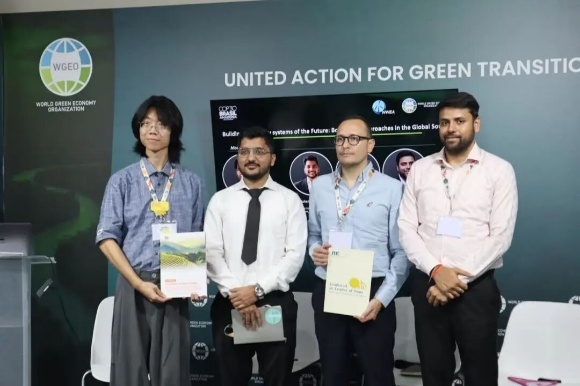
Core Insights - The 30th United Nations Climate Conference (COP30) in Brazil concluded with the release of a briefing titled "Small Money Big Change: Financial Empowerment for Local Energy Transition and Economic Growth," showcasing innovative models emerging in China's rural green transition [1][3]. Group 1: Urgency of Rural Green Transition - The urgency for rural energy transition in China is driven by escalating climate risks and long-term rural revitalization goals, highlighting the potential but lack of resources and mechanisms [4]. - Rural areas possess natural advantages such as solar and wind energy, yet face multiple barriers to investment [4]. Group 2: Challenges in Rural Energy Projects - Growth is slowing as centralized solar and wind energy projects approach capacity limits, shifting focus to distributed energy solutions in rural settings [5]. - Rural renewable energy projects are often small and fragmented, making them unattractive to institutional investors due to low investment amounts and long payback periods [5]. - Unclear revenue distribution among stakeholders leads to some projects becoming burdensome for farmers, resulting in negative returns [6]. Group 3: Objectives of the Case Study Collection - The case study collection aims to address key issues in rural energy transition, including damaged farmer confidence, cautious financial institutions, and the chaotic mix of quality renewable energy firms and ordinary distributors [9]. - It emphasizes the need for effective capital flow into rural areas through a diversified financing system that includes policy, commercial, and social capital [10]. - The collection advocates for innovative governance and operational models to ensure that project benefits remain within rural communities [11]. Group 4: Ecosystem of Rural Green Transition - The case study presents an ecosystem involving policymakers, market players, NGOs, and rural communities, focusing on creating a value network that connects diverse stakeholders [14]. - It highlights that the core of rural renewable energy development lies not in seeking large funds but in designing inclusive financing mechanisms that can create significant impacts with smaller investments [14]. Group 5: Content of the Case Study Collection - The collection includes insights on the impact of climate change on rural areas, core challenges in green low-carbon transition, and the importance of renewable energy for rural revitalization [15][16]. - It constructs a comprehensive financing theory framework for rural energy transition, detailing the logic of collaborative funding and innovative mechanisms like blended finance [17]. - The collection features seven representative innovative practice cases, providing a framework for understanding the current state of rural energy transition in China [19].

阿联酋与塞内加尔加强对非水资源基础设施投资合作
Shang Wu Bu Wang Zhan· 2025-08-23 16:53
Core Insights - The UAE and Senegal are enhancing investment cooperation in water resource infrastructure in Africa, as they co-host the 2026 UN Water Resources Conference [2] - The "Africa Water Investment Summit" held in Cape Town aimed to address the significant funding gap for water infrastructure, which is projected to require $6.7 trillion by 2030 and $22.6 trillion by 2050 [2] - Currently, Africa mobilizes only $10 billion to $19 billion annually for water infrastructure, falling short of the $30 billion target, highlighting the need for innovative financing mechanisms and public-private partnerships [2]
美国财长贝森特:与日本讨论了整体关系。对日本汽车15%的关税是一种不同类别的协议。日本就15%的汽车关税提出了创新的解决方案。日本提出了伙伴关系、股权、信贷担保。日本之所以能获得15%的关税,是因为采用了创新的融资机制。日本的外商直接投资承诺全部为新增资本。
news flash· 2025-07-23 11:13
Group 1 - The U.S. Treasury Secretary discussed the overall relationship with Japan, indicating that the 15% tariff on Japanese automobiles represents a different category of agreement [1] - Japan has proposed an innovative solution regarding the 15% automobile tariff [2] - Japan's approach includes partnerships, equity, and credit guarantees, which facilitated the acquisition of the 15% tariff through an innovative financing mechanism [3] Group 2 - Japan's foreign direct investment commitments are entirely new capital [4]
大消息!四年,超2000亿!
Zhong Guo Ji Jin Bao· 2025-06-30 06:55
Core Insights - The public REITs market in China has experienced significant growth since its inception, with total market size increasing from 31.4 billion to over 200 billion, and the number of products reaching 73 [2][4] - The cumulative dividend amount has surpassed 22 billion, indicating a strong return to investors [4][5] - The market has expanded its asset categories from traditional sectors to include ten categories such as affordable housing and data centers, reflecting a diverse asset matrix [2][5] Market Development - The REITs market is accelerating institutional innovation and aligning with international standards, attracting global capital to reassess the value of Chinese infrastructure [3] - As of June 28, the total market capitalization of public REITs reached 206.07 billion, maintaining stability above the 200 billion mark despite slight fluctuations [4] - The market's evolution is characterized by a deep transformation in capital structure, with a diverse range of investor types enhancing market stability and liquidity [5][6] Regulatory and Policy Framework - The development of the public REITs market is a result of synchronized institutional design and market demand, with a clear policy evolution since the pilot launch in 2020 [5][6] - The introduction of regulatory guidelines in early 2024 has clarified the equity attributes of REITs, facilitating the entry of long-term capital such as insurance funds [6] Future Prospects - The Chinese REITs market is expected to continue expanding, with potential for product diversification and fundraising strategies inspired by international practices [7] - There is a significant opportunity for the market to incorporate a wider range of quality assets, including cultural tourism facilities, to enhance liquidity and investor returns [7][8] - The domestic REITs market is positioned to become a "new blue ocean" for global capital seeking to invest in Chinese assets, supported by a vast array of infrastructure and real estate assets [8][9]