
制造业融合化

Search documents
《经济日报》整版报道 解码2025年中国制造的升级脉动
Jing Ji Ri Bao· 2026-01-22 06:41
Core Viewpoint - The article emphasizes the significant advancements in China's manufacturing sector by 2025, highlighting its transition towards high-end, intelligent, green, and integrated manufacturing, which is crucial for the country's economic high-quality development [3][4]. High-end Manufacturing - High-end manufacturing is identified as a critical focus for achieving high-quality development in the manufacturing sector, addressing issues such as reliance on foreign technology and the need for a self-sufficient supply chain [5][6]. - The article notes that by 2025, China's automotive production and sales are expected to exceed 34 million units, maintaining its position as the world's largest automotive market for 17 consecutive years [6][7]. - The successful development of advanced technologies, such as the AS700D electric airship and AG600 amphibious firefighting aircraft, showcases China's progress in high-end manufacturing [6][7]. Intelligent Manufacturing - Intelligent manufacturing is positioned as a primary pathway for enhancing quality and efficiency, with artificial intelligence becoming a driving force for transformation [8][9]. - By 2025, China is expected to have over 1 million industrial devices connected through industrial internet platforms, significantly improving production efficiency and reducing operational costs [10]. - The integration of AI into manufacturing processes is leading to faster R&D cycles and smarter production methods, marking a shift from experience-driven to data-driven manufacturing [9][10]. Green Manufacturing - The article highlights the necessity of green manufacturing as a response to global climate challenges, emphasizing the importance of reducing carbon emissions and enhancing resource efficiency [11][12]. - By 2025, nearly 60% of new energy vehicles are projected to be part of vehicle replacement programs, indicating a strong consumer shift towards green products [12][13]. - The development of green technologies and equipment is expected to support traditional industries in reducing emissions and enhancing sustainability [12][13]. Integrated Manufacturing - Integrated manufacturing is described as a transformative approach that combines manufacturing with services and digital economies, enhancing overall competitiveness [14][15]. - Policies are being implemented to promote the deep integration of advanced manufacturing and modern services, fostering new growth drivers [15][16]. - The article notes that the integration of manufacturing with digital technologies and services is reshaping the value chain, moving from product sales to service-oriented models [15][16].

中国制造业智能化、绿色化、融合化加快
Ren Min Ri Bao Hai Wai Ban· 2026-01-22 04:38
Core Insights - The manufacturing sector in China is projected to see a sales revenue growth rate that exceeds the national average by 1.7 percentage points by 2025, with its share of total national sales increasing to 29.7%, up by 0.5 percentage points from the previous year [1] Group 1: Intelligent Upgrading - The acceleration of intelligent upgrades in the manufacturing sector is evident, with the purchase of automation and digital equipment increasing by 11.3% and 10% year-on-year, respectively [1] - The sales revenue of the intelligent equipment manufacturing industry has grown by 28.1% year-on-year, with industrial robots and special operation robots seeing increases of 17.4% and 42.1%, respectively [1] Group 2: Green Transformation - The share of high-energy-consuming manufacturing sales revenue within the manufacturing sector has decreased by 1.1 percentage points compared to the previous year, indicating ongoing structural optimization [1] - The amount spent by manufacturing enterprises on environmental governance services has increased by 7.3% year-on-year, with high-energy-consuming sectors seeing a 14.6% increase in spending [1] - Sales revenue in the new energy vehicle manufacturing sector and lithium-ion battery manufacturing sector has grown by 14.3% and 25.1% year-on-year, respectively [1] Group 3: Digital Integration - The sales revenue of the digital product manufacturing sector is expected to grow by 9.4% year-on-year by 2025, with manufacturing enterprises' spending on digital technology increasing by 10.4%, a 3.5 percentage point acceleration from the previous year [2] - The automotive manufacturing sector and computer communication equipment manufacturing sector have seen year-on-year increases in digital technology procurement of 24.5% and 11.8%, respectively [2]
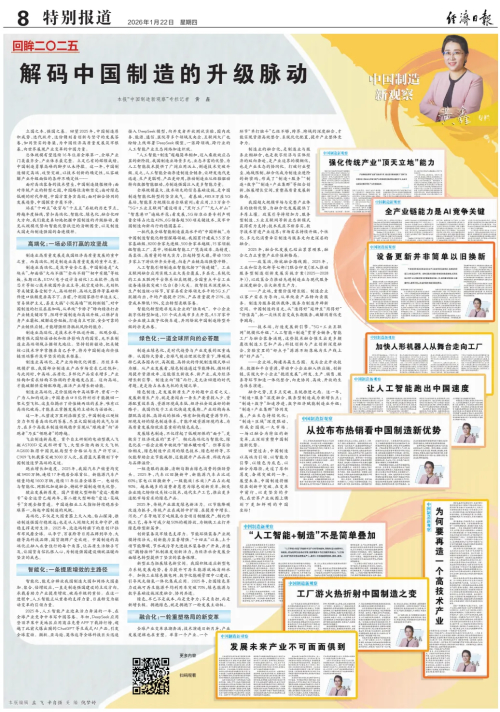
回眸二〇二五:解码中国制造的升级脉动
Jing Ji Ri Bao· 2026-01-22 00:02
Core Viewpoint - China's manufacturing sector is poised for high-quality development, focusing on high-end, intelligent, green, and integrated approaches to overcome challenges and enhance its global competitiveness [1][2][3][6][12]. High-End Development - High-end manufacturing is crucial for China's economic quality, addressing issues like reliance on foreign technology and enhancing the resilience of the supply chain [2][3]. - The transition to high-end manufacturing is necessary to optimize industrial structure and meet the growing demand for high-quality products [3]. - By 2025, China's automotive production and sales are expected to exceed 34 million units, maintaining its position as the world's largest market for 17 consecutive years [3]. Intelligent Development - The integration of artificial intelligence in manufacturing is transforming the sector, enhancing efficiency and driving innovation [6][7]. - By 2025, over 1 million industrial devices are expected to be connected through industrial internet platforms, significantly improving production efficiency and reducing costs [7][8]. - The digital transformation is not limited to large enterprises; small and medium-sized enterprises are also rapidly adopting digital technologies [8]. Green Development - The shift towards green manufacturing is essential for sustainability and economic growth, with a focus on reducing carbon emissions and enhancing resource efficiency [9][10]. - By 2025, nearly 60% of new energy vehicles are expected to be part of vehicle replacement programs, reflecting a strong consumer preference for green products [10][11]. - Innovative green technologies are being adopted across industries, contributing to significant reductions in carbon emissions [10]. Integrated Development - The integration of manufacturing with services and digital technologies is reshaping the industry, creating new growth opportunities and enhancing competitiveness [12][13]. - Policies are being implemented to promote service-oriented manufacturing, encouraging companies to shift from product sales to service-oriented business models [13][14]. - The collaboration between large and small enterprises is fostering a more integrated and efficient industrial ecosystem [14][15].
税收数据显示:2025年我国制造业智能化、绿色化、融合化加快发展“十五五”
Zhong Guo Jing Ji Wang· 2026-01-21 02:52
Group 1 - The core viewpoint of the articles emphasizes the importance of focusing on the real economy, particularly in manufacturing, while accelerating the transition towards intelligent, green, and integrated development [1][2] Group 2 - By 2025, manufacturing sales revenue in China is projected to grow 1.7 percentage points faster than the overall national sales growth, reaching a share of 29.7% of total sales, an increase of 0.5 percentage points from the previous year [1] - The intelligent upgrade of manufacturing is accelerating, with a projected year-on-year increase of 11.3% in the purchase of automation equipment and 10% in digital equipment by manufacturing enterprises [1] - The sales revenue of the intelligent equipment manufacturing industry is expected to grow by 28.1% year-on-year, with industrial robots and special operation robots seeing increases of 17.4% and 42.1% respectively [1] Group 3 - The green transformation is ongoing, with high-energy-consuming manufacturing sales revenue decreasing by 1.1 percentage points, indicating an optimization of the industrial structure [2] - The purchase of environmental governance services by manufacturing enterprises is expected to increase by 7.3% year-on-year, with high-energy-consuming sectors seeing a 14.6% increase [2] - Sales revenue in the new energy vehicle manufacturing and lithium-ion battery manufacturing sectors is projected to grow by 14.3% and 25.1% year-on-year, respectively [2] Group 4 - The digital integration within manufacturing is deepening, with digital product manufacturing sales revenue expected to grow by 9.4% year-on-year and the purchase of digital technology by manufacturing enterprises increasing by 10.4% [2] - The growth rate of digital technology purchases is accelerating by 3.5 percentage points compared to the previous year, with the automotive manufacturing and computer communication equipment manufacturing sectors seeing increases of 24.5% and 11.8% respectively [2] Group 5 - The tax authorities are committed to implementing policies that support the transformation and upgrading of the manufacturing sector, ensuring that tax benefits reach enterprises effectively to contribute to high-quality development [2]