
制造业智能化

Search documents
省政协十三届四次会议举行第二次全体会议信长星刘小涛听取委员发言 张义珍出席
Xin Hua Ri Bao· 2026-02-05 00:12
Group 1 - The Jiangsu Provincial Political Consultative Conference emphasized the importance of innovation and entrepreneurship ecosystems, with suggestions for strengthening institutional design and policy incentives to accelerate the development of an OPC innovation ecosystem [2] - The integration of artificial intelligence into higher education was proposed to promote a virtuous cycle of education, technology, and talent, transforming resource advantages into developmental strengths [2] - Recommendations were made to enhance the intelligent transformation of the manufacturing industry by sharing pilot experiences and reducing technical barriers for small and medium-sized enterprises [2] Group 2 - A call for systematic policies to support talent cultivation and the construction of a youth-friendly and fertility-friendly society was highlighted, aiming to enhance urban renewal and rural revitalization [2] - The establishment of a comprehensive overseas service system was suggested to align with international high-standard trade rules, facilitating orderly overseas development and industry safety [2] - The need for a collaborative approach to build a unified market for technology services in the Yangtze River Delta was emphasized, focusing on high-quality development in the technology service sector [2]
加快我省制造业智能化提质升级
Xin Hua Ri Bao· 2026-02-04 23:11
Core Insights - Artificial intelligence technology is deeply and broadly integrating into the manufacturing industry, becoming a core engine driving industrial transformation [1] Group 1: Recommendations for Manufacturing Industry - Comprehensive review of pilot results and experiences in intelligent manufacturing is suggested to transform them into overall advantages for the province [1] - Summarization of practices like "data asset valuation for equity" in Wuxi and formulation of unified operational guidelines with clear process standards is recommended [1] - Reference to the "data treasury + data components + data intellectual property + scenario applications" reform pilot experience in Xuzhou to establish provincial industrial data component standards [1] Group 2: Financial Tools and Policy Development - Evaluation and standardization of financial tools explored by various regions should be conducted to build a provincial "AI + manufacturing" policy toolbox [1] - Development of specialized, high-level "AI + manufacturing" cross-industry integration service institutions is encouraged to bridge the gap between technology supply and manufacturing demand [1] Group 3: Support for Small and Medium-sized Enterprises - Emphasis on open-source sharing to lower the technical barriers for small and medium-sized manufacturing enterprises in their intelligent transformation [1] - Launch of an "industry basic model casting and popularization plan" focusing on key sectors to develop lightweight AI foundational models and create a "model supermarket" [1] - Encouragement for leading enterprises to open technology platforms to upstream and downstream partners and co-build application scenarios in the industrial chain [1]


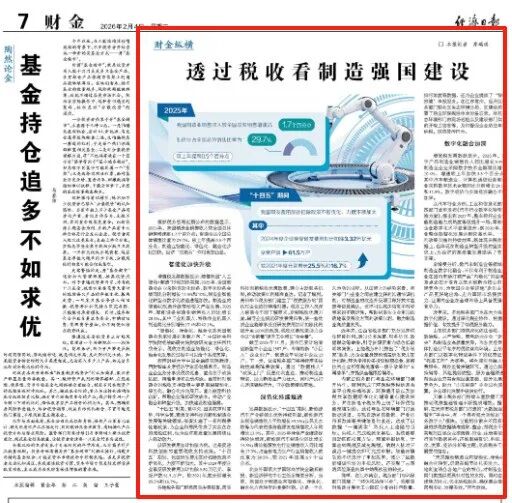
经济日报:透过税收看制造强国建设
Xin Lang Cai Jing· 2026-02-04 12:20
Core Insights - The manufacturing sector in China is projected to grow faster than the overall national sales growth by 1.7 percentage points by 2025, with its share of total sales reaching 29.7%, an increase of 0.5 percentage points from the previous year, highlighting its role as an economic stabilizer [2][14]. Intelligent Upgrading - By 2025, the procurement of automation and digital equipment by manufacturing enterprises is expected to increase by 11.3% and 10% year-on-year, respectively, indicating a rapid transformation towards intelligent manufacturing [4][16]. - The sales revenue of the intelligent equipment manufacturing sector is anticipated to grow by 28.1% year-on-year, with industrial robots and special operation robots seeing increases of 17.4% and 42.1%, respectively [4][16]. - Tax policies are being tailored to support the intelligent, green, and integrated development of the manufacturing sector, encouraging technological innovation and reducing R&D costs [4][16]. Green Development - The sales revenue of the new energy vehicle manufacturing sector is expected to grow by 14.3% year-on-year by 2025, while the clean energy generation sector is projected to see a 17.3% increase, with its share of total electricity production revenue rising to 38.5%, up 6.9 percentage points from 2021 [7][19]. - The government is focusing on establishing effective communication mechanisms between departments and enterprises to facilitate the accurate enjoyment of tax benefits related to green development [7][19]. Digital Integration - The sales revenue of the digital product manufacturing sector is projected to grow by 9.4% year-on-year by 2025, with manufacturing enterprises' procurement of digital technologies increasing by 10.4%, reflecting a deepening integration of the digital economy with the real economy [10][22]. - The automotive industry is set to enhance its digital transformation capabilities significantly by 2027, with a goal of achieving a high level of digital development by 2030 [10][22]. - Local tax authorities are enhancing their digital capabilities to improve tax services and compliance, thereby supporting the manufacturing sector's transition towards intelligent, green, and integrated development [10][22]. Tax Incentives and Support - During the "14th Five-Year Plan" period, tax incentives have been implemented to support technological innovation and manufacturing development, resulting in significant tax reductions for businesses [5][17]. - The R&D expense deduction policy has been optimized, with an expected deduction of 3.32 trillion yuan for 2024, benefiting 615,000 enterprises, marking increases of 25.5% and 16.7% from 2021 [5][17]. - Local tax departments are actively engaging with enterprises to ensure they can access these tax benefits effectively, including personalized support for R&D expense deductions [5][17][18].
四个关键字看2025年工业和信息化发展!
中汽协会数据· 2026-01-26 09:13
Core Viewpoint - The article emphasizes the continuous stabilization of economic growth, focusing on the real economy and implementing a new round of key industry growth plans to support industrial provinces in driving steady industrial growth [2]. Group 1: Economic Growth and Industrial Performance - By 2025, the industrial added value above designated size is expected to grow by 5.9% year-on-year, with the manufacturing added value maintaining a stable share of GDP [3]. - The manufacturing sector is projected to retain its position as the world's largest for 16 consecutive years, with telecommunications business volume increasing by 9.1% year-on-year [4]. Group 2: High-Quality Development and Technological Advancement - The focus remains on high-quality development, advancing the intelligent, green, and integrated development of manufacturing [6]. - The added value of equipment manufacturing and high-tech manufacturing above designated size grew by 9.2% and 9.4% year-on-year, respectively, outpacing the overall industrial growth by 3.3 and 3.5 percentage points [6]. - Over 35,000 basic-level and 8,200 advanced-level smart factories have been established, with 15 leading smart factories nurtured [6]. Group 3: Innovation and Emerging Industries - The integration of technological and industrial innovation is being promoted, with breakthroughs in major equipment such as ultra-large diameter shield machines and heavy-duty gas turbines [10]. - The added value of integrated circuits and electronic special materials increased by 26.7% and 23.9% year-on-year, respectively, while industrial robot production rose by 28% [10]. - New energy vehicle sales reached 16.49 million units, reflecting a year-on-year growth of 28.2% [10]. Group 4: Business Environment and Competitive Landscape - Efforts to reform key areas and reduce enterprise burdens are underway, with actions to clear overdue payments to businesses and implement supportive policies [11]. - The competitive ecology in key industries such as new energy vehicles and photovoltaics is showing signs of improvement [11]. - Over 140,000 specialized and innovative small and medium-sized enterprises have been nurtured, with high-tech enterprises reaching 504,000 [11].

2025年我国制造业智能化绿色化加快发展
Yang Shi Wang· 2026-01-22 11:47
Core Insights - The latest data from the National Taxation Administration indicates that by 2025, the intelligent upgrade process in China's manufacturing industry will accelerate, with a more than 10% increase in the amount spent on automated and digital equipment by manufacturing enterprises [1] Group 1: Intelligent Equipment Manufacturing - Sales revenue in the intelligent equipment manufacturing sector is expected to grow by 28.1% year-on-year, with industrial robots and special operation robots seeing year-on-year growth of 17.4% and 42.1%, respectively [1] Group 2: Digital Integration - The sales revenue of the digital product manufacturing industry is projected to increase by 9.4% year-on-year by 2025, while the amount spent by manufacturing enterprises on digital technologies is expected to rise by 10.4%, accelerating by 3.5 percentage points compared to the previous year [1] Group 3: Green Transformation - The amount spent by manufacturing enterprises on environmental governance services is anticipated to grow by 7.3% year-on-year, indicating an increase in green governance investments [1] - The sales revenue of high-energy-consuming manufacturing industries will decrease by 1.1 percentage points compared to the previous year, reflecting ongoing optimization of the industrial structure [1] Group 4: New Energy Industries - The sales revenue of the new energy vehicle manufacturing industry is expected to grow by 14.3% year-on-year, while the lithium-ion battery manufacturing sector is projected to see a year-on-year increase of 25.1% [1]
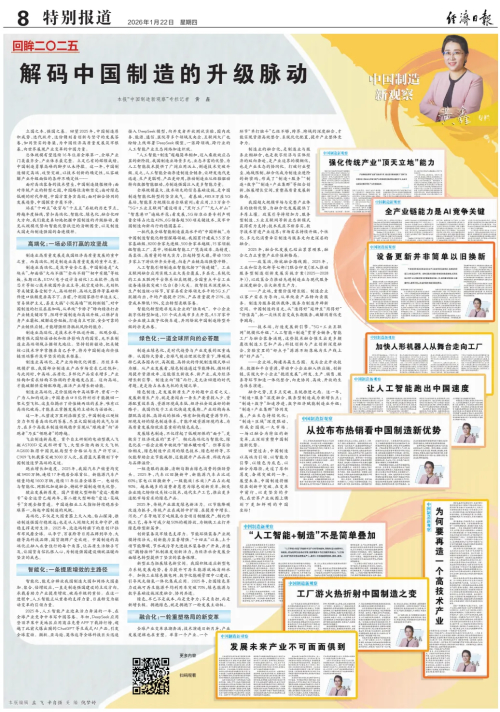
《经济日报》整版报道 解码2025年中国制造的升级脉动
Jing Ji Ri Bao· 2026-01-22 06:41
Core Viewpoint - The article emphasizes the significant advancements in China's manufacturing sector by 2025, highlighting its transition towards high-end, intelligent, green, and integrated manufacturing, which is crucial for the country's economic high-quality development [3][4]. High-end Manufacturing - High-end manufacturing is identified as a critical focus for achieving high-quality development in the manufacturing sector, addressing issues such as reliance on foreign technology and the need for a self-sufficient supply chain [5][6]. - The article notes that by 2025, China's automotive production and sales are expected to exceed 34 million units, maintaining its position as the world's largest automotive market for 17 consecutive years [6][7]. - The successful development of advanced technologies, such as the AS700D electric airship and AG600 amphibious firefighting aircraft, showcases China's progress in high-end manufacturing [6][7]. Intelligent Manufacturing - Intelligent manufacturing is positioned as a primary pathway for enhancing quality and efficiency, with artificial intelligence becoming a driving force for transformation [8][9]. - By 2025, China is expected to have over 1 million industrial devices connected through industrial internet platforms, significantly improving production efficiency and reducing operational costs [10]. - The integration of AI into manufacturing processes is leading to faster R&D cycles and smarter production methods, marking a shift from experience-driven to data-driven manufacturing [9][10]. Green Manufacturing - The article highlights the necessity of green manufacturing as a response to global climate challenges, emphasizing the importance of reducing carbon emissions and enhancing resource efficiency [11][12]. - By 2025, nearly 60% of new energy vehicles are projected to be part of vehicle replacement programs, indicating a strong consumer shift towards green products [12][13]. - The development of green technologies and equipment is expected to support traditional industries in reducing emissions and enhancing sustainability [12][13]. Integrated Manufacturing - Integrated manufacturing is described as a transformative approach that combines manufacturing with services and digital economies, enhancing overall competitiveness [14][15]. - Policies are being implemented to promote the deep integration of advanced manufacturing and modern services, fostering new growth drivers [15][16]. - The article notes that the integration of manufacturing with digital technologies and services is reshaping the value chain, moving from product sales to service-oriented models [15][16].
中国制造业智能化、绿色化、融合化加快
Ren Min Ri Bao Hai Wai Ban· 2026-01-22 04:38
Core Insights - The manufacturing sector in China is projected to see a sales revenue growth rate that exceeds the national average by 1.7 percentage points by 2025, with its share of total national sales increasing to 29.7%, up by 0.5 percentage points from the previous year [1] Group 1: Intelligent Upgrading - The acceleration of intelligent upgrades in the manufacturing sector is evident, with the purchase of automation and digital equipment increasing by 11.3% and 10% year-on-year, respectively [1] - The sales revenue of the intelligent equipment manufacturing industry has grown by 28.1% year-on-year, with industrial robots and special operation robots seeing increases of 17.4% and 42.1%, respectively [1] Group 2: Green Transformation - The share of high-energy-consuming manufacturing sales revenue within the manufacturing sector has decreased by 1.1 percentage points compared to the previous year, indicating ongoing structural optimization [1] - The amount spent by manufacturing enterprises on environmental governance services has increased by 7.3% year-on-year, with high-energy-consuming sectors seeing a 14.6% increase in spending [1] - Sales revenue in the new energy vehicle manufacturing sector and lithium-ion battery manufacturing sector has grown by 14.3% and 25.1% year-on-year, respectively [1] Group 3: Digital Integration - The sales revenue of the digital product manufacturing sector is expected to grow by 9.4% year-on-year by 2025, with manufacturing enterprises' spending on digital technology increasing by 10.4%, a 3.5 percentage point acceleration from the previous year [2] - The automotive manufacturing sector and computer communication equipment manufacturing sector have seen year-on-year increases in digital technology procurement of 24.5% and 11.8%, respectively [2]
税收数据显示2025年我国制造业智能化、绿色化、融合化加快发展
Ren Min Ri Bao· 2026-01-22 01:55
Core Insights - The manufacturing sector in China is projected to have a sales revenue growth rate that exceeds the national average by 1.7 percentage points by 2025, with a manufacturing share of 29.7% of total sales, an increase of 0.5 percentage points from the previous year [1] Group 1: Intelligent Upgrading - The procurement of automation and digital equipment by manufacturing enterprises is expected to grow by 11.3% and 10% year-on-year respectively in 2025, indicating a rapid advancement in the intelligent transformation and digital renovation of the manufacturing sector [1] - The sales revenue of the intelligent equipment manufacturing industry is anticipated to increase by 28.1% year-on-year in 2025, driven by the intelligent upgrades in manufacturing [1] Group 2: Green Transformation - The sales revenue of high-energy-consuming manufacturing industries is projected to decrease by 1.1 percentage points as a share of total manufacturing, reflecting an ongoing optimization of the industrial structure [1] - The amount spent by manufacturing enterprises on environmental governance services is expected to grow by 7.3% year-on-year, with high-energy-consuming sectors seeing a 14.6% increase in spending on environmental governance services, indicating a significant rise in green investment [1] Group 3: Digital Integration - The sales revenue of the digital product manufacturing industry is forecasted to grow by 9.4% year-on-year in 2025, showcasing the deepening integration of the digital economy with the real economy [1] - The procurement of digital technologies by manufacturing enterprises is expected to increase by 10.4% year-on-year, further emphasizing the trend of digital integration within the manufacturing sector [1]
2025年我国制造业智能化、绿色化、融合化加快发展
Ren Min Ri Bao· 2026-01-22 00:56
Core Insights - The core viewpoint of the article highlights the accelerated development of China's manufacturing industry towards intelligence, greenness, and integration by 2025, with significant growth in sales revenue and structural optimization [1] Group 1: Intelligent Upgrading - By 2025, the sales revenue of the manufacturing sector is expected to grow 1.7 percentage points faster than the overall national sales growth [1] - The procurement of automation and digital equipment by manufacturing enterprises is projected to increase by 11.3% and 10% year-on-year, respectively, indicating a rapid advancement in intelligent transformation and digital renovation [1] - The sales revenue of the intelligent equipment manufacturing industry is anticipated to grow by 28.1% year-on-year, driven by the intelligent upgrading of the manufacturing sector [1] Group 2: Green Transformation - The sales revenue of high-energy-consuming manufacturing industries is expected to decrease by 1.1 percentage points as a proportion of total manufacturing, reflecting ongoing structural optimization [1] - The amount spent by manufacturing enterprises on environmental governance services is projected to increase by 7.3% year-on-year, with high-energy-consuming sectors seeing a 14.6% increase in spending on environmental governance services [1] Group 3: Digital Integration - The sales revenue of the digital product manufacturing industry is expected to grow by 9.4% year-on-year, indicating a deepening integration of the digital economy with the real economy [1] - The procurement of digital technologies by manufacturing enterprises is projected to increase by 10.4% year-on-year, further emphasizing the trend of digital integration [1]
回眸二〇二五:解码中国制造的升级脉动
Jing Ji Ri Bao· 2026-01-22 00:02
Core Viewpoint - China's manufacturing sector is poised for high-quality development, focusing on high-end, intelligent, green, and integrated approaches to overcome challenges and enhance its global competitiveness [1][2][3][6][12]. High-End Development - High-end manufacturing is crucial for China's economic quality, addressing issues like reliance on foreign technology and enhancing the resilience of the supply chain [2][3]. - The transition to high-end manufacturing is necessary to optimize industrial structure and meet the growing demand for high-quality products [3]. - By 2025, China's automotive production and sales are expected to exceed 34 million units, maintaining its position as the world's largest market for 17 consecutive years [3]. Intelligent Development - The integration of artificial intelligence in manufacturing is transforming the sector, enhancing efficiency and driving innovation [6][7]. - By 2025, over 1 million industrial devices are expected to be connected through industrial internet platforms, significantly improving production efficiency and reducing costs [7][8]. - The digital transformation is not limited to large enterprises; small and medium-sized enterprises are also rapidly adopting digital technologies [8]. Green Development - The shift towards green manufacturing is essential for sustainability and economic growth, with a focus on reducing carbon emissions and enhancing resource efficiency [9][10]. - By 2025, nearly 60% of new energy vehicles are expected to be part of vehicle replacement programs, reflecting a strong consumer preference for green products [10][11]. - Innovative green technologies are being adopted across industries, contributing to significant reductions in carbon emissions [10]. Integrated Development - The integration of manufacturing with services and digital technologies is reshaping the industry, creating new growth opportunities and enhancing competitiveness [12][13]. - Policies are being implemented to promote service-oriented manufacturing, encouraging companies to shift from product sales to service-oriented business models [13][14]. - The collaboration between large and small enterprises is fostering a more integrated and efficient industrial ecosystem [14][15].