半导体上升周期

Search documents
北水成交净卖出35.21亿 通义千问全面对标ChatGPT 北水抢筹阿里超13亿港元
Zhi Tong Cai Jing· 2025-11-13 11:46
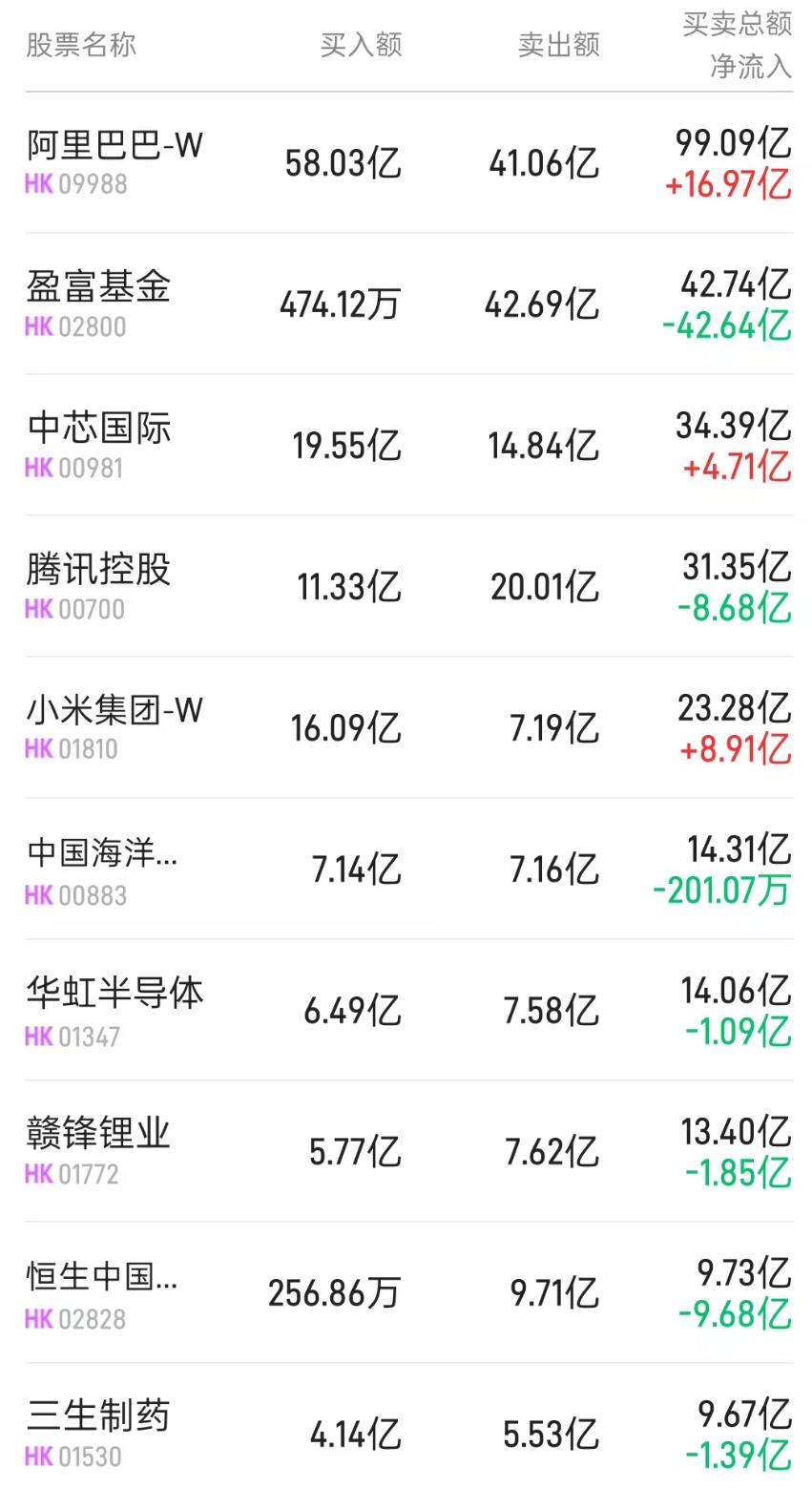
Core Viewpoint - The Hong Kong stock market experienced significant net selling from northbound capital, with a total net sell of 35.21 billion HKD on November 13, 2023, indicating a cautious sentiment among investors [1]. Group 1: Stock Performance - Alibaba-W (09988) saw a net inflow of 16.97 billion HKD, with a total trading volume of 99.09 billion HKD, reflecting strong investor interest [2]. - Xiaomi Group-W (01810) recorded a net inflow of 8.91 billion HKD, indicating positive market sentiment towards its stock [2]. - Tencent (00700) faced a net outflow of 8.68 billion HKD, highlighting investor concerns following its quarterly earnings report [2][6]. Group 2: Sector Trends - Semiconductor stocks, including Hua Hong Semiconductor (01347) and SMIC (00981), received net inflows of 868.1 million HKD and 760.6 million HKD respectively, driven by optimistic forecasts for the AI-driven semiconductor cycle extending until 2027 [5]. - The report from Morgan Stanley predicts global semiconductor revenue growth of 18% and 11% in 2026 and 2027, respectively, supporting the bullish outlook for Asian tech stocks [5]. Group 3: ETF Activity - The Hang Seng Index ETF (02800) and the Hang Seng China Enterprises Index ETF (02828) experienced significant net outflows of 62.26 billion HKD and 22.89 billion HKD, respectively, reflecting a broader market weakness [7]. - Despite the outflows, analysts maintain a cautiously optimistic view on the medium-term market outlook, emphasizing the importance of technology innovation and domestic demand [7].






北水动向|北水成交净卖出35.21亿 通义千问全面对标ChatGPT 北水抢筹阿里超13亿港元
Zhi Tong Cai Jing· 2025-11-13 09:59
Core Insights - The Hong Kong stock market experienced a net sell-off of 35.21 million HKD from northbound trading, with the Shanghai Stock Connect contributing a net sell of 21.28 billion HKD and the Shenzhen Stock Connect a net sell of 13.93 billion HKD [1] Group 1: Stock Performance - Alibaba-W (09988) saw a net inflow of 16.97 billion HKD, with a total trading volume of 99.09 billion HKD, comprising 58.03 billion HKD in buying and 41.06 billion HKD in selling [2] - Xiaomi Group-W (01810) recorded a net inflow of 8.91 billion HKD, with total trading of 23.28 billion HKD, including 16.09 billion HKD in buying and 7.19 billion HKD in selling [2] - Tencent (00700) faced a net outflow of 8.68 billion HKD, with total trading volume of 31.35 billion HKD, consisting of 11.33 billion HKD in buying and 20.01 billion HKD in selling [2] Group 2: Sector Trends - Northbound trading showed increased investment in semiconductor stocks, with Hua Hong Semiconductor (01347) and SMIC (00981) receiving net inflows of 868.1 million HKD and 760.6 million HKD, respectively [5] - Morgan Stanley's report indicates that the AI-driven semiconductor cycle is expected to extend beyond typical patterns, with global semiconductor revenue projected to grow by 18% and 11% in 2026 and 2027, respectively [5] Group 3: Market Sentiment - The market sentiment remains cautious, with significant net sell-offs in ETFs like the Tracker Fund of Hong Kong (02800) and Hang Seng China Enterprises (02828), which saw net outflows of 62.26 billion HKD and 22.89 billion HKD, respectively [7] - Analysts from Zheshang International suggest that despite short-term fluctuations, the overall market outlook remains cautiously optimistic, focusing on technology innovation and domestic demand expansion [7]
芯片股午后拉升 华虹半导体涨超5% 小摩称AI和半导体上升周期将延长至2027年
Zhi Tong Cai Jing· 2025-11-13 07:39
Group 1 - Semiconductor stocks experienced a rally in the afternoon, with notable increases in shares of Huahong Semiconductor (+5.78%), SMIC (+2.32%), ZTE (+1.91%), and Shanghai Fudan (+1.27%) [1] - Alibaba has reportedly launched a secret project called "Qianwen," aimed at developing a personal AI assistant app to compete directly with ChatGPT, leveraging its Qwen model [1] - Morgan Stanley's latest report indicates that concerns over an AI bubble persist, but the AI-driven semiconductor upcycle is far from peaking, with projections for global semiconductor revenue growth of 18% in 2026 and 11% in 2027 [1]

港股异动 | 芯片股午后拉升 华虹半导体(01347)涨超5% 小摩称AI和半导体上升周期将延长至2027年
智通财经网· 2025-11-13 07:36
Group 1 - Semiconductor stocks experienced a rally in the afternoon, with notable increases in shares of Huahong Semiconductor (+5.78% to HKD 78.75), SMIC (+2.32% to HKD 74.95), ZTE (+1.91% to HKD 30.98), and Shanghai Fudan (+1.27% to HKD 41.44) [1] - Alibaba has reportedly launched a secret project called "Qianwen," aimed at developing a personal AI assistant app to compete directly with ChatGPT, leveraging the Qwen model [1] - JPMorgan's latest research indicates that despite ongoing concerns about an AI bubble, the semiconductor upcycle driven by AI is far from peaking, with expectations for global semiconductor revenue to grow by 18% in 2026 and 11% in 2027 [1]
深夜,大涨!芯片,重大利好!
券商中国· 2025-11-12 15:03
Core Viewpoint - The semiconductor sector in the U.S. is experiencing a significant rally, driven by optimistic market sentiment regarding AI and expectations of Federal Reserve interest rate cuts due to weak employment data [2][3]. Semiconductor Market Performance - On November 12, U.S. stock indices opened higher, with the semiconductor sector leading the gains; the Philadelphia Semiconductor Index rose nearly 2%, and AMD surged nearly 9% at one point [2]. - Major semiconductor companies such as AMD, GlobalFoundries, Broadcom, and Micron all saw substantial increases in their stock prices, with AMD rising over 7% and GlobalFoundries over 5% [3]. Economic and Policy Factors - Analysts suggest that the potential reopening of the U.S. government and the resumption of economic data releases could further solidify market expectations for Federal Reserve rate cuts [4]. - The U.S. House of Representatives is set to vote on a bill to end the government shutdown, which is contributing to positive market sentiment [3]. AI Market Outlook - AMD's CEO, Lisa Su, provided an optimistic forecast for the AI market, predicting that the global AI chip market will reach $1 trillion by 2030, up from approximately $200 billion this year, with a compound annual growth rate (CAGR) exceeding 40% [5]. - AMD aims to capture a "double-digit" market share in the AI data center chip market, with projected annual revenue from AI data center chips reaching $100 billion within five years [5]. Morgan Stanley's Insights - Morgan Stanley's latest report indicates that concerns about an "AI bubble" are rising, but the semiconductor upcycle driven by AI is far from peaking, with expectations of continuation until 2027 [6]. - Global semiconductor revenue is forecasted to grow by 18% in 2026 and 11% in 2027 [7]. K-shaped Recovery in Semiconductor Sector - The current semiconductor upcycle is characterized as a "K-shaped recovery," with strong demand for AI-related products while other tech sectors face adjustments [8]. - The trajectory of this semiconductor recovery is likened to the early stages of smartphones and public cloud services, with generative AI still having significant growth potential [8]. Supply Chain Dynamics - Key cloud service providers (CSPs) are expected to maintain strong capital expenditures, with the top six CSPs projected to increase spending by 67% in 2025 and about 32% in 2026 [8]. - Supply shortages in critical areas such as 3nm processes and high bandwidth memory (HBM) are anticipated to persist until 2026, extending the semiconductor upcycle [8]. NAND Flash Market Developments - Major players like Samsung and SK Hynix are planning to increase NAND prices by 20% to 30% as they reduce supply to drive price increases [9]. - Analysts predict that DRAM prices will continue to rise significantly in the coming weeks, with NAND contract prices potentially increasing by 20% to 30% in the fourth quarter [9].