卡尔达肖夫Ⅱ型文明

Search documents
马斯克:向星辰进发!地球史新一页|附:SpaceX收购xAI内部信中英原文
Xin Lang Cai Jing· 2026-02-03 09:39
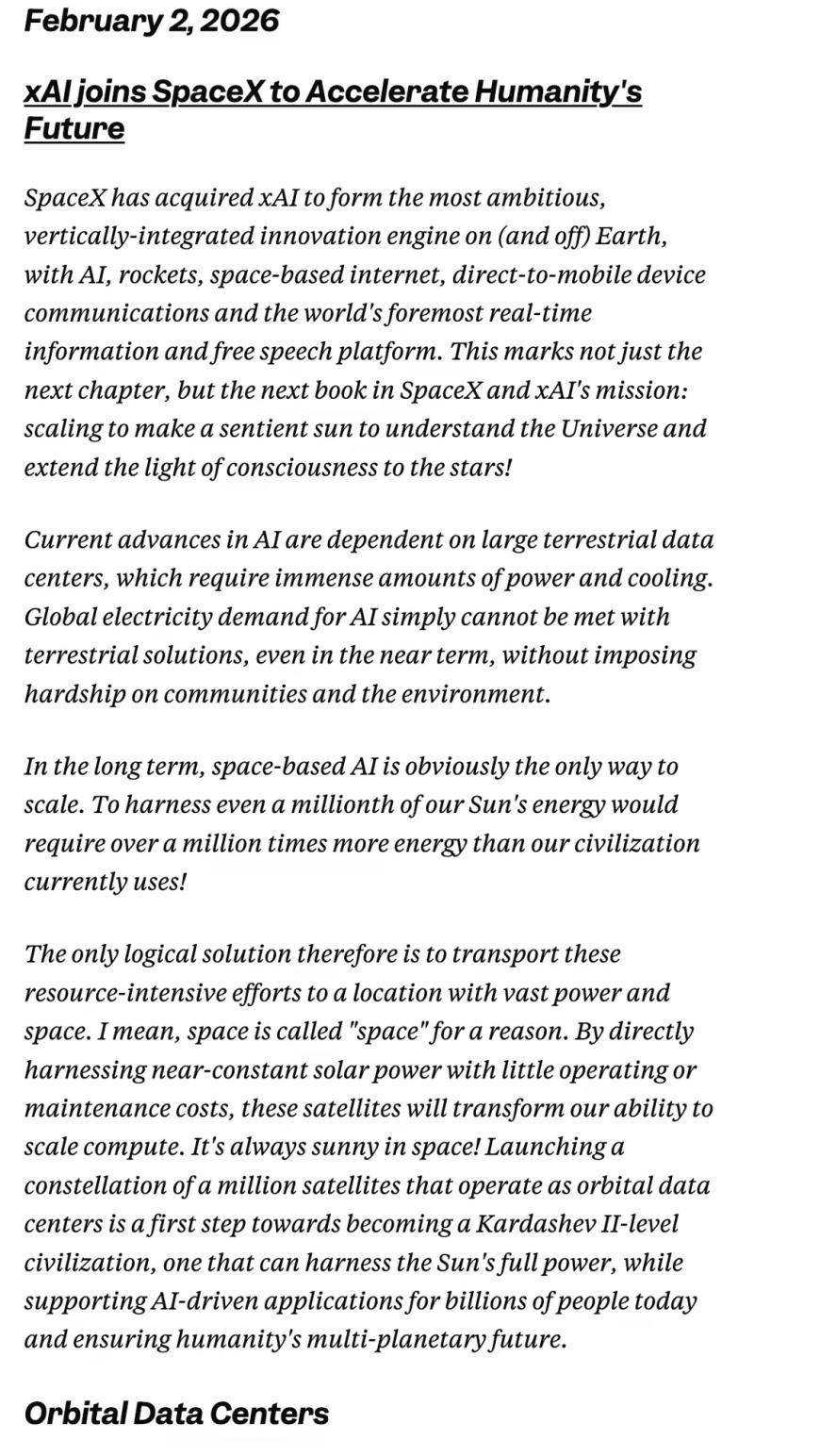
Core Viewpoint - SpaceX has officially announced the acquisition of xAI, creating a vertically integrated innovation engine that combines AI, rocket technology, space-based internet, and direct-to-mobile communications, aiming to accelerate humanity's future and establish a unique competitive advantage in the industry [3][19][21]. Group 1: Acquisition Details - SpaceX's valuation is approximately $1 trillion, while xAI is valued at around $250 billion, resulting in a combined valuation of $1.25 trillion post-acquisition [3][19]. - The merger is seen as a strategic move to create a "launch capability (SpaceX Starship) + communication network (Starlink) + AI brain (xAI's Grok)" vertical integration, which is difficult for competitors like OpenAI and Google to replicate in the short term [3][19][20]. Group 2: Future IPO and Valuation Projections - SpaceX plans to go public this year, with market estimates suggesting a target valuation exceeding $1.5 trillion; however, following the merger, some analysts believe the valuation could reach $4 trillion, potentially marking the largest IPO in history [3][19][20]. - The narrative of building a space AI infrastructure for humanity is expected to push the valuation ceiling to unprecedented levels [3][19][20]. Group 3: Strategic Vision and Infrastructure - The acquisition is described as a "cash flow (SpaceX) acquiring imagination (xAI)" operation, aiming to create the largest and most imaginative capital event in human history [4][20]. - The integration of AI and space technology is positioned as essential for scaling AI capabilities, as current advancements depend on large terrestrial data centers that are unsustainable in the long term [5][6][22]. Group 4: Space-Based AI and Sustainability - Long-term plans include launching a constellation of one million satellites that will serve as orbital data centers, which is a step towards achieving a Kardashev II-level civilization capable of harnessing the Sun's full power [7][23]. - The operational strategy will incorporate sustainable practices, including end-of-life disposal for satellites, building on successful models from existing SpaceX broadband systems [30]. Group 5: Technological Advancements and Future Prospects - The Starship program is expected to significantly enhance launch capabilities, with projections of delivering millions of tons to orbit annually, facilitating the exploration of space [27][28]. - Within 2 to 3 years, the lowest cost for generating AI compute power is anticipated to be in space, which will accelerate technological advancements and innovations beneficial to humanity [29][14].

马斯克万亿帝国诞生,“卡尔达肖夫Ⅱ型文明”迈出第一步
Sou Hu Cai Jing· 2026-02-03 06:18
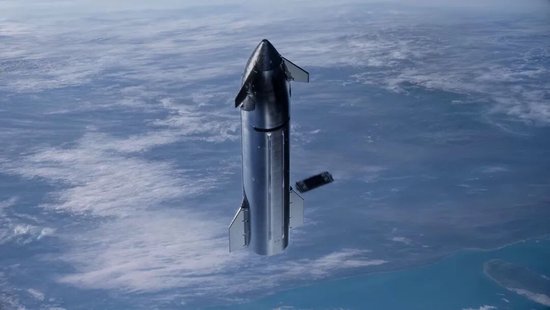
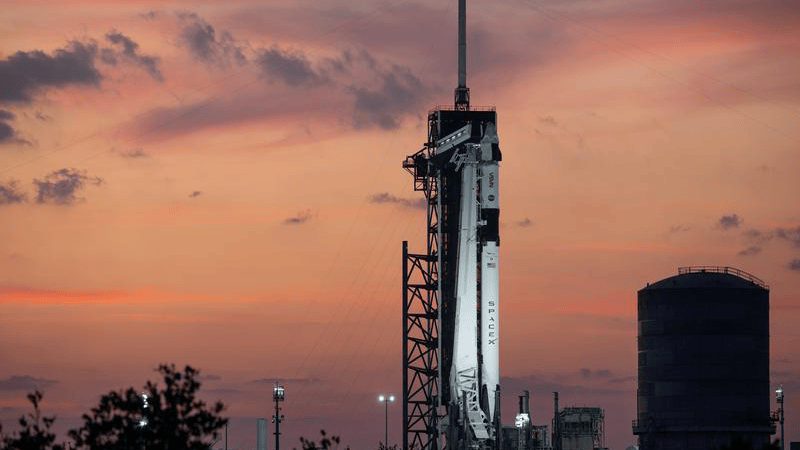
Core Insights - SpaceX has completed the acquisition of xAI for $250 billion, integrating AI with aerospace and communication to create a super innovative platform [1][3][8] - The merger is a strategic vertical integration aimed at building a highly ambitious innovation engine that combines SpaceX's core capabilities with xAI's technology [3][4] Financial Overview - The acquisition values the combined entity at $1.25 trillion, surpassing most publicly listed tech giants, reflecting market expectations of significant synergies and growth potential [1][8] - Prior to the merger, SpaceX was valued at approximately $800 billion, while xAI was valued at $230 billion [8] Strategic Vision - Elon Musk envisions a "space-based AI" that leverages solar energy to meet the growing power demands of AI, proposing a constellation of satellites functioning as orbital data centers [4][5] - The long-term goal is to transition resource-intensive computing tasks to space, which Musk believes is the only logical solution for scaling AI capabilities [4][5] Engineering Challenges - The construction of a million-ton payload launch vehicle is a fundamental engineering challenge necessary for supporting space-based data centers and lunar or Martian bases [5][9] - Current launch capabilities are insufficient, with only about 3,000 tons of payload delivered to orbit in record-setting 2025, highlighting the need for advancements in launch frequency and reliability [5][9] Technological Integration - The merger aligns with Musk's broader technological roadmap, including the development of fully reusable Starship rockets and the establishment of manufacturing capabilities on the Moon [6][7] - There are potential synergies between SpaceX's satellite network and Tesla's autonomous driving systems, although Tesla is not included in this merger [7][9] Regulatory Considerations - The combined entity will face complex regulatory scrutiny across multiple sectors, including aerospace, telecommunications, and antitrust [9] - The acquisition marks a decisive step towards Musk's vision of a unified "space AI," aiming to reconstruct energy acquisition and computational paradigms [9]
SpaceX为何要收购xAI? 马斯克内部信全文曝光
Sou Hu Cai Jing· 2026-02-03 01:16
Core Viewpoint - Elon Musk announced the acquisition of xAI by SpaceX, aiming to integrate AI, rocket technology, satellite internet, and mobile communication to create a highly ambitious and vertically integrated innovation engine on Earth and beyond [1][2]. Group 1: Acquisition and Integration - SpaceX has completed the acquisition of xAI, which will accelerate the future of humanity by merging AI with rocket technology and satellite internet [1]. - The integration aims to deploy data centers in space, marking a new chapter for both SpaceX and xAI [1][3]. Group 2: Space-Based AI and Energy Utilization - The long-term solution for AI's energy demands is space-based AI, which can utilize solar energy at a scale far exceeding current civilization's consumption [2][3]. - A constellation of one million satellites is proposed to operate as orbital data centers, representing a step towards a Type II Kardashev civilization that can harness the sun's total energy [3][4]. Group 3: Satellite Launch and Infrastructure - SpaceX's Starship will significantly enhance satellite launch capabilities, with the potential to deliver 200 tons per launch, enabling the deployment of millions of tons of satellites annually [4][5]. - The projected output of AI computing power from these satellites could reach 1 terawatt annually, transforming the landscape of AI capabilities [4][5]. Group 4: Future Prospects and Technological Advancements - The cost-effectiveness of generating AI computing power in space is expected to drive unprecedented innovation in training AI models and processing data [5]. - Establishing a permanent base on the Moon could facilitate scientific research and industrial production, further supporting the development of space-based infrastructure [5].