
天基AI

Search documents
马斯克断言:地球电力难撑AI发展,未来3年太空成AI最具经济效益部署地【附人工智能行业市场分析】
Sou Hu Cai Jing· 2026-02-06 09:07
Group 1 - Elon Musk asserts that the most economically viable locations for AI deployment will shift to space within the next 30 to 36 months due to Earth's energy supply limitations [2] - Musk announced the merger of SpaceX and his AI company xAI, creating a valuation of $1.25 trillion, emphasizing that space-based AI is the only way to achieve scalability in the long term [2] - Current U.S. average electricity consumption is 0.5 terawatts, but future AI infrastructure may require up to 1 terawatt, which is double the current consumption [2] Group 2 - The development of AI is characterized as an "electricity consumption war," with large models consuming millions of kilowatt-hours for a single training session, equivalent to the annual electricity usage of thousands of households [3] - The annual electricity consumption of global large models is nearing 40% of the annual output of the Three Gorges Dam, and electricity costs near data centers have increased by up to 267% over the past five years [3] - China has maintained the world's highest electricity generation for over a decade, with a projected 2023 output of 9.4 trillion kilowatt-hours, expected to exceed 10 trillion kilowatt-hours by 2025, providing a solid energy foundation for its AI industry [3] Group 3 - China's AI core industry is rapidly growing, nearing a scale of 600 billion yuan, with projections indicating it will surpass 1.2 trillion yuan by 2025 [4] - Microsoft CEO Satya Nadella stated that energy costs will determine which countries succeed in the AI competition during the World Economic Forum [4]


SpaceX收购xAI估值1.25万亿美元!马斯克:未来两到三年内,太空有望成为AI计算成本最低途径【附卫星互联网行业市场分析】
Sou Hu Cai Jing· 2026-02-04 03:12
Core Viewpoint - SpaceX has completed the acquisition of its AI startup xAI, creating a new entity valued at $1.25 trillion, making it the most valuable private company globally, marking a significant step in Elon Musk's technology empire across space, AI, and communications [2] Group 1: Acquisition Details - The acquisition was conducted as an all-stock transaction, with xAI becoming a wholly-owned subsidiary of SpaceX [2] - Musk envisions this deal as a means to create a highly integrated innovation engine that spans AI, rocket technology, and space internet [2][3] Group 2: Strategic Rationale - The core motivation behind the acquisition is the increasing demand for computational power and energy in AI, which is nearing the limits of traditional ground data centers [3] - Musk argues that space-based AI (or space-based computing) is the only viable path for scaling AI in the long term [3] Group 3: SpaceX's Market Position - SpaceX holds a dominant position in the commercial launch market, completing 98 launches in 2023, which accounts for approximately 44% of global launch activity [4] - The company is projected to complete a total of 138 launches in 2024, including Starship test flights [4] Group 4: Starlink's Revenue Contribution - Starlink, SpaceX's low Earth orbit satellite internet project, is a significant revenue driver, contributing approximately 50% to 80% of the company's income [5] - Starlink has deployed thousands of satellites and serves over 9.2 million active users across 155 countries, making it the largest satellite operator globally [5] Group 5: Future Outlook - Musk estimates that within the next two to three years, space could become the lowest-cost option for AI computing, potentially accelerating the development of AI models and data processing [11] - This cost advantage positions SpaceX to dominate the emerging space-based AI market [11]
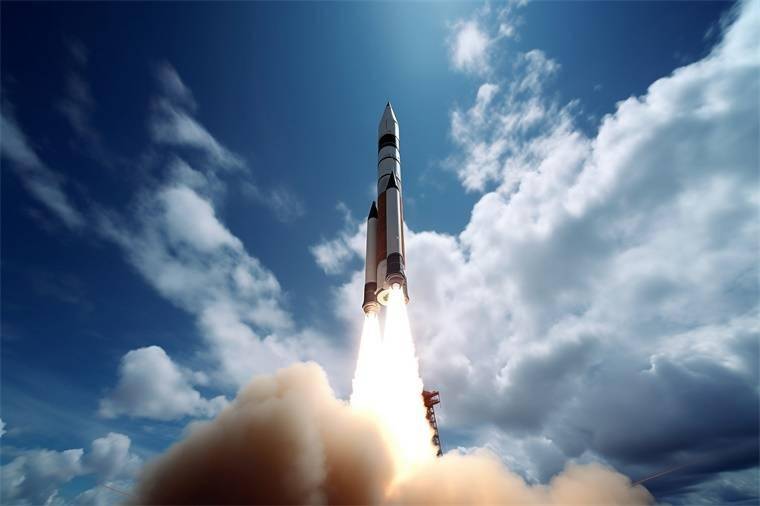
马斯克左手换右手屡试不爽,天基AI要来了
Xin Lang Ke Ji· 2026-02-04 01:07
Core Viewpoint - The acquisition of xAI by SpaceX marks a significant merger in the tech industry, creating a combined entity valued at $1.25 trillion, which is the largest merger in history, surpassing the previous record held for 25 years [2][4]. Group 1: Merger Details - The merger involves a stock exchange where xAI shareholders will receive SpaceX shares at a ratio of 0.1433, or cash at $75.46 per share for some executives [4]. - Post-merger, SpaceX's valuation will reach $1 trillion, while xAI will be valued at $250 billion, leading to a total valuation of $1.25 trillion for the merged entity [4]. - The combined company plans to conduct an IPO later this year, potentially raising $50 billion, which would set a new record for the largest IPO [5]. Group 2: Financial Context - xAI has been burning through nearly $1 billion per month, necessitating the merger to stabilize its financial situation [7][12]. - In contrast, SpaceX is projected to generate approximately $80 billion in profit by 2025, with revenues expected to reach $150-160 billion [16]. - The Starlink satellite internet service is a major revenue driver for SpaceX, contributing $10.4 billion in revenue in 2025, which is 69% of total revenue [17]. Group 3: Strategic Implications - The merger is seen as a strategic move to integrate AI capabilities with space technology, potentially leading to the development of space-based AI data centers [19][29]. - This acquisition reflects a broader trend in the AI industry where startups must align with financially stable parent companies to survive [26]. - The merger could lead to a significant shift in the space industry, intensifying competition and prompting traditional satellite manufacturers to adapt to new business models [21]. Group 4: Market Reactions - Analysts are divided on the merger's implications, with some expressing optimism about the combined entity's potential to create a comprehensive infrastructure platform [23][24]. - Others have raised concerns about the risks associated with merging high-valuation companies under Musk's leadership, suggesting it may lead to a chaotic structure [25]. - The merger is also viewed as beneficial for the X platform, reducing its reliance on advertising revenue and allowing for a more stable financial outlook [25].
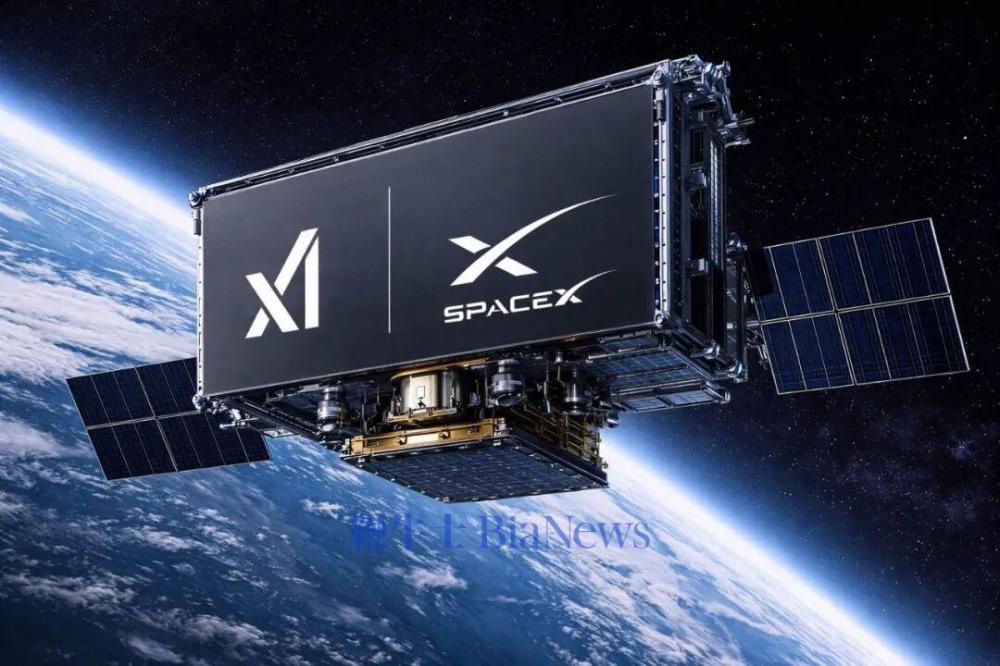
马斯克左手换右手屡试不爽,天基AI要来了|硅谷观察
Xin Lang Cai Jing· 2026-02-03 23:44
Core Viewpoint - The acquisition of xAI by SpaceX marks the creation of a $1.25 trillion super unicorn, representing one of the largest mergers in history, driven by Elon Musk's vision for an integrated innovation engine encompassing AI, space exploration, and communication technologies [3][6][30]. Group 1: Transaction Details - The merger was executed through a stock exchange, with xAI shareholders receiving 0.1433 shares of SpaceX for each xAI share, while some executives could opt for cash at $75.46 per share [6][32]. - Post-merger, SpaceX's valuation reached $1 trillion, xAI's at $250 billion, and the combined entity's valuation at $1.25 trillion, breaking a 25-year record for the largest merger [6][33]. - The merged entity plans to conduct an IPO later this year, potentially raising $50 billion, which would surpass the previous record set by Saudi Aramco in 2019 [6][33]. Group 2: Financial Context - xAI has been burning approximately $1 billion per month, necessitating the merger as a strategic move to stabilize its financial situation [7][39]. - In contrast, SpaceX is projected to generate $150 to $160 billion in revenue by 2025, with a profit of around $8 billion, primarily driven by its Starlink satellite internet business [15][43]. - Starlink is expected to contribute $104 billion in revenue by 2025, accounting for 69% of SpaceX's total revenue, highlighting its role as a cash cow for the merged entity [16][44]. Group 3: Industry Implications - The merger signals a shift in the AI industry, indicating that standalone AI startups may struggle to survive without backing from cash-rich parent companies [51]. - The combined entity aims to establish a "space-based AI data center," which could alleviate the energy and resource constraints faced by terrestrial data centers, potentially revolutionizing AI operations [45][54]. - This merger may intensify competition in the space industry, prompting other companies like Amazon and Google to accelerate their own projects in response to the new capabilities of the merged entity [48]. Group 4: Investor Reactions - Investor sentiment is mixed, with some analysts optimistic about the merger's potential to create a comprehensive infrastructure platform, while others express concerns about the high valuations and risks associated with Musk's ventures [49][50]. - The merger is seen as a strategic move to consolidate Musk's various enterprises into a cohesive ecosystem, potentially leading to future integrations with Tesla [49][50]. - Some investors have voiced skepticism, comparing the merger to previous high-risk acquisitions and questioning the sustainability of xAI's financial model [50][53].
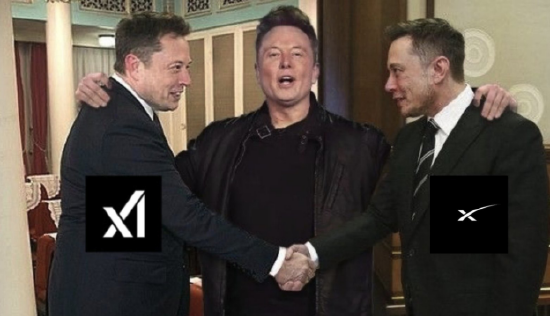
SpaceX将xAI纳入马斯克帝国
Xin Lang Cai Jing· 2026-02-03 16:02
Group 1 - Tesla (TSLA) saw a 0.9% increase in early trading on Tuesday [1][2] - xAI, supported by Tesla, will be acquired by SpaceX through a private transaction [1][2] - The acquisition aims to deploy space-based AI infrastructure for Elon Musk's business ventures [1][2] - SpaceX is reportedly preparing for an IPO [1][2]

马斯克:向星辰进发!地球史新一页|附:SpaceX收购xAI内部信中英原文
Xin Lang Cai Jing· 2026-02-03 09:39
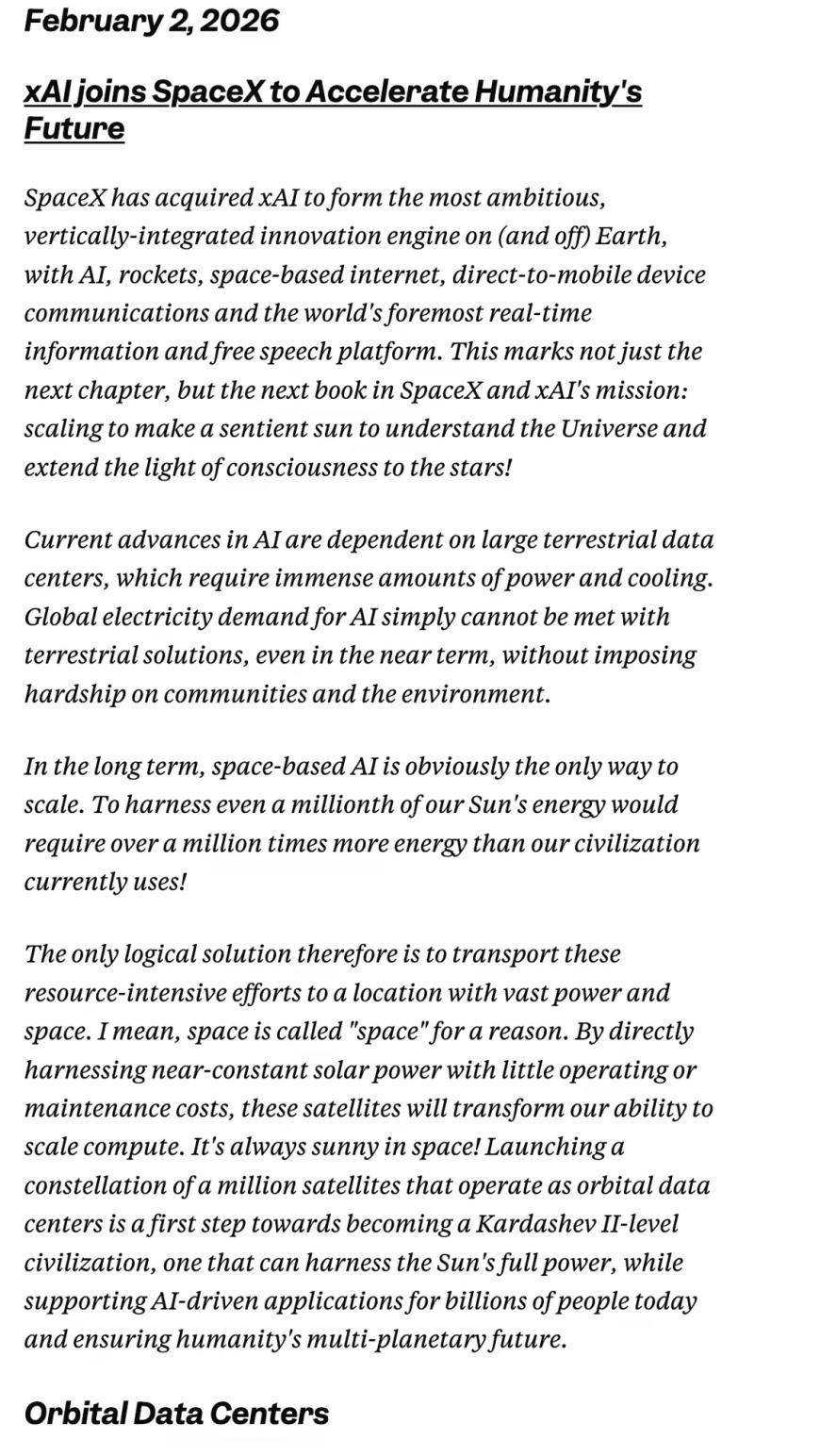
Core Viewpoint - SpaceX has officially announced the acquisition of xAI, creating a vertically integrated innovation engine that combines AI, rocket technology, space-based internet, and direct-to-mobile communications, aiming to accelerate humanity's future and establish a unique competitive advantage in the industry [3][19][21]. Group 1: Acquisition Details - SpaceX's valuation is approximately $1 trillion, while xAI is valued at around $250 billion, resulting in a combined valuation of $1.25 trillion post-acquisition [3][19]. - The merger is seen as a strategic move to create a "launch capability (SpaceX Starship) + communication network (Starlink) + AI brain (xAI's Grok)" vertical integration, which is difficult for competitors like OpenAI and Google to replicate in the short term [3][19][20]. Group 2: Future IPO and Valuation Projections - SpaceX plans to go public this year, with market estimates suggesting a target valuation exceeding $1.5 trillion; however, following the merger, some analysts believe the valuation could reach $4 trillion, potentially marking the largest IPO in history [3][19][20]. - The narrative of building a space AI infrastructure for humanity is expected to push the valuation ceiling to unprecedented levels [3][19][20]. Group 3: Strategic Vision and Infrastructure - The acquisition is described as a "cash flow (SpaceX) acquiring imagination (xAI)" operation, aiming to create the largest and most imaginative capital event in human history [4][20]. - The integration of AI and space technology is positioned as essential for scaling AI capabilities, as current advancements depend on large terrestrial data centers that are unsustainable in the long term [5][6][22]. Group 4: Space-Based AI and Sustainability - Long-term plans include launching a constellation of one million satellites that will serve as orbital data centers, which is a step towards achieving a Kardashev II-level civilization capable of harnessing the Sun's full power [7][23]. - The operational strategy will incorporate sustainable practices, including end-of-life disposal for satellites, building on successful models from existing SpaceX broadband systems [30]. Group 5: Technological Advancements and Future Prospects - The Starship program is expected to significantly enhance launch capabilities, with projections of delivering millions of tons to orbit annually, facilitating the exploration of space [27][28]. - Within 2 to 3 years, the lowest cost for generating AI compute power is anticipated to be in space, which will accelerate technological advancements and innovations beneficial to humanity [29][14].
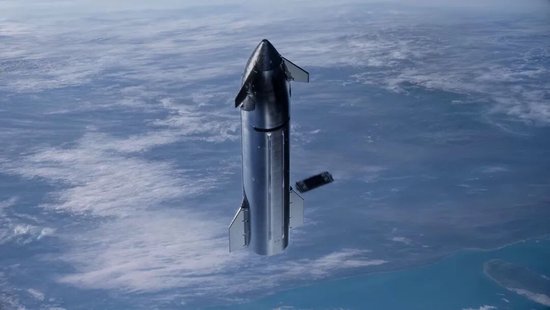
刚刚,马斯克收购了马斯克
Sou Hu Cai Jing· 2026-02-03 03:58
Core Viewpoint - SpaceX has officially announced the acquisition of xAI, aiming to create a vertically integrated innovation engine that combines artificial intelligence, rocket technology, satellite internet, and communication systems [2][5]. Group 1: Company Overview - The merged entity is expected to be priced at approximately $527 per share, with a total valuation of $1.25 trillion [4]. - The acquisition is seen as a new chapter for both SpaceX and xAI, focusing on the development of a "conscious sun" to understand the universe and extend consciousness beyond Earth [6]. Group 2: Technological Advancements - The integration of AI and space technology is positioned as a solution to the increasing energy demands of AI, which cannot be met solely by terrestrial data centers [6]. - The plan includes launching a constellation of satellites that will serve as space-based data centers, which is a step towards achieving a Type II Kardashev civilization capable of harnessing the full energy of the sun [6][9]. Group 3: Future Prospects - The company aims to launch one million tons of satellites annually, which could generate an additional 100 GW of AI computing power each year without ongoing operational costs [9]. - The Starship will enhance the capacity for satellite launches, significantly increasing the number of satellites deployed and supporting the development of a sustainable space economy [8][10]. Group 4: Long-term Vision - The initiative includes plans for establishing permanent bases on the Moon and Mars, utilizing local resources for manufacturing and deploying satellites deeper into space [10]. - The overarching goal is to create a self-sustaining base on the Moon and a complete civilization on Mars, ultimately facilitating human expansion throughout the universe [10].

SpaceX为何要收购xAI? 马斯克内部信全文曝光
Sou Hu Cai Jing· 2026-02-03 01:16
Core Viewpoint - Elon Musk announced the acquisition of xAI by SpaceX, aiming to integrate AI, rocket technology, satellite internet, and mobile communication to create a highly ambitious and vertically integrated innovation engine on Earth and beyond [1][2]. Group 1: Acquisition and Integration - SpaceX has completed the acquisition of xAI, which will accelerate the future of humanity by merging AI with rocket technology and satellite internet [1]. - The integration aims to deploy data centers in space, marking a new chapter for both SpaceX and xAI [1][3]. Group 2: Space-Based AI and Energy Utilization - The long-term solution for AI's energy demands is space-based AI, which can utilize solar energy at a scale far exceeding current civilization's consumption [2][3]. - A constellation of one million satellites is proposed to operate as orbital data centers, representing a step towards a Type II Kardashev civilization that can harness the sun's total energy [3][4]. Group 3: Satellite Launch and Infrastructure - SpaceX's Starship will significantly enhance satellite launch capabilities, with the potential to deliver 200 tons per launch, enabling the deployment of millions of tons of satellites annually [4][5]. - The projected output of AI computing power from these satellites could reach 1 terawatt annually, transforming the landscape of AI capabilities [4][5]. Group 4: Future Prospects and Technological Advancements - The cost-effectiveness of generating AI computing power in space is expected to drive unprecedented innovation in training AI models and processing data [5]. - Establishing a permanent base on the Moon could facilitate scientific research and industrial production, further supporting the development of space-based infrastructure [5].
1000000颗卫星,SpaceX彻底引爆“太空算力”
Xin Lang Cai Jing· 2026-02-01 01:25
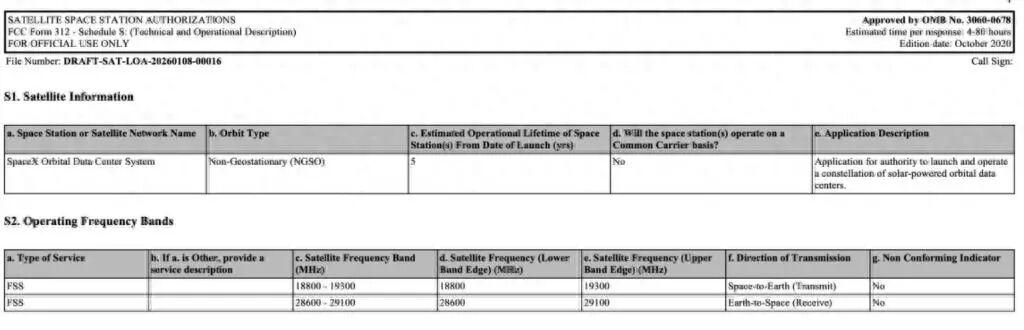
Group 1 - SpaceX is leading the industry with innovations ranging from reusable rockets to satellite communication and space-based AI [1] - The company has submitted a new application to the FCC for a satellite network called the "Orbital Data Center System," which aims to launch and operate a constellation of up to 1 million satellites [4][5] - These satellites will operate in various orbital shells between 500 km and 2000 km, designed to meet the growing demand for AI computing power [4][5] Group 2 - The Orbital Data Center System is defined as a satellite constellation with unprecedented computing capabilities to drive advanced AI models and applications [5] - The system aims to provide the computational power necessary for large-scale AI inference and data center applications for billions of users globally [5] - Experts categorize space computing into three forms, including reusing existing communication satellites, dedicated computing satellites, and advanced systems like Starcloud [6] Group 3 - The realization of space computing faces five major technical challenges, including bandwidth aggregation, radiation resistance, thermal management, construction and control of large flexible structures, and continuous operational assurance [7][9] - Addressing these challenges is crucial for the successful deployment and operation of high-power satellites capable of supporting advanced computing tasks [9]
打造太空算力!SpaceX申请部署100万颗卫星
Xin Lang Cai Jing· 2026-01-31 17:25
Core Insights - SpaceX is leading advancements in the space industry, focusing on reusable rockets, satellite communication, and space-based AI [1] Group 1: SpaceX's New Application - SpaceX submitted a new application to the FCC for a satellite network called the "Orbital Data Center System," which aims to launch and operate a constellation of up to 1 million satellites [4][5] - The satellites will operate in various orbital shells between 500 km and 2000 km, designed to meet the growing demand for AI computing [4][5] Group 2: Technical and Operational Aspects - The Orbital Data Center System is defined as a satellite constellation with unprecedented computing power to drive advanced AI models and applications [5] - The system is intended to provide computational capabilities for billions of users globally, with a narrow orbital shell of no more than 50 km to avoid conflicts with similar systems [5] Group 3: Expert Insights on Space Computing - Experts categorize space computing into three forms: reusing existing communication satellites for additional computing power, dedicated computing satellites with distributed networking, and advanced systems like Starcloud that can achieve up to 5 GW of computing power [6] - The ultimate goal is to achieve lower computing costs in space compared to ground-based systems, presenting significant commercial value [6] Group 4: Challenges in Space Computing - Five major technical challenges for implementing space computing include bandwidth and latency control, radiation resistance, thermal management, construction and control of large flexible structures, and continuous operational assurance [7][9] - Addressing these challenges is crucial for the successful deployment and operation of high-power satellites [9]