去美元化预期

Search documents
地缘局势与商品周期共振 国际油价中期有望延续强势
Zhong Guo Zheng Quan Bao· 2026-02-25 22:34
Core Viewpoint - International crude oil prices have continued their strong performance since the Spring Festival, with Brent crude futures experiencing the highest increase in 13 years during this period, driven primarily by geopolitical tensions rather than supply-demand fundamentals [1][2]. Geopolitical Factors - The rise in international oil prices is significantly supported by geopolitical tensions, particularly the ongoing situation between the U.S. and Iran, which has raised concerns about potential military conflict and supply risks [2][5]. - Analysts suggest that the geopolitical premium in the oil market is currently around $1, which could increase to $4-$5 if tensions escalate further [3][8]. Supply-Demand Dynamics - Despite a shift in the global oil market towards oversupply, with an estimated surplus of 1.5 to 2 million barrels per day expected as OPEC+ begins to increase production in 2025, the current price trends are largely influenced by geopolitical factors rather than fundamental supply-demand metrics [2][4]. - Historical data indicates that while there have been more years of price declines post-Spring Festival, the magnitude of price increases during those years has been significantly higher, suggesting a favorable risk-reward ratio for potential price increases in the near term [4][5]. Market Predictions - Short-term predictions indicate that if the U.S. and Iran reach an agreement, oil prices may face downward pressure, potentially reversing gains made during the Spring Festival. Conversely, if tensions escalate, prices could remain elevated, with Brent crude expected to trade between $70 and $75 per barrel [8]. - In the medium to long term, analysts project that oil prices could rise to the range of $75 to $80 per barrel by 2026, supported by bullish market expectations and geopolitical premiums [8].
黄金、白银,强劲反弹
Sou Hu Cai Jing· 2026-02-14 04:15
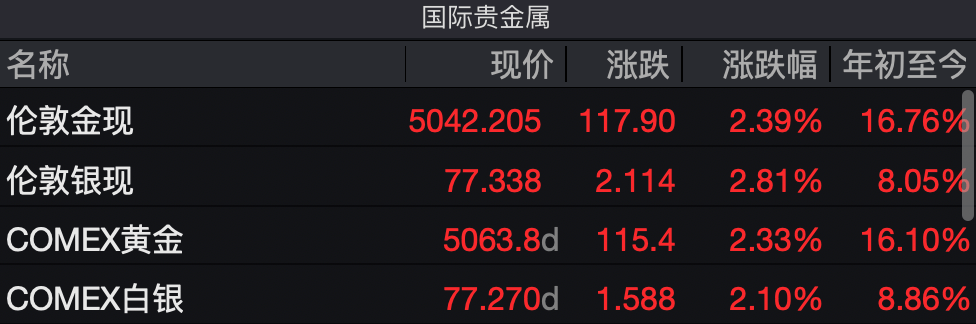
Core Viewpoint - The precious metals market, particularly gold and silver, has shown a strong rebound, with gold prices surpassing $5000 per ounce and silver also experiencing significant gains this year [1][2]. Price Movements - As of February 13, spot gold rose by 2.39% to $5042.205 per ounce, marking a year-to-date increase of 16.76% [1][2]. - Spot silver increased by 2.81% to $77.338 per ounce, with a year-to-date rise of 8.05% [1][2]. - COMEX gold futures rose by 2.33% to $5063.80 per ounce, with a weekly increase of 1.51% [1][2]. - COMEX silver futures increased by 2.10% to $77.27 per ounce, although it saw a weekly decline of 0.33% [1][2]. Economic Indicators - The U.S. Labor Statistics report indicated that the January CPI fell to 2.4% year-on-year, below expectations, while core CPI dropped to 2.5%, the lowest since 2021 [2]. - Analysts suggest that the positive reaction to inflation data is tempered by the improving job market, which may reduce the necessity for further rate cuts by the Federal Reserve [2]. Geopolitical Factors - The geopolitical landscape, particularly U.S. military actions in the Middle East, has bolstered the attractiveness of precious metals [3]. - The current rise in gold prices is attributed to expectations of de-dollarization, increased central bank gold purchases, and geopolitical risk premiums, rather than immediate monetary policy easing [3]. Market Outlook - Several Wall Street institutions have raised their gold price targets, with BNP Paribas predicting gold could reach $6000 per ounce by year-end due to ongoing macroeconomic and geopolitical risks [4]. - Analysts from Wells Fargo view recent price corrections as healthy adjustments following a strong upward trend, expecting continued benefits for gold from geopolitical uncertainties and central bank buying [4].