去通道化

Search documents
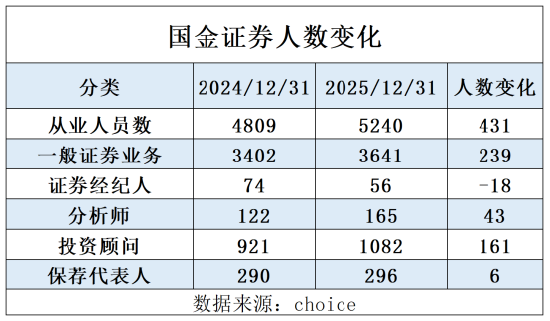
爱“挖墙脚”的国金证券:2025年人数增加431人,分析师增加43人,超20名分析师离职
Xin Lang Cai Jing· 2026-02-06 09:55
Core Viewpoint - The securities industry in China is experiencing a decline in workforce numbers, while Guojin Securities is expanding its personnel and shifting its focus towards professional services rather than traditional brokerage [1][2][3][10]. Industry Overview - The number of employees in the securities industry has decreased for three consecutive years, from 356,100 at the end of 2022 to 327,800 by the end of 2025, with nearly 30,000 professionals leaving the industry [1][11]. - The number of personnel in "general securities business" has dropped by over 20,000 in the last two years, and the number of securities brokers has decreased by more than 60,000 over the past eight years [1][11]. Guojin Securities Personnel Changes - Guojin Securities has shown a counter-cyclical growth, increasing its total number of employees from 4,809 in 2024 to 5,240 by the end of 2025, a net increase of 431 employees, representing an 8.22% growth [2][12]. - The number of personnel in general securities business increased by 239, while the investment advisor team grew from 921 to 1,082, marking a 17.5% increase. The analyst team expanded from 122 to 165, a growth of 35.2% [3][13]. Structural Optimization - The number of traditional securities brokers at Guojin Securities decreased from 74 to 56, reflecting a broader industry trend of "de-channelization" and a reduction in traditional brokerage services [3][13]. - The strategic shift is evident as resources are redirected towards wealth management and research, indicating a clear human resource strategy of reducing reliance on traditional brokerage [3][13]. Analyst Team Developments - In 2025, Guojin Securities' analyst team grew from 122 to 165, forming over 30 research teams covering various sectors, including macroeconomics, strategies, and specific industries like automotive and technology [4][14]. - A total of 64 new analysts were registered in 2025, with 22 coming from internal transitions and 42 from other institutions, indicating a high turnover rate with over 20 analysts leaving [4][14]. Financial Performance Challenges - Despite personnel growth, Guojin Securities faced challenges with declining commission income, with a drop of 25.03% in 2024 and 16.44% in the first half of 2025, leading to significant losses in investment banking operations [7][17]. - The investment banking revenue for the first half of 2025 was 377 million yuan, down 17.94% year-on-year, with a loss of approximately 98.07 million yuan, making it one of the worst-performing firms in this sector [8][18]. Business Segment Performance - Wealth management business generated 1.83 billion yuan in revenue, with a gross margin of 51.04%, reflecting a 38.37% increase year-on-year [19]. - The investment banking segment reported a revenue of 377 million yuan, with a gross margin of -26.01%, indicating a significant decline [19].


华泰证券开启“忙碌季”!集团及子公司齐换帅、境外业务同步加码
Xin Lang Cai Jing· 2026-01-26 03:31
Core Viewpoint - Huatai Securities has completed its seventh board of directors reshuffle, appointing Wang Huiqing as the new chairman and Zhou Yi as the CEO, while the former chairman Zhang Wei has retired due to age [1][10]. Leadership Changes - Wang Huiqing, born in February 1970, has a background in finance and law, along with qualifications as a certified public accountant and lawyer, creating a comprehensive skill set in "law + finance + management" [2][11]. - Wang has experience in various governmental roles and has been involved in the financial sector since 2009, leading significant financial platforms [2][11]. - Zhou Yi, who has been with Huatai since 2006, has successfully led the company's digital transformation and global expansion since becoming CEO in 2019 [5][14]. Strategic Focus - The new leadership emphasizes a dual-driven strategy of wealth management and institutional services powered by technology, aiming to enhance the global collaborative organizational and business framework [4][13]. - Huatai Securities has maintained a leading position in financial technology investments, with expenditures of 2.724 billion yuan in 2022, and projected investments of 2.578 billion yuan and 2.448 billion yuan for 2023 and 2024, respectively [5][14]. Subsidiary Management Changes - Huatai Securities Asset Management has also undergone management restructuring, with Jiang Xiaoyang becoming the sole chairman and Zhu Qian appointed as the new general manager [7][16]. - The new management team consists of experienced individuals who have been with Huatai for many years, ensuring continuity and expertise in the company's operations [7][16]. Business Performance - Huatai Securities Asset Management has focused on various investment areas, including fixed income, equity, multi-asset, and FOF investments, as well as ABS and REITs [7][16]. - By the end of 2025, the company had issued 994 ABS products totaling 1,011.123 billion yuan, ranking third in the industry [8][17]. - The public fund management scale reached 180.824 billion yuan by the end of 2025, marking a year-on-year growth of 31.59% [8][17].

新规落地一年有余,期货公司资管业务有哪些关键变化?
Qi Huo Ri Bao· 2026-01-21 03:05
Core Viewpoint - The implementation of the "Futures Company Asset Management Business Filing Management Rules" has led to a significant transformation in the futures industry, shifting from a reliance on channel business to a focus on high-quality, actively managed asset management that leverages the unique characteristics of futures and derivatives [1][2]. Group 1: Industry Transformation - The futures asset management business is undergoing a profound change characterized by "quality improvement and quantity reduction," moving away from extensive reliance on channel business towards a model centered on active management [1][2]. - As of the end of 2025, the number of active futures asset management institutions is expected to decrease to 91, down from 110 at the beginning of the previous year, indicating a trend towards license clearance and consolidation in the industry [2]. - The shift towards higher entry barriers and reduced channel business is seen as beneficial for fostering healthy competition and enhancing the overall professional level of the industry [2][6]. Group 2: Focus on Active Management - The industry is collectively moving towards active management strategies, with a focus on utilizing the professional advantages of futures and derivatives [3]. - Current transformations in futures asset management are concentrated in areas such as Fund of Funds (FOF), Commodity Trading Advisors (CTA), macro hedging, multi-strategy arbitrage, and fixed income plus [3]. - Companies like Jin Xin Futures and Zhe Shang Futures are developing distinctive product lines that cater to various risk-return preferences and investment strategies, emphasizing active management and the integration of fundamental research with quantitative tools [3][4]. Group 3: Structural Adjustments and Competitive Focus - The industry is expected to experience structural adjustments in asset management scale and competitive landscape due to the ongoing removal of channel business and increased operational thresholds [6]. - While the overall asset management scale may decline in the short term, the demand for actively managed products is anticipated to grow, leading to a more diversified product offering [6]. - The market share of institutions with specialized research and investment capabilities is expected to increase, as the industry transitions towards a high-quality, professionalized model [6][7].

“去通道化”加速 行业主动管理转型谋突围
Qi Huo Ri Bao Wang· 2026-01-21 02:59
Core Viewpoint - The implementation of the "Futures Company Asset Management Business Filing Management Rules" has led to a significant transformation in the futures industry, shifting from a reliance on channel business to a focus on high-quality, actively managed asset management that leverages the unique characteristics of futures and derivatives [1] Group 1: Industry Transformation - The futures asset management business is undergoing a profound change characterized by "quality improvement and quantity reduction," moving away from extensive channel-based development towards a model centered on active management [2][3] - As of the end of 2025, the number of existing futures asset management institutions is expected to decrease to 91, down from 110 at the beginning of the previous year, indicating a trend of license clearance and industry consolidation [2] - The shift towards higher entry barriers and reduced channel business scale is seen as beneficial for promoting professional and differentiated development within the industry [2][3] Group 2: Focus on Active Management - The industry is collectively moving towards active management, abandoning reliance on channel business, which is viewed as regulatory arbitrage [3] - Current transformations in futures asset management are primarily focused on areas such as Fund of Funds (FOF), Commodity Trading Advisors (CTA), macro hedging, multi-strategy arbitrage, and fixed income plus [3] - Companies like Jin Xin Futures and Zhe Shang Futures are developing distinctive product lines that cater to various risk-return preferences and investment strategies, emphasizing active management and the unique advantages of futures and derivatives [3][4] Group 3: Structural Adjustments and Competitive Focus - The asset management scale and competitive landscape in the industry are expected to undergo structural adjustments due to the ongoing removal of channel business and increased operational thresholds [5][6] - Active management product scales are anticipated to grow against the trend of overall asset management scale decline, with funds concentrating on high-performing managers [5] - The future will see a clearer differentiation in competition, with resources increasingly flowing towards leading and specialized institutions [6][7] Group 4: Future Directions - Institutions are encouraged to deepen their focus on commodity and derivative strategies, moving away from homogeneous competition to establish differentiated advantages [6][7] - The development of a core competitive edge through an integrated approach of research, risk control, and technology is deemed essential for future success in the futures asset management sector [7]
公开“海选”3个月后,46岁证券老将升任财达证券总经理!
Xin Lang Cai Jing· 2026-01-12 11:36
Core Viewpoint - The appointment of Hu Hengsong as the new general manager of Caida Securities marks a significant internal transition, following the resignation of Zhang Ming from the same position while retaining his role as chairman. The company has shown strong financial performance despite challenges in certain business areas [1][2][9]. Management Changes - Hu Hengsong, aged 46, has been promoted from the position of executive vice president to general manager, having been with Caida Securities for over seven years and possessing more than 18 years of experience in the securities industry [1][4][6]. - Zhang Ming, who served as general manager for one year and nine months, has stepped down from this role but continues as chairman and party secretary, ending a dual-role situation [1][2]. Financial Performance - For the first three quarters of 2025, Caida Securities reported revenues of 2.072 billion yuan and a net profit of 664 million yuan, representing year-on-year increases of 21.52% and 79.5%, respectively [9][10]. - The brokerage and proprietary trading businesses have seen significant growth, particularly the brokerage business, which reported a net commission income of 751 million yuan, up 82.75% year-on-year [11][9]. - However, the investment banking segment has faced continuous revenue declines since 2023, with net income from investment banking fees dropping to 236 million yuan, a decrease of 0.96% year-on-year [13][14]. Shareholder Activity - In mid-2025, the second-largest shareholder, Hebei Guokong Operations, executed a share reduction plan, selling 3% of its holdings for a total of 667 million yuan, marking the first instance of shareholder reduction since the company's IPO in 2021 [15][18]. - Despite the share reduction, Caida Securities' stock price experienced an increase during the same period, attributed to a broader market rally [17][18]. Market Outlook - The company faces challenges including management turnover, shareholder reductions, and stock price pressures, which may impact investor confidence moving forward [18]. - The ability of Hu Hengsong to leverage his extensive management experience to convert short-term market gains into sustainable competitive advantages will be critical for the company's future [18].