
台湾地位未定论

Search documents
新华时评丨高市早苗企图蒙混过关行不通
Xin Lang Cai Jing· 2025-12-05 13:13
Core Viewpoint - Japanese Prime Minister Kishi Nobuo's recent remarks regarding Taiwan have sparked significant criticism both domestically and internationally, as he attempts to downplay the implications of his statements while failing to clarify Japan's official stance on the Taiwan issue [1][2][3]. Summary by Relevant Sections Japan's Position on Taiwan - Kishi Nobuo reiterated that Japan's fundamental stance on Taiwan remains unchanged as per the 1972 Japan-China Joint Communiqué, which recognizes the People's Republic of China as the sole legitimate government of China and acknowledges Taiwan as an inseparable part of Chinese territory [1][3][4]. - The Japanese government has made formal commitments in various treaties and declarations to uphold this position, which holds international legal validity and leaves no room for ambiguity or misinterpretation [3][4]. Criticism of Kishi Nobuo's Statements - Kishi's provocative comments suggesting that "Taiwan's situation could pose an existential crisis for Japan" imply potential military intervention, leading to multiple inquiries from China and criticism from both domestic and international communities [1][2][3]. - His failure to retract these statements and his evasive responses have been viewed as a lack of sincerity in addressing the concerns raised by China, further damaging mutual trust and the political foundation of Japan-China relations [2][4]. Call for Clarity and Accountability - There is a strong demand for the Japanese government to clearly articulate its so-called "consistent position" on Taiwan, emphasizing the need to adhere to the One China principle and the spirit of the four political documents between Japan and China [2][4]. - The article argues that merely reiterating a position without addressing specific content is ineffective and undermines the One China stance, suggesting that Japan must reflect and correct its course to maintain stable relations with China [2][4].
俄学者批高市早苗言论严重威胁地区稳定
Xin Hua She· 2025-12-04 12:27
Core Viewpoint - Recent provocative statements by Japanese Prime Minister Sanae Takaichi regarding Taiwan represent a serious interference in China's internal affairs and pose a significant threat to stability in Northeast Asia and international security [1][2]. Group 1: Provocative Statements - Takaichi's remarks on Taiwan are seen as highly provocative and detrimental to Sino-Japanese relations, with no benefits for Japan [1]. - The reference to the "San Francisco Peace Treaty," which is deemed illegal and invalid, is criticized as inappropriate and misleading regarding Taiwan's status [1]. Group 2: Military Developments - Japan's Defense Minister, Nobuo Kishi, announced plans to deploy missiles on Yonaguni Island, approximately 110 kilometers east of Taiwan, which is viewed as a destabilizing action [2]. - Takaichi's discussions about potentially allowing nuclear weapons on Japanese soil directly contradict Japan's long-standing "Three Non-Nuclear Principles" [2]. Group 3: Historical Context and Risks - Experts warn that Japan's recent military rhetoric reflects a dangerous trend of seeking to expand the Self-Defense Forces' capabilities and potentially engage in overseas operations [2]. - The revival of nationalist sentiments and the glorification of the "Bushido spirit" by Japanese leaders could lead the country into perilous situations reminiscent of its aggressive policies during World War II [2].
日本学者:高市早苗妄图煽炒所谓“台湾地位未定论”是对历史的歪曲
Xin Hua She· 2025-12-03 13:17
Core Viewpoint - The remarks made by Japanese Prime Minister Sanae Takaichi regarding Taiwan are seen as a distortion of history and have sparked significant criticism within Japan [1][2]. Group 1: Takaichi's Statements - On November 7, Takaichi stated that a "Taiwan emergency" could constitute a "survival crisis situation" for Japan, which led to strong backlash from various sectors in Japan [1]. - Takaichi continues to defend her statements, claiming that Japan has relinquished all rights according to the "San Francisco Peace Treaty" and does not hold a position on Taiwan's legal status [2]. Group 2: Historical Context and Criticism - Professor Hiroshi Onishi criticized Takaichi's focus on the "San Francisco Peace Treaty," arguing that it ignores other significant documents such as the Cairo Declaration and the Potsdam Proclamation, which clearly state Taiwan's return to China [2][3]. - Onishi emphasized that the "San Francisco Peace Treaty" was made without the participation of key WWII parties like China and the Soviet Union, making it an invalid basis for discussions regarding Taiwan's sovereignty [3]. - He highlighted the importance of documents like the Sino-Japanese Joint Statement and the Treaty of Peace and Friendship between Japan and China, urging Japan to return to a stance based on these agreements [3].
高市早苗妄图煽炒所谓“台湾地位未定论”是对历史的歪曲——访日本庆应义塾大学名誉教授大西广
Xin Hua Wang· 2025-12-03 04:39
Core Viewpoint - The remarks made by Japanese Prime Minister Kishi Nobuo regarding Taiwan's status are seen as a distortion of history and a dangerous escalation towards military involvement in the Taiwan Strait [1][2]. Group 1: Historical Context - Kishi's comments on Taiwan being a potential "survival crisis" for Japan have sparked significant criticism within Japan [1]. - The reference to the "San Francisco Peace Treaty" is criticized for ignoring other important documents like the Cairo Declaration and the Potsdam Proclamation, which clearly state Taiwan's return to China [2][3]. Group 2: Legal and Political Implications - The "San Francisco Peace Treaty" is deemed illegal and invalid as it was made without the participation of key wartime parties such as China and the Soviet Union, violating international law principles [3]. - The Cairo Declaration explicitly states that territories stolen from China, including Taiwan, should be returned to China, reinforcing that Taiwan is not a "temporary administrative object" of Japan [3]. Group 3: Call for Reassessment - There is a strong call for Japan to return to a stance based on the Sino-Japanese political documents, such as the Sino-Japanese Joint Statement and the Treaty of Peace and Friendship between Japan and China [3].
人民日报钟声:日本所谓“台湾地位未定”论 是对历史的无知和现实的误判
Ren Min Ri Bao· 2025-12-01 00:54
Core Viewpoint - The statements made by Japanese Prime Minister Kishi Nobuo regarding Taiwan reflect a deep-rooted historical revisionism and a misjudgment of current international political realities, indicating Japan's intentions to militarily intervene in the Taiwan Strait [1][2]. Historical Context - Japan's occupation of Taiwan began in 1895 through an unequal treaty, and subsequent international agreements, such as the Cairo Declaration and the Potsdam Proclamation, established the legal basis for Taiwan's return to China after World War II [1]. - The San Francisco Peace Treaty, cited by Kishi, is criticized for being an illegal document that disregards the established international legal framework regarding Taiwan's sovereignty [2]. Implications of Military Rhetoric - Kishi's assertion that "Japan is back" raises concerns about a resurgence of militarism in Japan, especially in light of historical atrocities committed during its colonial rule over Taiwan [3]. - The historical context of Japan's colonial rule is marked by severe human rights violations and exploitation of Taiwanese resources, which serves as a reminder of the potential dangers of militaristic rhetoric in contemporary politics [3]. Taiwan's Status - Taiwan is emphasized as a core interest of China, with a strong commitment from the Chinese government to counter any foreign interference or attempts to disrupt national unity [4]. - Japan is urged to reflect on its historical responsibilities and to refrain from provocative actions regarding Taiwan to avoid repeating past mistakes [4].


日本所谓“台湾地位未定”论,是对历史的无知和现实的误判(钟声)
Ren Min Ri Bao· 2025-11-30 22:01
Core Viewpoint - The statements made by Japanese Prime Minister Kishi Nobuo regarding Taiwan reflect a deep-rooted historical revisionism and a misjudgment of current international political realities, indicating Japan's intentions to militarily intervene in the Taiwan Strait [1][2]. Summary by Sections Historical Context - Japan's occupation of Taiwan began in 1895 through an unequal treaty, and the legal basis for Taiwan's return to China is established through international documents such as the Cairo Declaration and the Potsdam Declaration [1]. - The Cairo Declaration, issued in 1943, stated that territories stolen by Japan, including Taiwan, should be returned to China, reaffirmed by the Potsdam Declaration in 1945 [1]. Legal Implications - The San Francisco Peace Treaty, cited by Kishi, is criticized as an illegal document that violates international law and disregards the rights of China as a non-signatory [2]. - The selective reference to this treaty by Kishi is seen as a distortion of historical facts and a violation of established international norms [2]. Military and Political Concerns - Kishi's assertion that "Japan is back" raises concerns about a resurgence of militarism in Japan, particularly in relation to Taiwan, where historical atrocities committed by Japan are recalled [3]. - The historical context of Japan's colonial rule in Taiwan is highlighted, emphasizing the suffering and oppression experienced by the Taiwanese people during that period [3]. National Interests - Taiwan is identified as a core interest of China, with a strong commitment from the Chinese government to counter any foreign interference regarding Taiwan [4]. - Japan is warned against provocative actions related to Taiwan, with a reminder of its historical responsibilities and the potential consequences of such actions [4].
日本最新神操作,世界哭笑不得
Bei Jing Ri Bao Ke Hu Duan· 2025-11-27 23:36
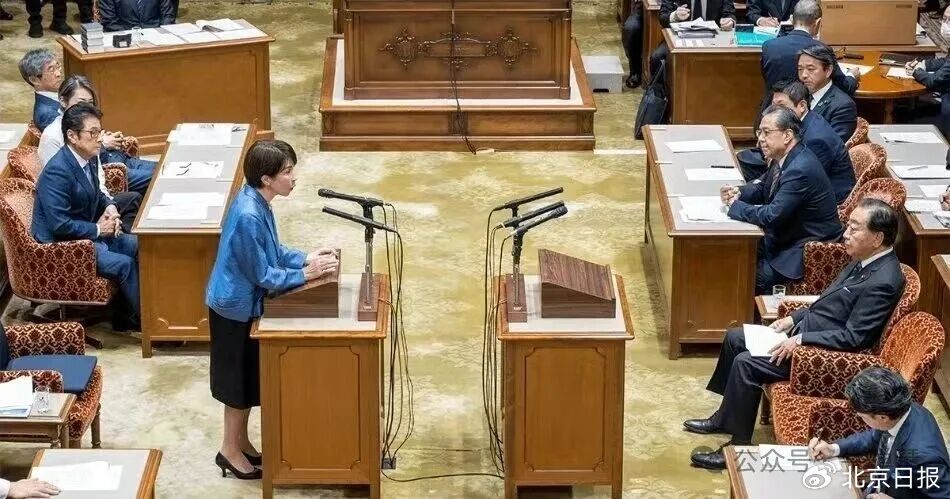
Core Viewpoint - The article discusses the diplomatic tensions between Japan and China, particularly focusing on Japanese Prime Minister Sanae Takaichi's controversial statements regarding Taiwan, which have led to significant backlash from China and raised concerns about Japan's foreign policy approach [2][11][31]. Group 1: Japan's Diplomatic Maneuvering - Takaichi's initial comments on Taiwan being a potential "survival crisis" for Japan were perceived as a hint at possible military involvement in the Taiwan Strait, causing outrage in China [2][11]. - In a subsequent debate, Takaichi attempted to clarify her stance by stating that Japan would assess situations based on specific circumstances, avoiding direct references to Taiwan's legal status [3][4]. - The Japanese government is seen as trying to navigate the fallout from Takaichi's remarks while maintaining a balance between domestic pressures and international relations [29][30]. Group 2: China's Response - China's Foreign Ministry firmly rejected Takaichi's attempts to downplay her previous statements, emphasizing that "not mentioning" does not equate to a retraction of her erroneous comments [7][12]. - The Chinese government highlighted that Takaichi's reference to the "San Francisco Peace Treaty" was inappropriate, as it undermines China's territorial claims and disregards significant historical agreements [13][14]. - China's stance reflects a broader concern about Japan's adherence to its political commitments and the potential implications for regional stability [16][31]. Group 3: International Reactions - The article notes that while Western nations typically support Japan, there has been a notable silence from other countries regarding Takaichi's comments, indicating a lack of consensus on the issue [20][21]. - U.S. President Trump reportedly urged Takaichi to tone down her rhetoric on Taiwan, suggesting that even allies are wary of escalating tensions in the region [23][24][26]. - The situation illustrates the complexities of international diplomacy, where historical grievances and current political dynamics intersect [30][31].
外交部:高市早苗突出非法无效的“旧金山和约”是错上加错
Xin Hua She· 2025-11-27 10:49
Core Viewpoint - The Chinese Foreign Ministry firmly opposes Japanese Prime Minister Fumio Kishida's remarks regarding Taiwan, emphasizing that his reference to the "San Francisco Peace Treaty" is illegal and invalid, and calls for international vigilance against such statements [1][2] Group 1: Legal and Historical Context - The return of Taiwan to China is considered a significant outcome of World War II and an essential part of the post-war international order, confirmed by various international legal documents such as the Cairo Declaration and the Potsdam Proclamation [1] - The establishment of the People's Republic of China (PRC) on October 1, 1949, is viewed as a legitimate government representing all of China, maintaining the country's sovereignty over Taiwan [1] - The 1972 Sino-Japanese Joint Statement acknowledges the PRC as the sole legal government of China and reiterates that Taiwan is an inseparable part of Chinese territory [1] Group 2: Critique of Japanese Statements - The "San Francisco Peace Treaty" is criticized for being a unilateral agreement that excluded major WWII parties like China and Russia, violating international law principles [2] - Kishida's focus on the "San Francisco Peace Treaty" while ignoring legally binding documents like the Cairo Declaration and the Potsdam Proclamation is seen as a disregard for the political foundation of Sino-Japanese relations [2] - The Chinese government urges Japan to reflect on and correct its erroneous statements, emphasizing the need for Japan to fulfill its obligations as a UN member [2]
不容青史尽成灰
Ren Min Ri Bao· 2025-10-27 22:38
Core Viewpoint - The article emphasizes the importance of recognizing the historical significance of Taiwan's return to China and condemns the "Taiwan independence" narrative that distorts this history [1][5]. Group 1: Historical Narratives - The article criticizes the Taiwanese authorities for promoting a distorted view of history regarding the end of World War II and Taiwan's status, particularly through the rhetoric of "end of war" and neglecting the contributions of the Chinese people in the anti-Japanese war [2][4]. - It highlights the deliberate omission of Taiwan's "Restoration Day" by Taiwanese officials, framing it as a "poisoned candy" and denying its significance in the context of Taiwan's return to China [3][5]. Group 2: Legal and International Context - The article discusses the "Taiwan status undecided theory," asserting that it is a fabricated narrative stemming from U.S. policies post-Korean War, which aims to undermine China's sovereignty over Taiwan [4]. - It references international legal documents such as the Cairo Declaration and the Potsdam Proclamation, which affirm China's sovereignty over Taiwan, countering claims made by Taiwanese officials and U.S. entities [3][4]. Group 3: Political Implications - The article argues that the actions of the Taiwanese authorities reflect a broader agenda of seeking independence through foreign support, particularly from the U.S. and Japan, which is viewed as a betrayal of national interests [5]. - It calls for unity among Chinese people to remember history and oppose separatist movements, emphasizing the inevitability of China's reunification [5].
台湾的地位非常明确,就是中国领土不可分割的一部分
Ren Min Ri Bao Hai Wai Ban· 2025-09-19 09:41
Core Viewpoint - The spokesperson for the Taiwan Affairs Office of the State Council, Chen Binhua, emphasized that Taiwan is an inseparable part of China, historically and legally established, and criticized the U.S. for distorting historical documents regarding Taiwan's status [1][2][3] Group 1: Historical Context - The Cairo Declaration (1943), the Potsdam Declaration (1945), and the Japanese Instrument of Surrender (1945) clearly affirm China's sovereignty over Taiwan [2] - Taiwan was restored to China in October 1945, marking the end of Japanese rule and the resumption of Chinese governance over Taiwan and the Penghu Islands [2] - The issue of Taiwan's status was resolved with the victory of the Chinese people in the War of Resistance against Japan [2] Group 2: Current Political Stance - The establishment of the People's Republic of China (PRC) on October 1, 1949, replaced the Republic of China (ROC) government, maintaining China's sovereignty and territorial integrity, including Taiwan [2] - The return of Taiwan to China is considered a significant outcome of World War II and an essential part of the post-war international order [3] - The U.S., as a signatory of the Cairo Declaration and Potsdam Declaration, is criticized for promoting the "Taiwan status undecided" narrative, which is seen as a distortion of historical facts [3] Group 3: Response to External Influence - Chen Binhua expressed strong dissatisfaction and opposition to the U.S. for manipulating Taiwan-related issues and supporting "Taiwan independence" forces [3] - The Democratic Progressive Party (DPP) is accused of colluding with specific media and U.S. institutions to create a false narrative regarding Taiwan's status [3] - The spokesperson asserted that historical facts cannot be altered, and the unification of China, including Taiwan, is an unstoppable trend [3]