咖啡市场价格战

Search documents
一杯咖啡的“底线”在哪?美式低至3.9元,价格卷起来供应链跟不跟
Hua Xia Shi Bao· 2025-11-28 05:44
Core Insights - The coffee market in China is experiencing a price war initiated by brands like Luckin Coffee and Kudi, with prices dropping significantly to attract consumers [3][6] - Luckin Coffee has recently surpassed 10,000 stores globally, becoming the third domestic coffee chain to achieve this milestone, following Luckin and Kudi [3][4] - The entry of new players like JD's Qixian Coffee and discount supermarket Haotemai is intensifying the competition in the low-price coffee segment [4][5] Price Competition - Kudi Coffee started the price war in 2023 with a price point of 9.9 yuan, followed by Luckin Coffee lowering prices to 6.6 yuan, leading to a significant shift towards affordable coffee options [3][6] - The average price of coffee is approaching cost levels, raising concerns about quality and profitability for brands [3][6] - The competitive landscape is shifting towards everyday consumption, with brands needing to optimize supply chains and reduce operational costs to maintain low prices [6][8] Market Expansion - Luckin Coffee has rapidly expanded its store count, particularly in first-tier cities, reaching over 1,000 stores in these markets [4][5] - Kudi Coffee has also seen significant growth, with over 18,000 stores globally, making it the second-largest domestic coffee chain [4][5] - The overall coffee market in China is still considered to have substantial growth potential, with expectations of a consumption growth rate exceeding 20% [5] Profitability Concerns - The cost structure of a cup of coffee includes raw materials, rent, labor, and utilities, with the raw material cost estimated at around 5.5 yuan per cup [6][7] - Kudi Coffee maintains a long-term strategy of pricing all products at 9.9 yuan while ensuring product quality and profitability for franchisees [7] - Luckin Coffee reported a decline in net profit despite a 50% increase in net revenue, indicating challenges in maintaining profitability amid aggressive pricing [7] Supply Chain Strategies - The trend towards affordable coffee is pushing brands to enhance supply chain efficiency and adopt digital or automated operations to reduce costs [8] - Luckin Coffee has established a comprehensive supply chain, including direct sourcing of coffee beans and self-built logistics systems [8][9] - Kudi Coffee is also focusing on securing stable supplies of coffee beans through strategic partnerships with producers in countries like Rwanda and Colombia [9]



增收不增利的瑞幸,站上新的增长十字路口
美股研究社· 2025-11-18 11:33
Core Viewpoint - Luckin Coffee is experiencing a significant growth in revenue while facing challenges in profitability, indicating a potential shift in its business model and growth strategy [1][5][12]. Revenue and Profitability - In Q3, Luckin Coffee reported a net revenue of 15.29 billion RMB, a year-on-year increase of 50.2%, continuing its trend of high growth [5]. - However, net profit decreased by 1.9% year-on-year to 1.28 billion RMB, marking a rare decline in profitability for the company [5]. - The GAAP operating profit was 1.777 billion RMB, up 12.9% year-on-year, but the operating profit margin fell from 15.5% to 11.6% [5]. Cost Structure - Total costs increased by 57% year-on-year, outpacing revenue growth, with delivery costs surging by 211.4%, significantly impacting profitability [7]. - Material costs rose by 40.6%, and rental and operational costs increased by 35.5% [7]. - The shift towards a higher reliance on delivery orders and rapid store expansion is leading to structural changes in the company's growth model [8]. User Growth and Market Position - Luckin Coffee added over 42 million new transaction customers in Q3, with an average monthly transaction customer count of 112 million, both reaching historical highs [7]. - The company remains the only one in the domestic coffee market capable of sustained explosive growth [8]. Expansion Strategy - As of the end of Q3 2025, Luckin had 29,214 stores globally, with 3,008 new stores opened in Q3, averaging 33 new stores per day [9]. - Self-operated store revenue grew by 47.7%, while same-store sales growth improved to 14.4% [9]. - The revenue from franchise stores increased by 62.3% to 3.799 billion RMB, indicating a strategic shift towards expanding the franchise model to reduce fixed cost pressures [10]. Future Challenges - The company faces challenges in maintaining profitability as it shifts from a focus on single-store efficiency to a reliance on franchise stores and delivery orders [10]. - The need for a sustainable growth model is emphasized, as the current rapid expansion may lead to increased operational complexity and cost management issues [10][12]. - To sustain growth without becoming passive, Luckin must enhance product quality, improve delivery efficiency, and develop differentiated capabilities beyond price competition [10].

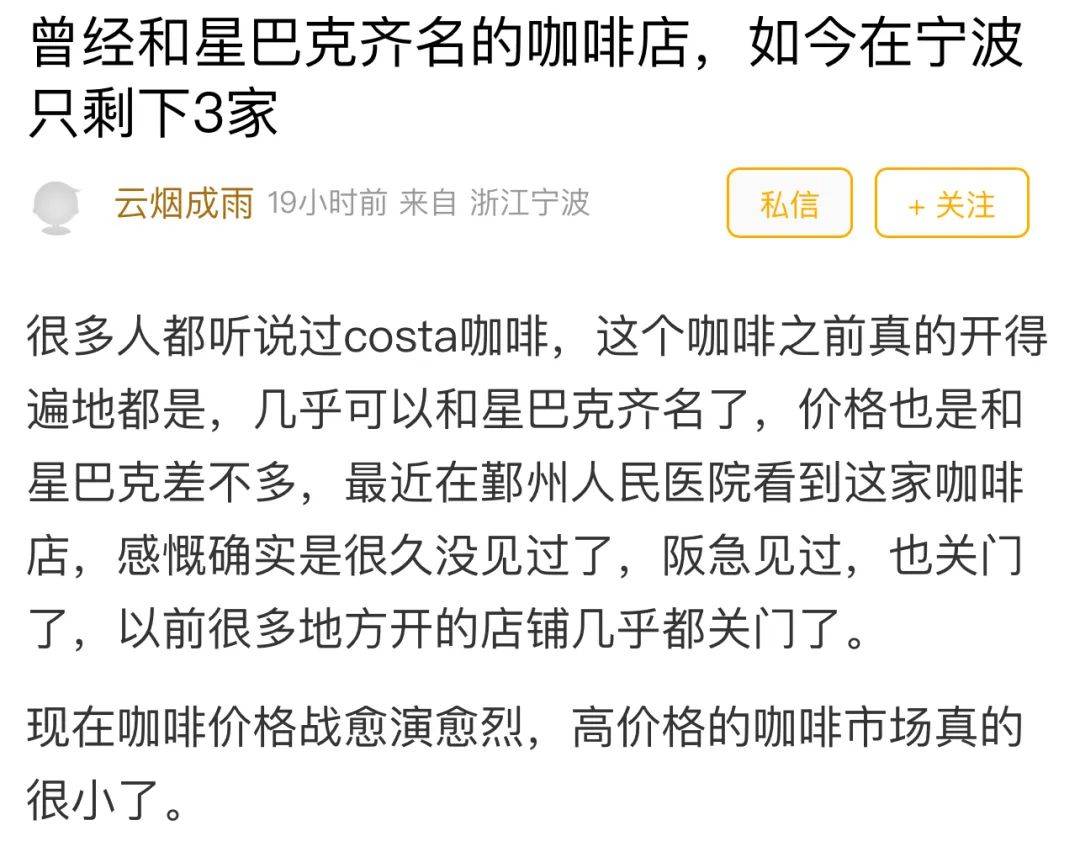
价格战愈演愈烈,曾经和星巴克齐名的咖啡品牌,如今在宁波正常营业的只剩两家
Sou Hu Cai Jing· 2025-06-10 08:11
Core Insights - Starbucks announced a price reduction for several products starting June 10, contrasting with the struggles faced by Costa Coffee, which has seen a significant decline in its presence in the market [1][4]. Company Overview - Costa Coffee was founded in London in 1971 and entered the Chinese market in 2006, positioning itself as a premium brand slightly above Starbucks, claiming to embody European aristocratic charm [4]. - In 2020, Costa Coffee began withdrawing from various markets, including a complete exit from Qingdao and temporary closures in Beijing and Shanghai [4]. Market Position - Over the past five years, the coffee market has become increasingly competitive, with Costa Coffee's operational stores in Ningbo decreasing from four to only two currently [4]. - Starbucks continues to grow, benefiting from its strong marketing and social attributes, which Costa Coffee lacks, leading to perceptions of Costa's products as less competitive in terms of price and taste [6]. Consumer Sentiment - Consumer feedback indicates dissatisfaction with Costa Coffee's pricing and product quality compared to Starbucks, with comments highlighting the lack of compelling reasons to choose Costa over its competitors [7][9]. - Despite challenges, Costa Coffee has shifted focus towards ready-to-drink products, which may appeal to its loyal customer base [21].