国产芯片自主创新

Search documents
战略合作落地,国产AI芯片再添新动能,关注科创芯片ETF易方达(589130)、科创芯片设计ETF易方达(589030)投资价值
Mei Ri Jing Ji Xin Wen· 2026-02-11 02:37
Group 1 - The A-share market experienced a decline in the semiconductor industry chain, with the Shanghai Stock Exchange Science and Technology Innovation Board semiconductor index dropping by 1.6% and the semiconductor design theme index falling by 1.4% [1] - The TuringEvo, an AI chip innovation company, signed a strategic cooperation agreement with the National Integrated Circuit Innovation Center, focusing on AI computing power chips and key core chips, aiming to enhance domestic chip innovation and market application [1] - Galaxy Securities noted a revival in the analog chip design sector, with related companies announcing price increases, indicating a potential shift in supply-demand dynamics within the analog chip industry [1] Group 2 - The Shanghai Stock Exchange Science and Technology Innovation Board semiconductor index covers various segments of the semiconductor industry, with digital chip design and semiconductor equipment accounting for approximately 65% of the index [2] - The semiconductor design theme index focuses on the chip design field, with digital chip design comprising over 75% and analog chip design around 20% [2] - Investors can access opportunities in domestic AI chip development through products like the E Fund Science and Technology Innovation Chip ETF (589130) and the E Fund Science and Technology Innovation Chip Design ETF (589030) [2]
商道创投网·会员动态|博瑞晶芯·完成超10亿元A轮融资
Sou Hu Cai Jing· 2026-01-20 10:22
Core Viewpoint - Zhu Hai Bo Rui Jing Xin Technology Co., Ltd. has completed an A-round financing of over 1 billion yuan, indicating strong investor confidence in the company's potential in the high-performance computing chip sector [2][5]. Company Overview - Established in 2021, Bo Rui Jing Xin focuses on high-performance computing chip design, primarily developing CPU processors for industries such as servers and automotive electronics [3]. - The company aims to promote independent innovation in domestic chip technology through an open chip design platform and has achieved significant results in chip design [3]. Financing Purpose - The CEO of Bo Rui Jing Xin, Yu Zhenhua, stated that the financing will be used mainly for the research and development of high-performance chips and to enhance the platform's capabilities [4]. - The company plans to invest in high-end R&D talent and improve its research team, accelerating the implementation of key projects [4]. - Collaboration with industry partners will be pursued to advance the domestic ARM server computing ecosystem and support the development of China's information technology innovation industry [4]. Investment Rationale - The Zhuhai New Quality Productivity Fund highlighted Bo Rui Jing Xin as a core player in the domestic ARM server chip sector, possessing ARM V9 instruction set architecture authorization and a full suite of the latest ARM IP licenses [5]. - The company's technological strength and innovative potential are expected to provide high-performance and diversified chip options for the information technology innovation market, enhancing the security of the domestic chip industry chain [5]. Investment Perspective - The financing round is seen as a significant breakthrough in the domestic chip sector, with the government emphasizing the development of the semiconductor industry and supporting independent innovation [6]. - Bo Rui Jing Xin's technological advantages in ARM server chips have attracted capital market interest, reflecting investor recognition of the company's technical capabilities and market potential [6]. - The company is anticipated to play a larger role in the information technology innovation industry, driving continuous progress in domestic chip technology [6].

国产芯片新势力冲刺IPO!
是说芯语· 2025-12-23 01:41
Core Viewpoint - Shanghai Silang Technology Co., Ltd. has officially initiated its IPO process, aiming to enhance the domestic integrated circuit industry with its self-developed chip architecture [1][2]. Company Overview - Established on June 16, 2016, Silang Technology focuses on "independent innovation" in the semiconductor sector, with its core team originating from the Chinese Academy of Sciences [2]. - The founder, Dr. Wang Donglin, has over 30 years of experience in the chip field and conceptualized the idea of creating a domestic chip architecture as early as 2009 [2]. - The company has a registered capital of 14.317801 million yuan and is controlled by Wang Donglin, who holds 19.21% of the shares directly and 34.24% in total through partnerships [2]. Technological Innovation - The core technology supporting Silang Technology's market entry is its 100% self-owned intellectual property of the MaPU architecture, which is a trillion-level algebraic operation microprocessor [4]. - This "soft ASIC" architecture combines the high performance of ASICs, the programmability of FPGAs, and the flexibility of CPUs, achieving over 90% resource utilization, significantly higher than traditional architectures [4]. - The MaPU architecture has led to the filing of over 240 core invention patents, ensuring complete autonomy from foreign technologies [4]. Product and Market Strategy - Silang Technology has developed a mature product matrix, with its UCP series chips being widely adopted by major enterprises, including the three major telecom operators and Lenovo [5]. - The upcoming "Xinxin" UCP8016 chip, set to launch in 2024, will be the first domestic "communication + AI" integrated chip, featuring 100 TOPS computing power and 8T8R capabilities [5]. - The company's products are involved in key projects such as the "Thousand Sails Constellation" low-orbit satellite internet initiative, providing essential computing power for integrated communication [5]. Future Outlook - Silang Technology has taken 15 years to evolve from a technical concept in 2009 to a market-ready entity in 2016, now poised for an IPO [7]. - With capital support and ongoing technological advancements, the company is expected to play a significant role in the competitive landscape of advanced integrated circuits, contributing to the high-quality development of domestic chips [7].

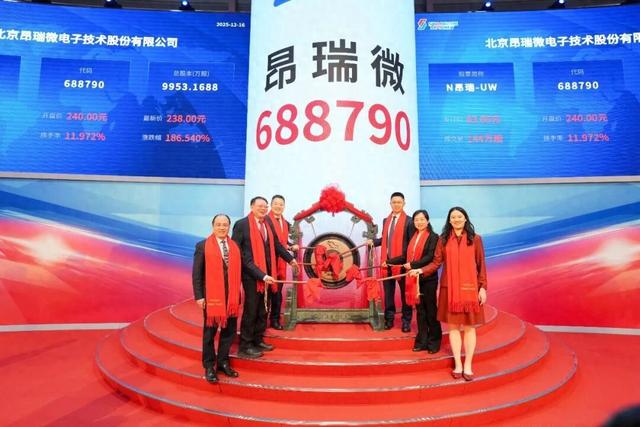
昂瑞微登陆科创板!半月内两家海淀科技企业先后上市
Bei Jing Ri Bao Ke Hu Duan· 2025-12-16 05:05
Core Viewpoint - Beijing Angrui Microelectronics Technology Co., Ltd. has successfully listed on the Shanghai Stock Exchange's Sci-Tech Innovation Board, marking a significant milestone for the domestic high-end RF chip sector and showcasing China's capabilities in independent innovation in this core area [3][6]. Company Overview - Angrui Micro was established in 2012 and specializes in the design and sales of RF front-end chips, RF SoC chips, and other analog chips. The company is recognized as a national-level "little giant" enterprise focusing on specialized and innovative technologies [6]. - The company has developed high-integration 5G L-PAMiD products that meet international advanced and domestic leading standards, breaking the long-standing monopoly of international manufacturers [5]. Financial Performance - On its listing day, Angrui Micro's stock opened with a surge of 188.95%, reaching 240 CNY per share, resulting in a total market capitalization of 23.888 billion CNY [3]. - According to the prospectus, by the first half of 2025, the revenue from RF front-end chips is projected to be 688 million CNY, accounting for 81.47% of total revenue, while RF SoC chip revenue is expected to be 151 million CNY, making up 17.91% [5]. Market Position and Client Base - Angrui Micro's RF front-end chips are already integrated into the supply chains of major smartphone brands such as Honor, Samsung, Vivo, Xiaomi, and OPPO. The RF SoC chips have entered the supply chains of companies like Alibaba, Pinduoduo, BYD, and Ninebot [5]. - The company is actively expanding into specialized markets such as smart retail, healthcare, and smart logistics, promoting diversified applications of RF SoC chips [5]. Future Plans - The funds raised from the IPO will primarily be used for the R&D and industrialization of 5G RF front-end chips and modules, RF SoC chips, and the construction of headquarters and R&D centers, aiming to strengthen the company's technological leadership and industry position in the RF chip sector [8]. - The chairman of Angrui Micro emphasized the commitment to compliance, transparency, innovation, and responsibility, aiming to leverage capital market resources to enhance core competitiveness and reward investor trust [8]. Industry Context - The successful listing of Angrui Micro, along with the recent listing of Moore Threads, represents a new chapter for the integrated circuit industry in Haidian District, positively impacting the regional ecosystem [9]. - Haidian District is home to over 240 integrated circuit companies, including 12 listed firms and more than 40 national-level "little giant" enterprises, fostering a collaborative innovation development pattern [8].
纳入核心宽基,澜起科技大涨超6%!科创芯片50ETF(588750)盘中涨近2%,份额再创历史新高,国产芯片加速自主创新
Xin Lang Cai Jing· 2025-06-03 05:53
Core Viewpoint - The A-share chip sector is experiencing strong growth, with significant inflows into the Sci-Tech Chip 50 ETF, indicating sustained investor confidence in the high-growth chip sector [1][3]. Group 1: Market Performance - The Sci-Tech Chip 50 ETF (588750) saw a volume increase of 1.52%, attracting over 14 million yuan in the last trading day, with total inflows exceeding 120 million yuan in the past 20 days [1]. - The Shanghai Sci-Tech Chip Index (000685) rose by 1.55%, with notable gains from constituent stocks such as SiRuPu (688536) up 7.04% and Lanqi Technology (688008) up 6.33% [3]. Group 2: Industry Trends - The global semiconductor market is entering an upward cycle, with a projected sales growth rate of 17% in 2024, and a 15.1% year-on-year increase in net profit for the chip sector in Q1 2025 [3][4]. - The rapid advancement of AI is expected to drive a second growth curve for the chip industry, with major internet companies planning to invest an average of 110 to 120 billion yuan annually in cloud and AI infrastructure over the next three years [4]. Group 3: Domestic Development - The need for domestic innovation in Electronic Design Automation (EDA) is becoming increasingly urgent due to overseas export restrictions on AI chips and EDA software, with domestic market penetration currently below 20% [3]. - The Chinese semiconductor industry is expected to see a significant increase in wafer fabrication capacity, with 32 new fabs planned by the end of 2024, focusing on mature processes [5].


浪潮、宁畅被列入美国实体清单,将推高国内AI算力成本
雷峰网· 2025-03-26 10:07
Core Viewpoint - The recent inclusion of 54 Chinese entities, including major server companies, on the U.S. Entity List is expected to impact the AI infrastructure and server market in China, potentially leading to increased prices and supply chain challenges [2][4][7]. Group 1: Impact of U.S. Entity List Inclusion - The U.S. Department of Commerce has added 54 Chinese entities to its Entity List, affecting companies in high-performance computing and quantum technology [2]. - Notable companies affected include Inspur Group and its subsidiaries, which may face restrictions in acquiring critical AI chips from U.S. suppliers [4][5]. - Following the announcement, Inspur's stock price fell by 2.89%, indicating a relatively calm market reaction, as companies had anticipated this outcome [3]. Group 2: Market Dynamics and Responses - The inclusion on the Entity List is expected to compel affected companies to seek alternative solutions, potentially fostering domestic innovation in server technology [7]. - Despite the challenges, some industry experts believe that there are still channels to acquire AI servers, although costs are likely to rise due to reduced supply options [8]. - The server market share data indicates that Inspur ranks second globally and first in China, while Ningchang also holds a top position domestically, highlighting their significance in the AI server market [7]. Group 3: Future Implications - The restrictions on U.S. chip purchases will likely increase operational costs for domestic companies relying on NVIDIA GPUs, which are already in high demand [8]. - There are concerns that the potential ban on NVIDIA's H20 GPU in China could further escalate costs and hinder the development of AI infrastructure [8].