
国谈药

Search documents
让新药好药“买得到、用得上、能报销”
Su Zhou Ri Bao· 2026-01-21 00:16
Core Insights - The new national medical insurance negotiation drug directory has been officially implemented since January 1, aiming to enhance the accessibility and affordability of innovative drugs for patients [1][2] Group 1: National Drug Directory Changes - The updated directory includes 114 new drugs, of which 50 are first-class innovative drugs, while 29 drugs have been removed due to lack of supply or better alternatives [1] - The adjustments significantly improve coverage for critical areas such as cancer, chronic diseases, mental health, rare diseases, and pediatric medications [1] Group 2: Implementation and Collaboration - Medical institutions are required to incorporate the national negotiation drugs into their procurement lists within one month of the directory's release, with Suzhou hospitals actively responding to this mandate [2] - The Suzhou Medical Insurance Bureau organized a collaborative meeting to facilitate communication among healthcare, medical insurance, and pharmaceutical sectors, involving over 100 participants from various institutions [2][3] Group 3: Innovative Approaches in Hospitals - Hospitals in Suzhou are adopting innovative measures, such as establishing intelligent medication review systems and a three-dimensional access mechanism for drug evaluation, to streamline the process of incorporating national negotiation drugs [2] - The total settlement amount for national negotiation drugs in Suzhou is projected to increase from 1.44 billion yuan in 2023 to 1.59 billion yuan in 2025 [2] Group 4: Future Developments - By 2025, Suzhou is expected to have 18 innovative drugs included in the new directory, with 14 in the national basic medical insurance directory and 4 in the commercial insurance innovative drug directory [3] - A dual-channel supply guarantee system has been established to provide patients with diverse and convenient purchasing options for innovative drugs [3][4]
1月1日起执行的新版医保药品目录有什么新变化?如何更好满足群众用药需求?
Xin Lang Cai Jing· 2026-01-05 11:45
Core Viewpoint - The National Healthcare Security Administration (NHSA) announced the 2025 version of the National Basic Medical Insurance Drug List and the first Commercial Health Insurance Innovative Drug List, which includes significant updates to enhance drug accessibility for patients [1][2][3]. Group 1: Drug List Adjustments - The new drug list adds 114 new drugs, including 50 innovative drugs, while removing 29 drugs that are either unavailable or can be replaced by others [1][2][3]. - The total number of drugs in the list now stands at 3,253, comprising 1,857 Western medicines and 1,396 traditional Chinese medicines, with improved coverage for critical areas such as cancer, chronic diseases, mental health, rare diseases, and pediatric medications [1][2][3]. Group 2: Financial Implications - The NHSA has assessed the budget impact of new drugs on the medical insurance fund, concluding that the overall financial burden remains manageable within the national budget [3][4][12]. - The introduction of new drugs may lead to increased costs, but many are expected to replace older medications, mitigating the financial impact [3][4][12]. Group 3: Challenges in Hospital Implementation - Despite being included in the insurance list, many "nationally negotiated drugs" face challenges in being adopted by hospitals due to limited capacity in hospital drug lists, which typically accommodate only 1,500 to 2,000 drugs [4][6][8]. - The approval process for new drugs in hospitals can be lengthy, often taking from one to twelve months, which complicates timely access for patients [8][12][44]. Group 4: Dual-Channel Policy - To address the issue of drug availability, the government introduced a "dual-channel" policy, allowing patients to access "nationally negotiated drugs" through designated hospitals and retail pharmacies, ensuring equal reimbursement [14][16][50]. - As of now, 402 nationally negotiated drugs have been integrated into this dual-channel system, significantly increasing sales from under 4 billion yuan in 2020 to nearly 15 billion yuan in 2024 [16][50]. Group 5: Commercial Health Insurance Innovations - The newly established Commercial Health Insurance Innovative Drug List includes 19 drugs, selected from 121 candidates, aimed at covering high-value drugs not included in the basic insurance [27][30][67]. - This list is designed to complement the basic medical insurance system, addressing the gap for high-cost innovative treatments that are crucial for patients with severe conditions [30][32][67]. Group 6: Future Implications - The introduction of the Commercial Health Insurance Innovative Drug List is expected to enhance patient access to high-value treatments, encouraging insurance companies to cover these drugs and potentially increasing patient enrollment in commercial health plans [30][66][73]. - The dual-directory approach aims to create a more robust healthcare financing system, ensuring that patients can access necessary medications while maintaining the sustainability of the insurance funds [30][66][73].


“救命药”进医院,最后一公里咋破
Qi Lu Wan Bao· 2025-12-08 21:48
Core Insights - The 2025 version of the National Basic Medical Insurance, Maternity Insurance, and Work Injury Insurance Drug Directory has been officially released, adding 114 new drugs, including 50 innovative drugs, while removing 29 drugs that are either not clinically available or can be replaced by better alternatives [1][2] - The total number of drugs in the directory has increased to 3,253, with significant improvements in coverage for key areas such as cancer, chronic diseases, mental health, rare diseases, and pediatric medications [1] - The new directory will be implemented nationwide starting January 1, 2026 [1] Group 1: Drug Inclusion and Economic Impact - The adjustment of the drug directory is a response to public health needs, with the inclusion of innovative and life-saving drugs for conditions like non-small cell lung cancer and cervical cancer [2] - Experts have assessed the budget impact of the new drugs on the medical insurance fund, suggesting that the overall effect will not be significantly detrimental [2] Group 2: Challenges in Hospital Access - Despite the inclusion of "nationally negotiated drugs" in the insurance directory, there are challenges in their availability in hospitals due to limited capacity in hospital drug lists, which typically accommodate only 1,500 to 2,000 drugs [3] - The rapid increase in the number of "nationally negotiated drugs" complicates decisions for hospitals regarding which drugs to include, especially when alternatives already exist [3][4] Group 3: Financial Management and Policy Recommendations - The current budget control system for hospitals means that higher sales of expensive innovative drugs could lead to reduced surpluses or even budget overruns, making hospitals cautious about purchasing "nationally negotiated drugs" [4] - Experts recommend improving incentive mechanisms for the use of "nationally negotiated drugs" and increasing investment in healthcare resources to alleviate financial pressures on hospitals [4] Group 4: Dual-Channel Policy and Payment Innovations - To address the issue of "drugs available in insurance but hard to find in hospitals," a "dual-channel" policy was introduced, allowing patients to access "nationally negotiated drugs" through designated hospitals and retail pharmacies with equal insurance reimbursement [6] - The sales of "nationally negotiated drugs" have significantly increased, from less than 4 billion yuan in 2020 to nearly 15 billion yuan in 2024 [6] - Sichuan Province has implemented a "single payment" policy for high-cost, clinically necessary "nationally negotiated drugs," allowing direct settlement by the insurance fund without affecting hospital budget assessments, thus reducing cost control pressures on hospitals [6]
奋进的河南——决胜“十四五”丨药费清单里的健康守护
He Nan Ri Bao· 2025-10-19 23:35
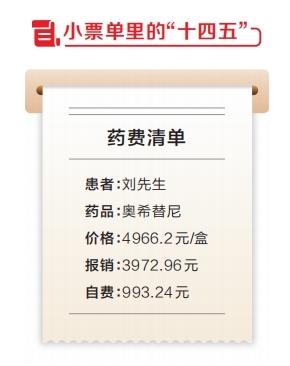
Core Viewpoint - The article highlights the significant impact of the inclusion of targeted lung cancer drug Osimertinib (Aozhi) in the national medical insurance directory, which has drastically reduced its price and improved access for patients, thereby enhancing their quality of life and health outcomes [2][3][5]. Group 1: Drug Pricing and Accessibility - Osimertinib was initially priced over 50,000 yuan per box, making it unaffordable for many patients before being included in the national medical insurance directory in 2018, which reduced the price to 15,300 yuan [2]. - The price of Osimertinib has continued to decrease through negotiations, reaching 4,966.2 yuan per box in 2022, allowing patients to afford the medication [2][3]. - The reimbursement system for outpatient specific drugs in the province offers approximately 85% coverage for employee insurance and 80% for rural residents' insurance, significantly lowering out-of-pocket expenses for patients [3]. Group 2: Impact on Patients - The reduction in drug costs has transformed the financial burden for patients, with some reporting monthly expenses dropping from five-digit figures to three-digit figures, thus restoring their dignity and hope [5][6]. - The number of patients benefiting from Osimertinib has significantly increased since its inclusion in the insurance program, demonstrating the positive effects of the policy on patient access to essential medications [5]. - The article emphasizes that the changes in drug pricing not only alleviate financial stress but also enhance the overall quality of life for patients, allowing them to focus on their health rather than financial constraints [4][6]. Group 3: National Health Policy Initiatives - The article discusses the concept of "national negotiated drugs," which refers to the government's efforts to negotiate prices with pharmaceutical companies to make high-quality medications more accessible to the public [2]. - Since 2018, the national drug procurement policy has led to the inclusion of 835 new drugs in the basic medical insurance directory, with 530 of these being negotiated, covering various treatment areas including cancer and rare diseases [3][6]. - The implementation of centralized procurement has resulted in the collection of 1,303 types of drugs, further contributing to the reduction of drug prices and improving accessibility for patients [6].
医院药剂科,在多方考核中找平衡
Hu Xiu· 2025-04-24 14:09
Core Viewpoint - The pharmacy department in hospitals has undergone significant changes, shifting from a profit center to a cost center and now to a department focused on compliance with various drug-related assessments and regulations [2][30]. Group 1: Changes in Pharmacy Department's Role - The pharmacy department was once a key profit center for hospitals but transformed into a cost center after the cancellation of drug markups in public hospitals in 2017 [2][30]. - The department now faces a multitude of drug-related assessment indicators, such as antibiotic usage intensity and basic drug ratio, complicating its operational landscape [3][4]. - The pharmacy department's responsibilities have expanded to include compliance with both clinical needs and regulatory requirements, creating a complex work environment [4][6]. Group 2: Challenges Faced by Pharmacy Departments - Pharmacy department heads, like Wang Jun, report feeling overwhelmed by the increasing number of policies and assessments they must navigate, often leading to conflicts between clinical needs and regulatory demands [6][9]. - Issues such as drug shortages, particularly for commonly used medications, have become a frequent challenge, leading to patient complaints and added pressure from hospital administration [8][9]. - The pharmacy department must balance various conflicting demands from regulatory bodies, clinical staff, and patients, making their role increasingly complex [17][19]. Group 3: Evolving Assessment Metrics - The performance assessment metrics for pharmacy departments have become more detailed and stringent, with a focus on antibiotic usage and cost management [14][15]. - The introduction of new metrics, such as the average drug cost per outpatient/inpatient, has added to the pressure on pharmacy departments to manage costs effectively while ensuring compliance [15][22]. - The shift in focus from drug ratios to cost metrics reflects a broader trend in healthcare towards more comprehensive performance evaluations [15][22]. Group 4: Future Implications - The pharmacy department's role is evolving from a cost center to a compliance support function, emphasizing the need for effective communication and professional knowledge to navigate complex regulations [26][30]. - As the healthcare landscape continues to change, pharmacy departments must adapt to new policies and assessment criteria, which may lead to further challenges in drug management and patient care [30].